


EN
Orchid Island Capital (ORC) Stock Seems Expensive Given Its Sales Burden
Orchid Island Capital has seen a mixed share-price journey, and that history puts extra focus on whether today’s valuation is properly grounded in the mortgage REIT’s ability to generate sales. With the stock trying to find its footing after a series of swings, the open question is how much revenue power the market is really pricing in.
- Over the past 5 years the share price has fallen 43.8%, which puts the spotlight on whether the current valuation can be explained by Orchid Island Capital’s sales profile rather than past trading highs.
- As a mortgage REIT that earns income from a portfolio of mortgage-backed securities, Orchid Island Capital’s future sales and fee-like revenue streams depend heavily on how well its asset mix, funding costs, and hedging decisions convert into sustainable interest income.
- Your read on Orchid Island Capital is one view; the desks covering it have another. See what analysts think Orchid Island Capital's shares could be worth.
The issue now is whether Orchid Island Capital’s current share price is justified by the level and quality of the sales it can generate from its underlying portfolio.
If you want a broader yardstick for Orchid Island Capital’s sales focused story, compare it with companies in the solid balance sheet and fundamentals stocks screener (23 results).
Is Orchid Island Capital Getting Expensive on Sales?
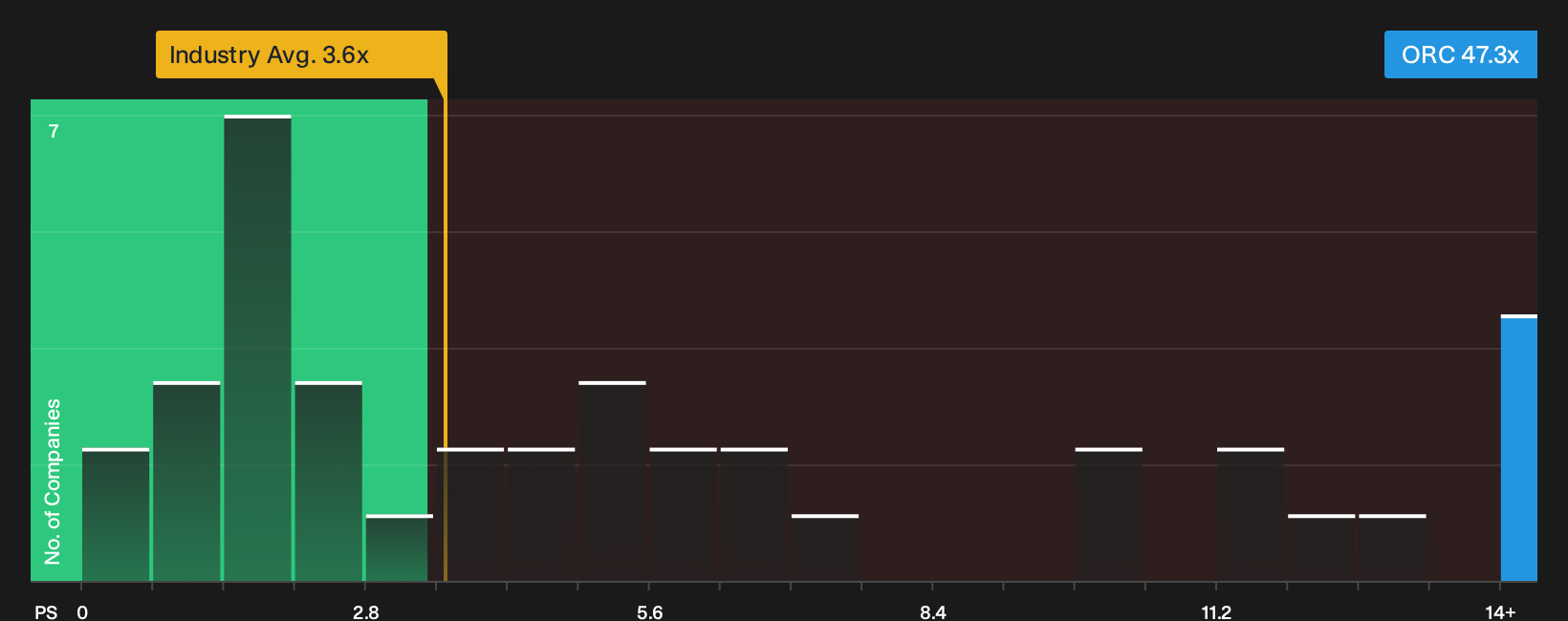
P/S makes sense for Orchid Island Capital because the trust is all about how much investors are willing to pay for each dollar of mortgage related income it can generate. On this yardstick, the stock trades on a P/S of 47.3x, compared with an industry average of 3.6x for mortgage REITs and a peer group around 3.1x. That is a very large premium to what similar businesses fetch in the sector.
The fair multiple implied by the valuation model, which tries to adjust for Orchid Island Capital’s economics, risk profile and size, sits well below the current P/S level. The gap suggests the framework is heavily penalising the trust’s risk and the quality of its revenue streams, so the headline figure is better read as a warning that Orchid Island Capital currently screens as overvalued on P/S rather than a precise anchor for where the shares should trade. Explore the numbers behind Orchid Island Capital's P/S valuation.
The Orchid Island Capital Narrative: What Would Justify Today's Price?
Narratives pick up where the Orchid Island Capital valuation puzzle leaves off, by mapping out what would need to happen to future growth, margins and earnings for the shares to be worth significantly more or less than they are today. They sit on Simply Wall St's Community page. Rather than a single multiple or headline model result, each scenario lays out the assumptions that sit behind its view of fair value so you can keep checking them against actual results over time.
A clear, number driven narrative on Orchid Island Capital helps you pin down what assumptions about growth, margins and execution are actually embedded in today’s rich P/S multiple, and then keep score as fresh results arrive.
Spelling that out in advance turns vague sentiment into a concrete roadmap so you can compare where the business and the share price go next against the expectations you set today.
Share your own Narrative for Orchid Island Capital and set out the assumptions behind your valuation.
One more crucial piece of the Orchid Island Capital puzzle
Before you file Orchid Island Capital under “too expensive” or “worth the premium,” it is worth seeing what the risk checks are flagging in the background, because those signals can change how you read everything else. Take a closer look at 2 warning signs (1 major) before settling on a valuation.
Have feedback on this article? Concerned about the content? Get in touch with us directly. Alternatively, email editorial-team@simplywallst.com