


EN
Investors Ignored This Little-Known AI Stock’s $200 Million Anthropic Deal Last Year. Now That Anthropic Is Worth Over $1 Trillion, It Could Pay Off Big.
Last week, Anthropic (ANT) raised about $93.5 billion in the biggest initial public offering (IPO) in history, a deal I wrote about recently when discussing how Amazon (AMZN) and Alphabet (GOOGL) became its biggest winners. But buying ANT stock isn't the only way to bet on Claude. One company has been quietly bringing Claude to thousands of businesses, and it reports earnings on Dec. 2.
On Dec. 3, 2025, Snowflake (SNOW) announced a $200 million multiyear artificial intelligence (AI) deal with Anthropic. The deal brings Anthropic's large language models to Snowflake's platform and more than 12,600 customers. According to the company, thousands of Snowflake customers were "already processing trillions of Claude tokens per month through Snowflake Cortex AI.” Snowflake also uses Claude internally across engineering and sales.
Investors weren't impressed with the news at the time. SNOW stock fell more than 11% after the deal announcement, which came alongside quarterly results, mainly because its outlook for the next quarter disappointed. Growth was expected to slow, while management cut its profit margin forecast, raising worries that heavy AI spending would weigh on profits.
But a lot has changed since then. Anthropic is now a public company worth more than $600 billion by market capitalization, while the IPO gave it a valuation of roughly $1.5 trillion. That makes the Snowflake-Anthropic deal look a lot more valuable today.
What to Watch When Snowflake Reports on Dec. 2
Snowflake reported its results for the second quarter of fiscal 2027 on Sept. 2, 2026. During the period, product revenue rose 37% year-over-year (YOY) to $1.49 billion, marking its third consecutive quarter of faster growth, helped by AI. For the next quarter, Snowflake guided product revenue of $1.588 billion to $1.593 billion, up 37% to 38% YOY. Management also raised its product revenue guidance for the full year to $6.07 billion, pointing to growth of 36% YOY.
When I covered Snowflake's $3.75 billion zero-interest loan in October 2026, big investors were betting that SNOW stock could climb more than 50%. Shares traded at about $328 when the deal was set. The stock now sits at around $268 per share, so it needs to climb even further for the bet to pay off.
The Dec. 2 report should provide a better idea of whether the company's AI push is really working.
About Snowflake Stock
Snowflake runs a cloud platform where companies store and analyze their data, and increasingly use AI on it. That's why the Claude deal matters, since businesses can run Anthropic's models directly on data already sitting in Snowflake. Founded in 2012, the company is led by CEO Sridhar Ramaswamy.
SNOW stock is up 22% this year, ahead of the First Trust Cloud Computing ETF's (SKYY) 9% gain during the same period. Most of Snowflake's gain has come from growth speeding up for three quarters in a row, helped by rising AI demand, along with management raising its full-year forecast. But the past month has been rough, with SNOW stock falling 18% as the AI selloff hit tech stocks. The stock is also well below its high closing price of $368.89 reached on Oct. 9, so there's a lot riding on the upcoming report.
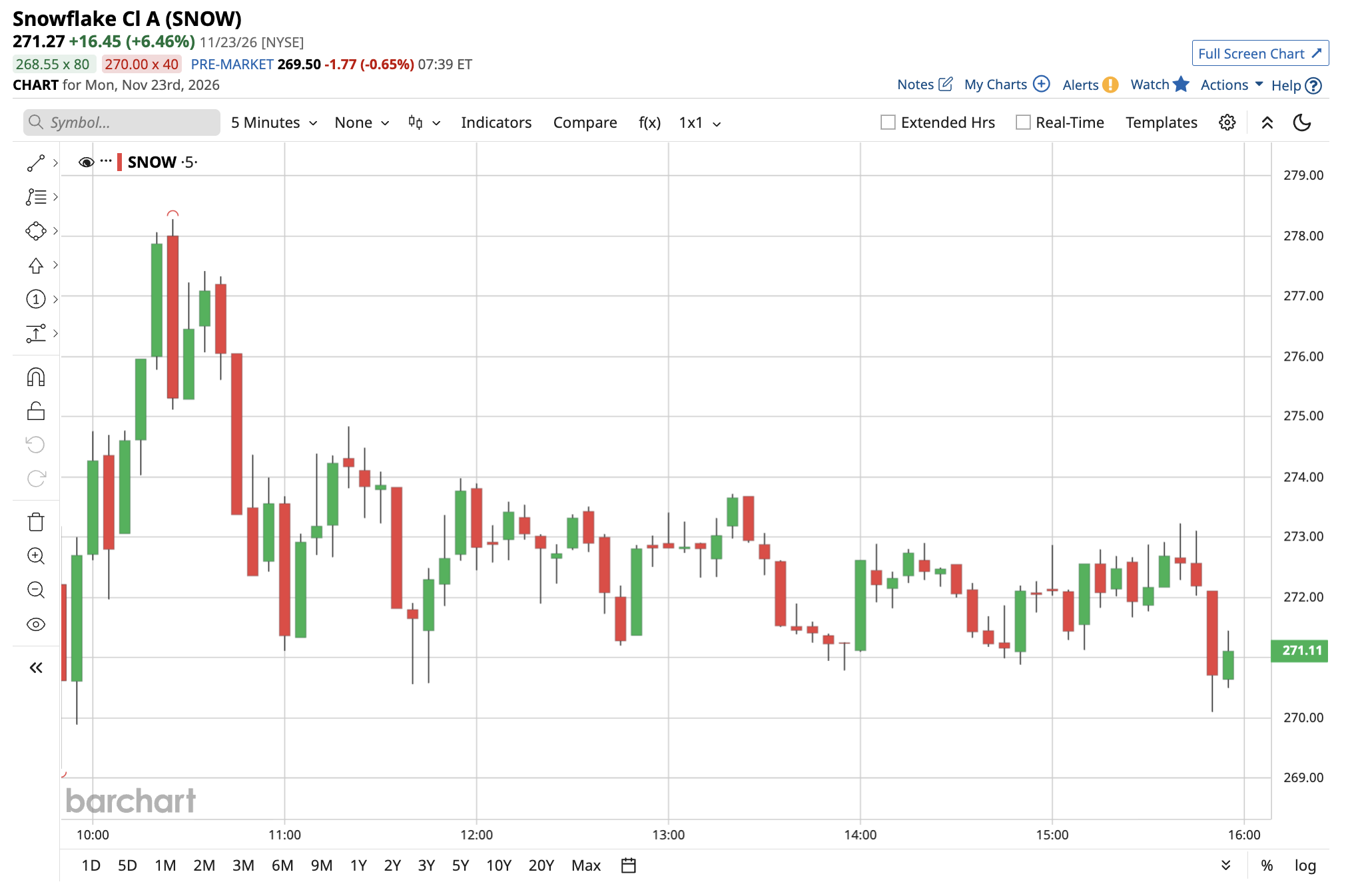
Snowflake's valuation is still steep, but it looks a lot more reasonable than it used to. Its forward price-to-earnings (P/E) ratio of 89.1 times is below the five-year average, while the price-to-sales (P/S) ratio of 20.2 times also sits below its average of roughly 21 times.
The EPS outlook helps explain the premium. Analysts expect earnings to grow 57% this fiscal year, then about 49% in fiscal 2028. So, SNOW stock is priced for strong growth, and the AI demand from deals like the one with Anthropic is what needs to deliver that growth.
What Do Analysts Expect for Snowflake Stock?
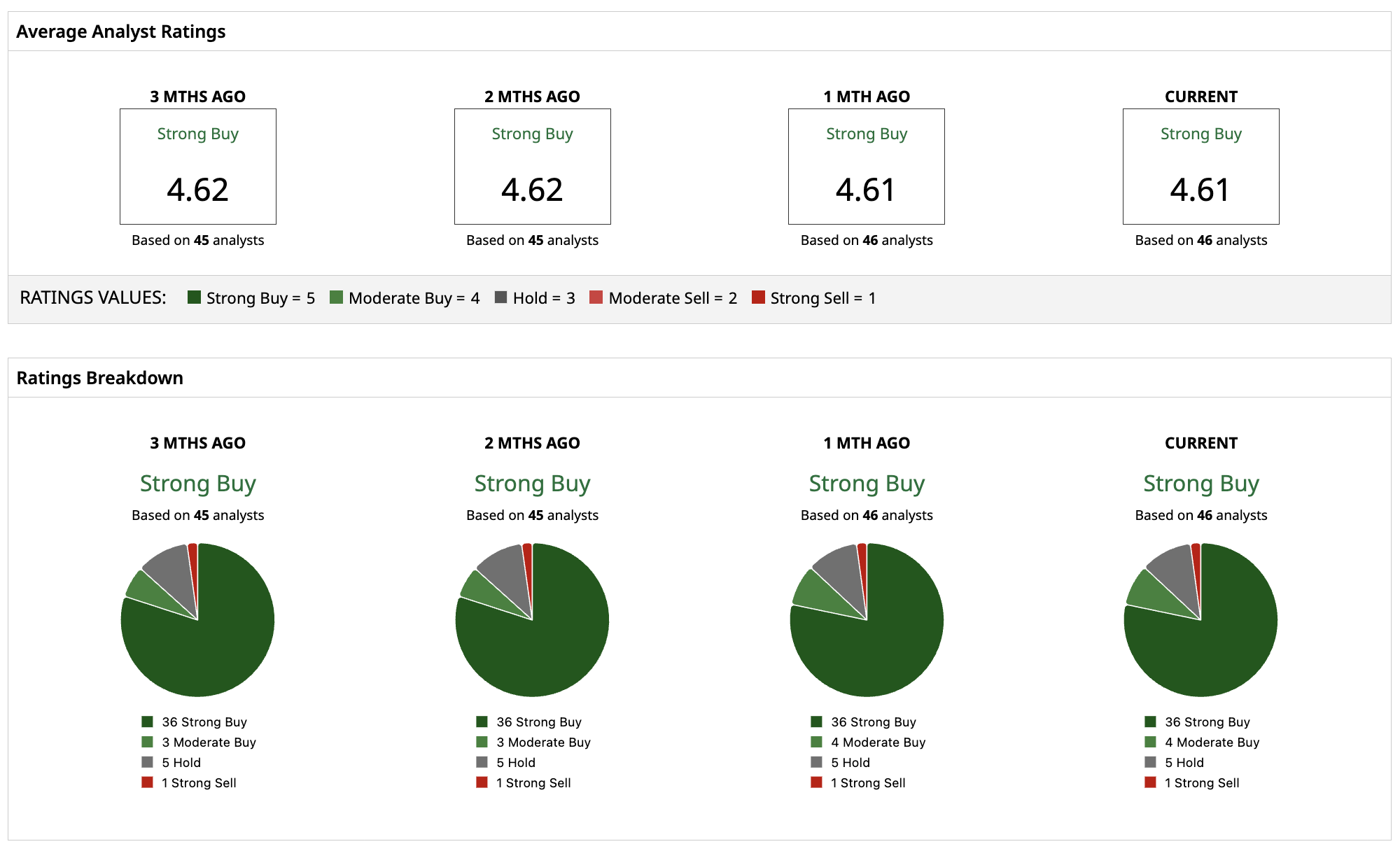
Based on 46 Wall Street analysts with coverage, Snowflake stock holds a consensus “Strong Buy” rating. Of those analysts, 36 have a “Strong Buy,” four have a “Moderate Buy” rating, five analysts have a “Hold,” and one has a “Strong Sell” rating.
The mean price target of $423.67 indicates potential upside of 58% from current levels. Meanwhile, the Street-high price target of $525 suggests a possible climb of 96% from here.
On the date of publication, Jabran Kundi did not directly have a position in any of the securities mentioned in this article. All information and data in this article is solely for informational purposes. For more information please view the Barchart Disclosure Policy here.