


EN
Unstoppable NVDA Stock? Jensen Huang is Back, and Nvidia Is Eyeing 75% Revenue Growth in FY 2028.
Nvidia (NVDA) is heading into a new chapter after co-founder and longtime CEO Jensen Huang was reinstated as president and CEO on Nov. 23, just 11 days after his resignation sent shockwaves through the artificial intelligence (AI) industry. The dramatic reversal removes one of the biggest uncertainties that had weighed on the stock and puts Nvidia’s iconic founder back at the helm as the company enters another potentially explosive phase of AI infrastructure growth.
Meanwhile, Nvidia’s latest results indicate that its underlying business remained remarkably strong even during the leadership turmoil. The company reported fiscal third-quarter revenue of about $115.8 billion, up 103% year-over-year (YoY), while data center revenue surged 110% to $107.6 billion.
More importantly, Nvidia has raised its fiscal 2028 revenue-growth outlook to approximately 75%, up from its previous 70% forecast. The stronger outlook reflects sustained customer demand and increased supply, while the rapid ramp of Nvidia’s Vera Rubin platform provides another major growth driver.
With Huang now back in charge, the central question for investors has changed. Rather than whether Nvidia can maintain its extraordinary growth trajectory without its iconic founder, investors must now assess whether Huang’s return can restore confidence in NVDA stock and help the company capitalize on a massive AI opportunity that management expects to support 75% revenue growth in FY2028.
About Nvidia Stock
Nvidia is a global leader in accelerated computing and AI, renowned for pioneering the GPU that revolutionized gaming, data centers, and AI-driven computing. Headquartered in Santa Clara, California, Nvidia’s technology now powers everything from high-performance gaming and cloud computing to autonomous vehicles and generative AI applications. With a market cap of $3 trillion, Nvidia stands among the world’s most valuable companies, driven by its dominance in AI infrastructure and continued innovation in next-generation chip design.
Nvidia has suffered a dramatic reversal in 2026, with the stock seeing a correction as investors grapple with a combination of leadership uncertainty, AI-spending concerns, valuation pressure, and broader semiconductor weakness. NVDA stock is down 17% year-to-date (YTD) and 16% over the past 52 weeks as of Nov. 24, trading at $152 versus its 52-week high of $243.37.
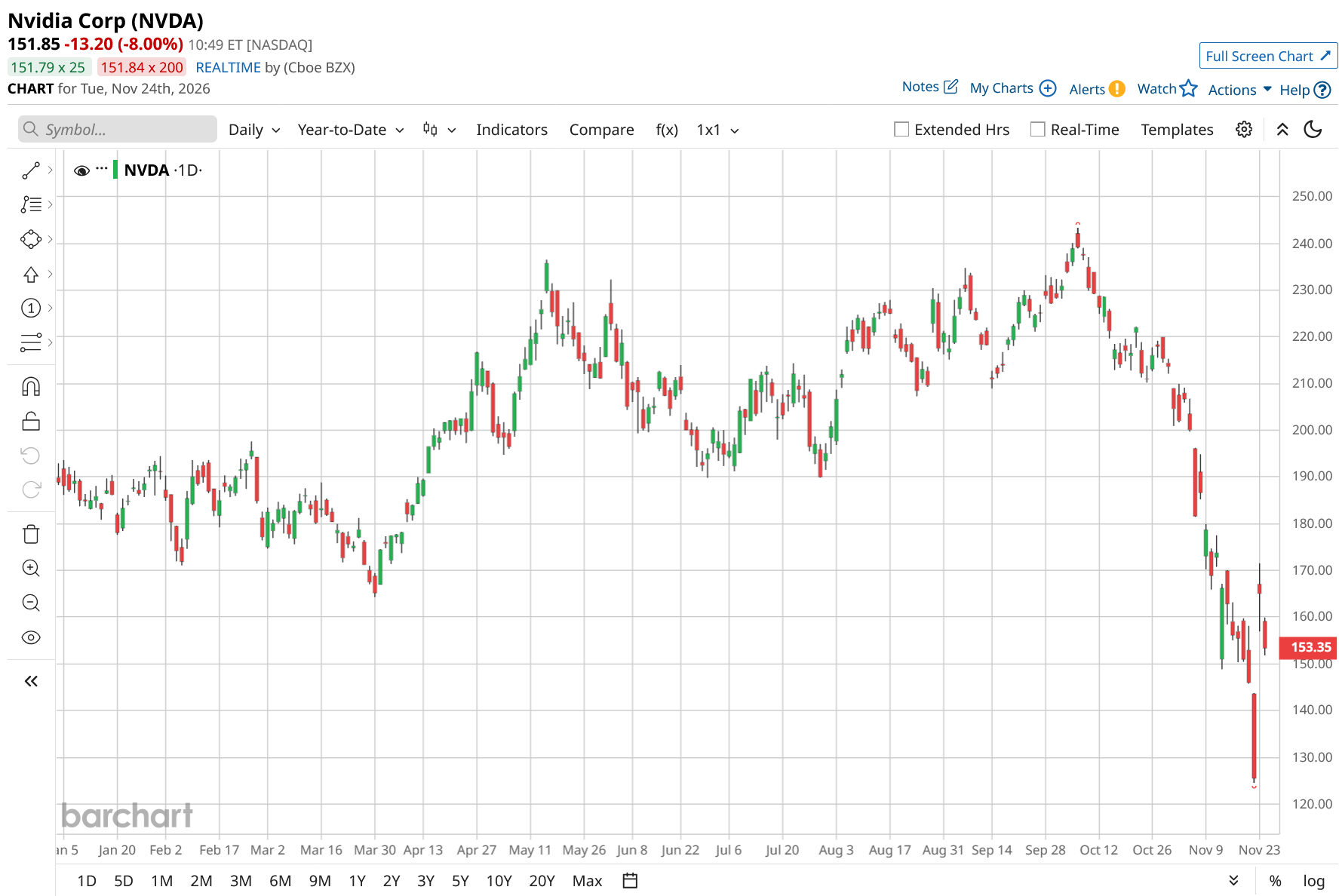
A Wild Ride for NVDA This Year
The selling has accelerated sharply in recent weeks. NVDA has plunged roughly 27% over the past month, while the stock is flat in just the past five trading days. The latest leg lower came on Nov. 20, when shares sank 14% in a single session amid a broader technology selloff and reports that the SEC was examining Nvidia. The decline has also coincided with the abrupt departure of Jensen Huang, who resigned as CEO on Nov. 12, leaving CFO Colette Kress as interim CEO.
However, Nvidia reinstated Jensen Huang as President and CEO on Nov. 23, bringing its iconic co-founder back to the helm. Huang’s return removes a major overhang that had weighed on investor sentiment and puts the architect of Nvidia’s AI strategy back in charge as the company prepares for its next phase of growth. Notably, the stock soared a massive 31.48% on Monday but ceded back some of those gains in Tuesday's trading session.
Huang’s brief departure had raised concerns about whether the company could maintain its technological lead and aggressive product roadmap without its founder at the helm. Nevertheless, his return addresses that specific concern, while Nvidia’s financial outlook remains remarkably strong as it raised its FY2028 revenue-growth target to 75% from 70%.
That outlook suggests Nvidia believes the AI infrastructure cycle remains powerful enough to sustain extraordinary growth, while Huang’s return could provide an additional catalyst for restoring investor confidence in NVDA stock.
The stock trades at 15.21 times forward earnings, which is a discount to industry peers, while 16.29 times sales is a premium.
Solid Q3 Results
Nvidia reported its fiscal third-quarter 2027 results on Nov. 17, for the quarter ended Oct. 25, delivering another quarter of triple-digit growth.
Revenue reached a record $115.8 billion, up 103% YoY, compared with $57 billion in Q3 FY2026 and 20% higher sequentially. The company’s AI infrastructure business remained the primary growth engine, with Data Center revenue jumping 110% YoY to $107.6 billion. Data Center revenue also increased 21% from the prior quarter.
Profitability remained exceptionally strong. On a non-GAAP basis, Nvidia reported $64.9 billion of net income, up 109% YoY, while adjusted EPS rose 111% to $2.68, ahead of expectations. Non-GAAP operating income increased 116% to $77.9 billion, while adjusted gross margin expanded to 74.9% from 73.5%. Operating expenses rose 52% to $8.8 billion, significantly slower than the 103% increase in revenue, highlighting the operating leverage in Nvidia’s business model.
The outlook was equally important. Nvidia expects Q4 FY2027 revenue of $130 billion, plus or minus 3%. The forecast includes an additional week in the quarter and, notably, assumes no Data Center compute revenue from China. Nvidia expects GAAP and non-GAAP gross margins of 71% to 72%, while operating expenses are projected at approximately $11 billion and $10.7 billion, respectively. The lower expected gross margin versus Q3 reflects the product transition and ramp of the next-generation Vera Rubin platform.
The quarter also provided an critical validation of Nvidia’s next product cycle. The company said it had ramped production and begun shipping Vera Rubin NVL72, describing it as the fastest product ramp in its history, with the systems already running at customers and cloud partners including CoreWeave (CRWV), Google (GOOG) (GOOGL) Cloud, Microsoft (MSFT) Azure, Oracle (ORCL) Cloud Infrastructure, and Nebius (NBIS).
Its financial momentum, combined with the Rubin ramp and Nvidia’s expectation for roughly 75% revenue growth in FY2028, gives the company a powerful fundamental counterweight to the current pressure on NVDA shares.
Street also expects Nvidia’s momentum to continue, with analysts forecasting EPS growth of 110.1% YoY to $9.60 in fiscal 2027, followed by another 69.9% increase to $16.31 in fiscal 2028.
What Do Analysts Expect for NVDA Stock?
The latest analyst actions show a clear split on NVDA stock following the leadership turmoil surrounding CEO Jensen Huang, although most firms have cut price targets rather than abandoned their bullish ratings, while some took a more cautious stance.
Wedbush analyst Matt Bryson reiterated an “Outperform” rating on Nvidia on Nov. 19, while raising his price target to $293 from $275, signaling continued confidence in the company’s long-term AI growth prospects despite the recent selloff. Bryson pointed to Nvidia’s better-than-expected fiscal Q3 results and stronger-than-anticipated guidance as evidence that the company’s near-to-intermediate-term demand profile remains intact, even without Jensen Huang.
Rosenblatt Securities analyst Kevin Cassidy maintained a “Buy” rating on NVDA on Nov. 18, with a $300 price target.
However, Evercore ISI analyst Mark Lipacis maintained an “In-Line” rating on Nvidia on Nov. 18, while trimming his price target to $184 from $186, remaining one of the more cautious voices on the stock.
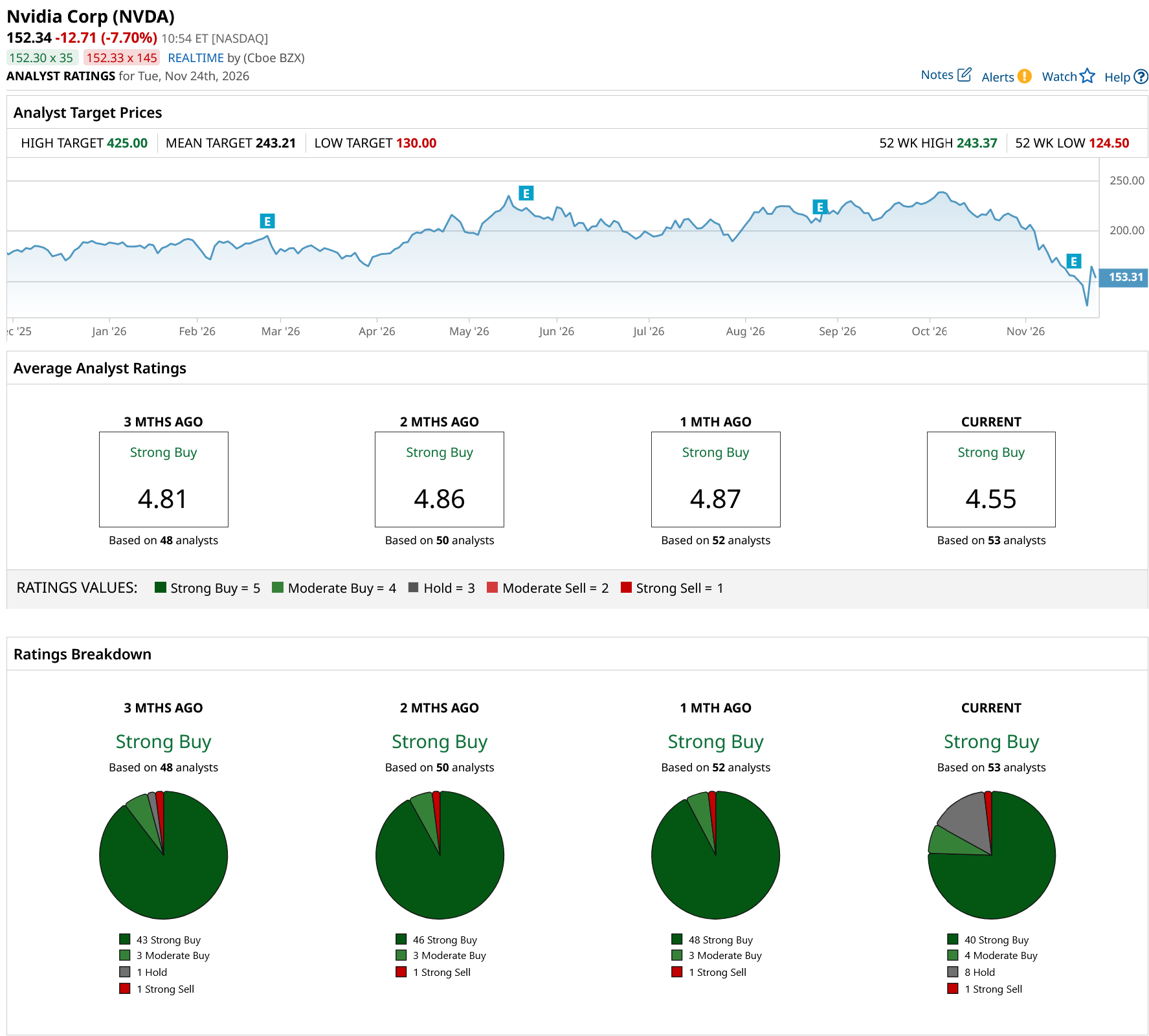
Overall, NVDA stock has a consensus “Moderate Buy” rating. Of the 53 analysts covering the stock, 40 advise a “Strong Buy,” four suggest a “Moderate Buy,” eight recommend a “Hold,” and one offers a “Strong Sell” rating.
The average analyst price target for NVDA is $243.21, indicating a potential upside of 60%. Furthermore, the Street-high target price of $425 suggests that the stock could rally as much as 180%.
On the date of publication, Subhasree Kar did not directly have a position in any of the securities mentioned in this article. All information and data in this article is solely for informational purposes. For more information please view the Barchart Disclosure Policy here.