


EN
This Anthropic Collar Options Strategy Wins Whether the Stock Goes Up or Down
Before the Anthropic (ANT) IPO, I promised to look at a potential collar trade once options became available a couple of days after the biggest-ever new equity issue started trading.
I found what I was looking for, so here’s what I did.
As with my attempt at this strategy for SpaceX (SPCX), my objective was not to “crush it” on the upside of ANT. I did want to reserve the right to get some appreciation. But my general posture on the AI trade is that it's past tense.
I believe we have already seen the best gains of the cycle, pulled forward by a market hungry for more and more “easy profits.” Like the type you can get when an IPO pops on day one, if you owned it before it opened.
For those of us who make the effort to squeeze our way into getting some shares of the next iteration of the American Dream — or being the first in line at Target, Walmart, or other retail stores on Black Friday — there’s the aftermarket. That’s when an IPO enters the mainstream stock market, and anyone can buy it.
Anthropic Options Trade: Why I Chose to Collar It
That involves buying 100 shares of ANT (or multiples of 100 shares), and surrounding it with a covered call option and a protective put option.
Naturally, there’s not much price history, given the newness of the ANT public offering. However, this 1-minute chart helps you picture some price levels that could matter.
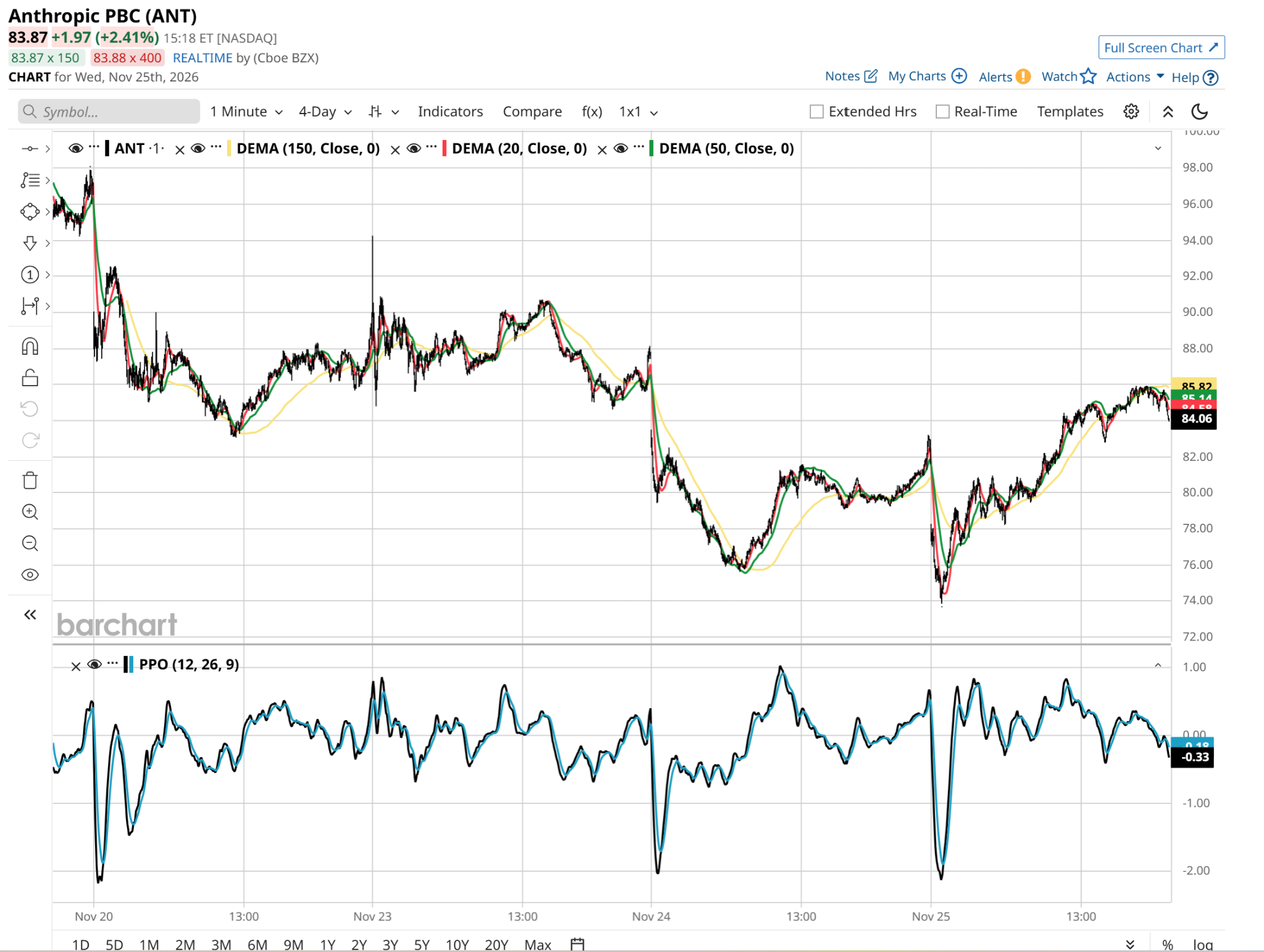
As we can see, ANT has moved much faster than an ant can! It's ranged from $74 to $98 in just the first four days of trading, after the stock debuted at $83. Yikes!
Here’s how I set up the trade. 100 shares bought at around $76. That’s the easy part, just getting the shares.
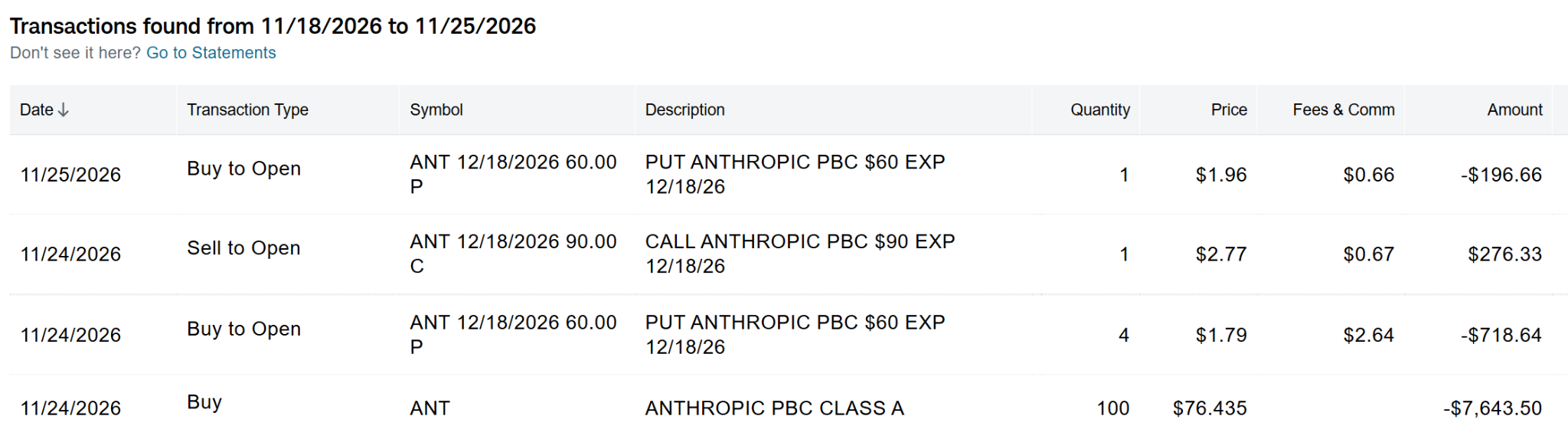
It allowed me to write a covered call option on ANT, which I did, taking in nearly $2.77 a share.
I only went out to 12/18/26, so this collar is tight in terms of time and range. This is just the initial setup. The goal is to leave the stock unfettered, so if it vaults higher during the next few weeks, I win. The options may cut into that, but I’d expect to remain up overall.
And that all allows me to “go to work” on the downside, using some of the budget I'd otherwise use to purchase Anthropic put options, paid for by the $277 I received for being willing to sell Anthropic if it hits $90 or higher before Dec.18.
See the purchase above of one put option at $1.96 a share. Using the 100x multiplier that applies to options, I paid $197 for the right to sell the stock if it plunged to below $60. I can sell it for $60 if that occurs by that expiration date.
Now, here is the twist.
I have ANT collared from $90 to $60 after buying it around $76. That’s about as nondescript and boring an option collar as you can create, whether on a stock of this magnitude or any other — which is exactly what I wanted.
With that in place, I can intentionally “overplay my hand” on the downside. I did this by buying four more of those same ANT $60 puts that mature on the same day in mid-December, bringing my total to five put contracts. Against one covered call and 100 shares.
Here is what it looked like later in the week.

At the moment captured above, the stock was up, and the options were down, which is very normal.
The question is what happens from here that will allow me to “win,” as my strategic objective aims to.
Let’s say the stock really takes it on the chin and, before or at expiration, trades at $50. That would make the options worth $10 each. I own five of them, so with the 100x multiplier, that’s a $5,000 gain. And I’d keep the call option proceeds I received when I put this trade on.
The stock would be down about $27 a share from where I bought it, so my loss would be around $2,700. Add in the call proceeds and the put profits, and I’d still be up about $2,600 for a stock that FELL about 35% from my purchase price.
Now, if ANT were to fly to, say, $90, and I get the stock called away… I would make around $1,350 on the stock, and keep the call proceeds. But the entire exaggerated put position is a loser — all $475 of it.
Add it all up, and it is still more than a $1,100 gain. The stock would have appreciated by 18%. In a sense, I would win by losing.
I say that because I gave myself a chance to win by playing offense AND defense at the same time. There are many ways to do this. Collaring in this off-balance manner can be one very effective way.
It just takes some practice, understanding the language, and offsetting the return and risk potential of each of the three legs. Most importantly, it needs to be a goal-driven process. Know what you want, then go try to get it.
Rob Isbitts created the ROAR Score, based on his 40+ years of technical analysis experience. ROAR helps DIY investors manage risk and create their own portfolios. For Rob's written research, check out ETFYourself.com.
On the date of publication, Rob Isbitts did not directly have a position in any of the securities mentioned in this article. All information and data in this article is solely for informational purposes. For more information please view the Barchart Disclosure Policy here.