


EN
‘Superfan’ Elon Musk Says ‘China Is Cool’ as Tesla Boosts Production in Shanghai: ‘The More the US and China Cooperate, the Better Off Both Will Be’
The U.S.-China rivalry has turned the global automotive industry into something of a geopolitical battleground, and electric vehicles are right in the middle of it. As Washington tightens restrictions on Chinese technology and components, Beijing continues strengthening its domestic EV industry, with homegrown players like BYD (BYDDY) and other Chinese automakers giving established names a serious run for their money.
Tesla (TSLA), once the undisputed star of the EV race, is now navigating a rather complicated road in 2026. Between intensifying Chinese competition, trade restrictions, supply-chain uncertainties, and changing investor sentiment, the automaker has had its share of ups and downs. It’s also caught between two important markets—the U.S., where it is trying to reduce its dependence on Chinese suppliers, and China, where its manufacturing operations remain hugely important.
But Elon Musk does not appear to be backing away from China anytime soon. In fact, Tesla is looking to ramp up production at its Shanghai Gigafactory, one of its most indispensable manufacturing and export hubs. The facility delivered more than 810,000 Model 3 and Model Y vehicles in the first 10 months of 2026, up 21.4% year-over-year (YoY). And Musk has made his position on China abundantly clear.
During a recent meeting with Chinese officials in Shenzhen, the Tesla CEO called himself a “superfan” of China, praised its infrastructure and natural beauty, and declared, “China is cool.” He also added, “The more the U.S. and China cooperate, the better off both will be.”
For a company caught between the world’s two biggest economies, those words carry some weight. Here’s a closer look at Tesla’s latest performance and what lies ahead for the EV giant.
About Tesla Stock
Founded in 2003 and headquartered in Austin, Texas, Tesla has evolved from an EV manufacturer into a major name in clean energy, artificial intelligence (AI), and autonomous technology. While EVs remain its primary business, the company is broadening its reach through battery storage, Robotaxi services, and humanoid robotics with its Optimus project.
Tesla has also garnered attention with its next-generation Roadster, which Musk has teased could feature a rocket-inspired thruster system. Led by CEO Elon Musk, the company continues to bet big on the future of transportation, automation, and energy, with a market capitalization of about $1.4 trillion.
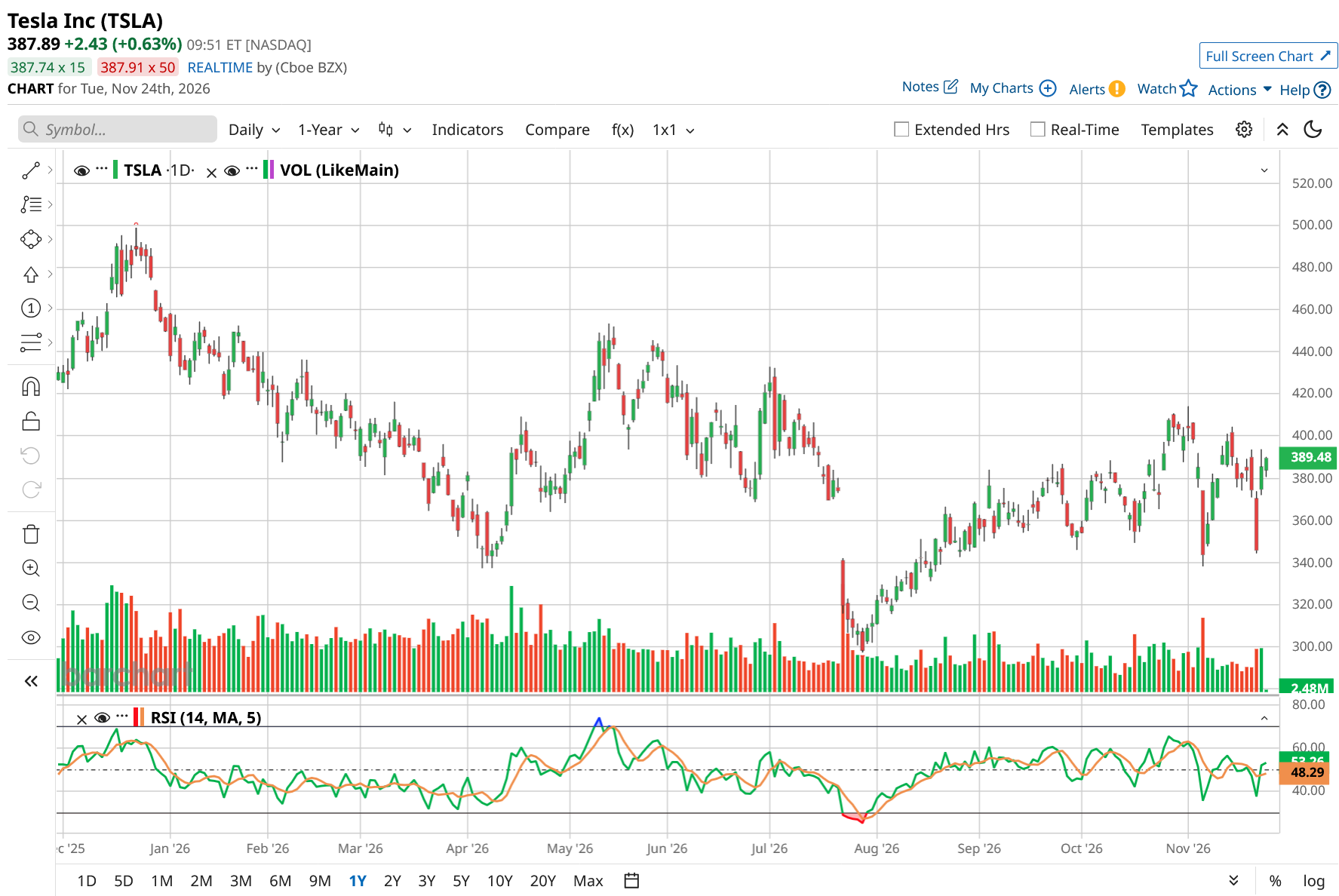
Tesla’s stock has been volatile from 2025 into 2026. After racing to a record high of $498.33 in December 2025, TSLA gradually lost momentum, slipping to around $297.38 by late July. The stock is now down roughly 23% from that all-time peak, with a 15% decline so far in 2026. Softer EV demand, rising costs, and concerns about Tesla’s hefty spending plans have kept investors on the sidelines for much of the year.
But things have started looking a little different lately. Better-than-expected Q3 2026 results and stronger cash flow have helped restore some confidence. Hopes surrounding potential Tesla-SpaceX (SPCX) merger discussions have also added to the excitement.
More recently, the rollout of version 15 of Tesla’s Full Self-Driving (FSD) software has given TSLA stock another push. On Monday, shares rose 11.5% after the release, with JPMorgan analyst Rajat Gupta noting that the latest FSD update further strengthens Tesla’s lead in consumer autonomous driving. Adding a broader market rally to the mix, Tesla bulls suddenly have something to cheer about again.
Tesla is not a bargain on Wall Street. The stock trades at roughly 200 times forward-adjusted earnings and 12.68 times forward sales, well above both sector averages and its historical valuation levels. Investors are clearly paying a premium for Musk’s bigger ambitions in AI, autonomy, robotaxis, and robotics.
A Snapshot of Q3's Numbers
Tesla’s third-quarter 2026 report, released in October, was a bit of a mixed bag. For the quarter ended Sept. 30, revenue edged down 0.2% YoY to $28.05 billion, slightly missing Wall Street’s estimates. Adjusted EPS came in at $0.48, compared with $0.50 a year earlier, but still managed to beat analysts’ expectations.
On the delivery front, Tesla handed over 486,532 vehicles, including 478,237 Model 3 and Model Y units and 8,295 vehicles from its other models. However, its automotive business faced some pressure. Automotive sales revenue slipped 1.3% to $20.09 billion, while total automotive revenue declined 3% to $20.56 billion. Energy generation and storage revenue wasn't much help either, falling 15.6% to $2.9 billion. Energy storage deployments reached 13,700 MWh.
Cash generation offered a brighter spot, with operating cash flow reaching $6.3 billion. However, capital expenditures more than doubled, jumping 110% to $4.7 billion. That pulled free cash flow down 62% to $1.5 billion. Still, Tesla ended the quarter with a healthy $45.45 billion in cash, cash equivalents, and short-term investments, up 9% YoY.
Beyond the financials, Tesla reported record quarterly deliveries in Canada, Australia, Japan, and Taiwan, alongside record production at Gigafactory Berlin. Its FSD business also gained ground, with record net new subscriptions and over 75% of new North American deliveries including FSD subscriptions. FSD received approvals in Croatia, Slovenia, the Czech Republic, and Slovakia, taking its EU presence to nine countries. More than 100,000 customers have used the system, logging over 160 million kilometers.
Meanwhile, Tesla’s Robotaxi ambitions moved forward as Cybercab vehicles joined its Austin fleet, helping push cumulative unsupervised Robotaxi miles close to two million by quarter-end.
Looking ahead, Tesla plans to keep pushing its AI, robotics, and renewable energy ambitions while its core business continues generating over $100 billion in trailing-12-month revenue for the second consecutive quarter. Interestingly, the company has trimmed its 2026 capex forecast by roughly 20% to $20 billion from over $25 billion. However, Tesla hasn't clarified which projects will face spending cuts, leaving investors guessing about its investment priorities.
Analysts tracking Tesla predict the EV company’s EPS for fiscal 2026 to decline 38.5% YoY to $0.67, but then rise by 58.2% annually, pushing EPS to around $1.06 in fiscal 2027.
Tesla’s Shanghai Factory
Tesla’s Shanghai Gigafactory is having a rather mixed year as well. While exports are picking up, domestic sales are telling a different story. In October, deliveries to customers in mainland China plunged 66.1% YoY to just 8,817 vehicles, marking their lowest monthly level since July 2022. Exports, meanwhile, went in the opposite direction, jumping 66.3% to 67,829 vehicles. The sharp domestic drop has raised concerns about weakening demand in Tesla’s second-largest market, although some analysts point to a temporary production halt during China’s weeklong National Day holiday in early October as a contributing factor.
Still, the bigger picture is not completely gloomy. During the first 10 months of 2026, the Shanghai factory delivered 810,889 vehicles across domestic and international markets. It remains the company’s largest manufacturing base and an important export hub serving markets such as Europe, South Korea, and Australia.
That said, Tesla’s domestic business in China has been losing some steam. Its mainland deliveries fell 15% YoY to 389,905 vehicles during the first 10 months of 2026. The slowdown also reflects broader weakness in China’s auto market, where EV sales dropped 12.9% to 8.87 million vehicles over the same 10-month period, as cautious consumers pulled back on big-ticket purchases and the government scaled back subsidies.
For Tesla, stronger exports are helping offset weaker local demand, but sustaining growth in China won’t be a cakewalk.
What Do Analysts Expect for TSLA Stock?
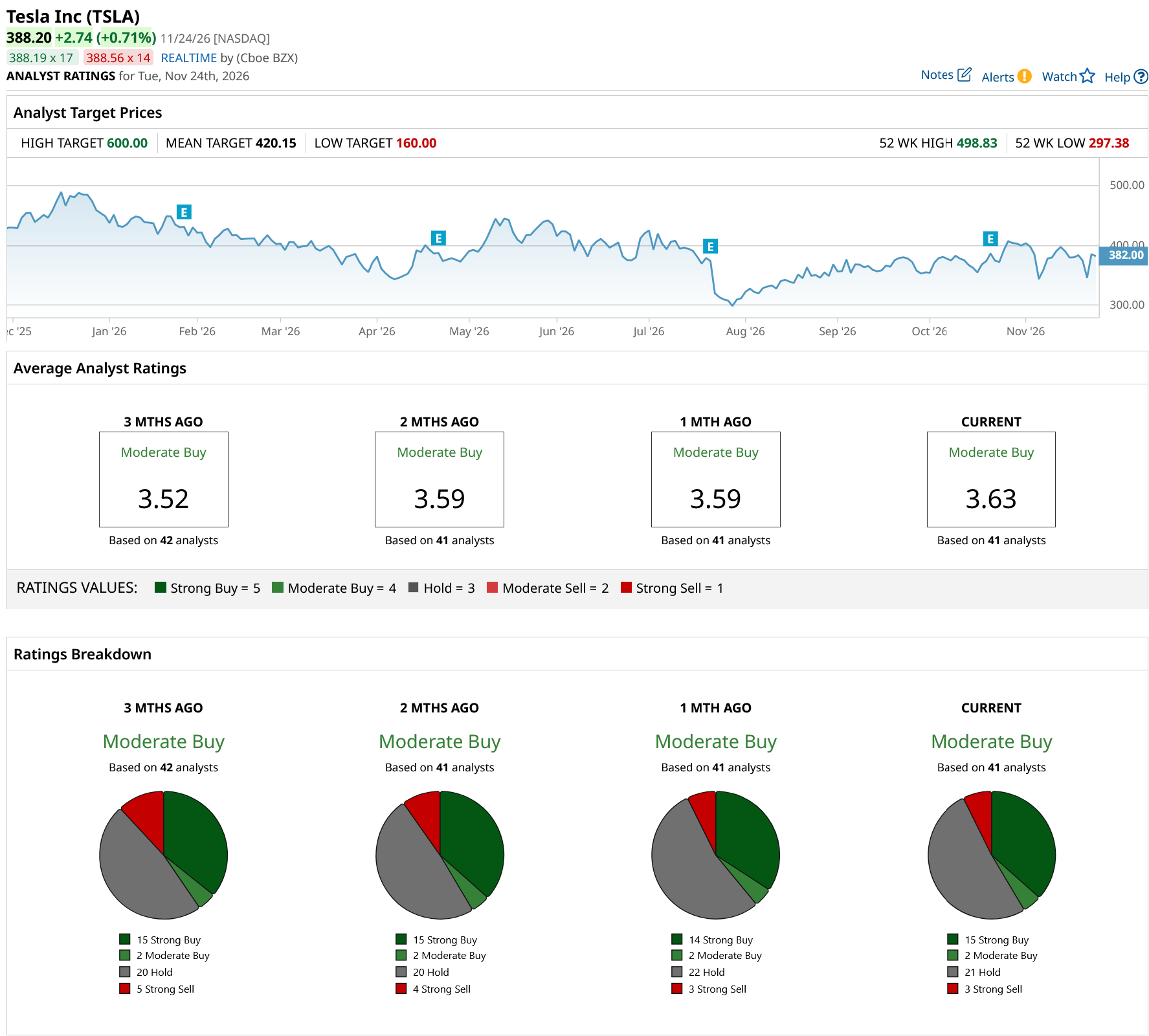
Analysts are bullish on TSLA stock with a dash of caution. The EV stock has a “Moderate Buy” rating overall. Of the 41 analysts covering it, 15 recommend a “Strong Buy,” two have a “Moderate Buy,” 21 suggest a “Hold,” and the remaining three have a “Strong Sell” rating.
The mean price target of $420.15 suggests TSLA stock has a potential upside of 8% from the current levels. The Street-high of $600 implies TSLA could rise as much as 55% from here.
On the date of publication, Sristi Suman Jayaswal did not directly have a position in any of the securities mentioned in this article. All information and data in this article is solely for informational purposes. For more information please view the Barchart Disclosure Policy here.