


EN
During the year, it soared 320%, and 17.94% of chips returned to the warehouse: What kind of capital story does Omori Holdings (01580) want to tell?
The recent stock price trend of Omori Holdings (01580) is not an exaggeration to describe it as a “violent pullup.”
Since November, its stock price has started around HK$0.30, reaching a high of HK$0.90, with a cumulative monthly increase of more than 150%, and an increase of nearly 320% during the year. By the end of November 27, its stock price was reported at HK$0.78. At the same time, its turnover also increased significantly. On November 23 and 26, its turnover was HK$22.5795 million and HK$66.1207 million, respectively, in stark contrast to its previous turnover of tens of thousands and hundreds of thousands.
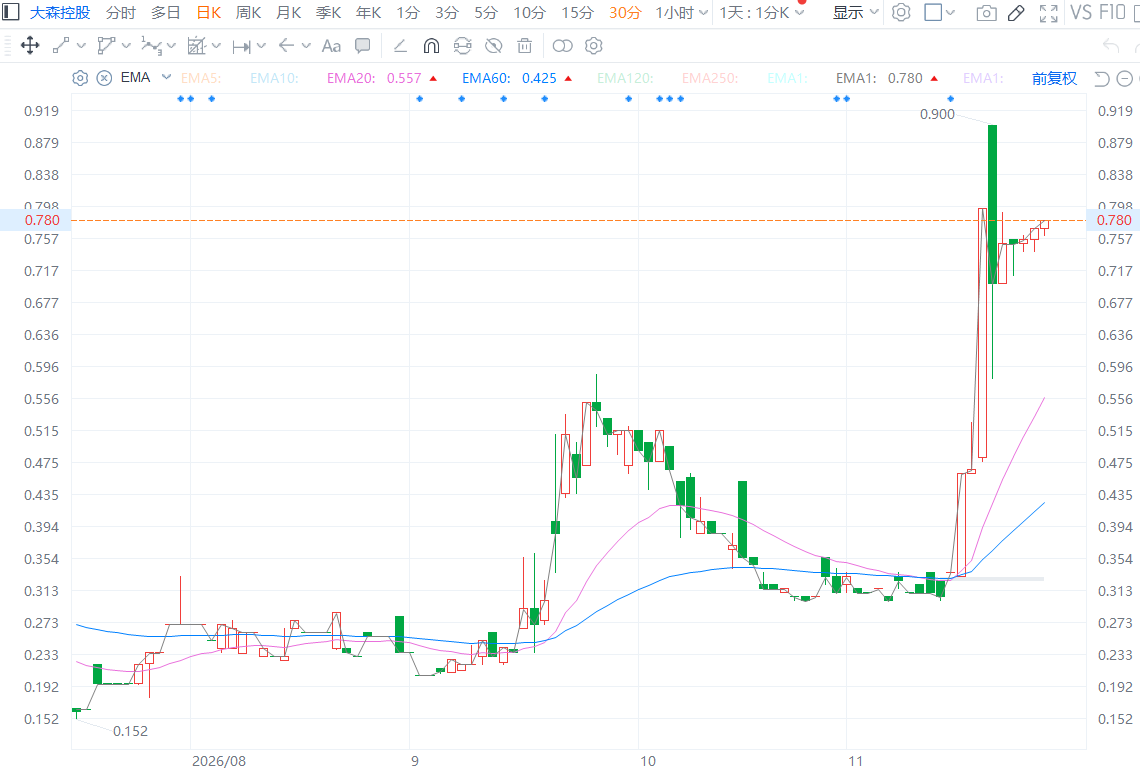
(Market source: Futu)
Of course, the sharp rise in Omori's stock price is no accident. With the intensive movement of transfers, warehousing, and placement, a drama about the capital operation of Omori Holdings also surfaced.
On September 18, 108 million shares were transferred from HSBC, and the placement agreement was implemented on the same day; on October 8, the placement was carefully terminated to allow flexibility; on November 17, the stock price took off; on November 19, 79.67 million shares were deposited into Future Finance; on November 23, an additional 117 million shares were deposited into Future Finance, and the stock price rose 7.14% on the same day to close at HK$0.75.
As can be seen, the various actions of Omori Holdings can be described as interlinked — the chips moved from the bank to the brokerage channel, the first round of placement was carefully halted, the two rounds of large shares were brought into the same escrow channel, and overseas wood product acquisitions settled simultaneously. Collect chips, set up platforms, etc., and a set of textbook-style inventory platforms have already taken shape.
But where did this game of chess actually go, and how should we proceed in the future? It's worth disassembling one by one.
17.94% of chips returned to position, 10.68% new market landed
Capital operations never begin with announcements, but change with the chip structure first.
On September 18, 108 million shares were transferred out of HSBC in Hong Kong and Shanghai, with a market value of about HK$29.2653 million, accounting for 9.89%. On the same day, the company disclosed a placement agreement to place up to 219 million shares at HK$0.241 per share, a discount of about 19.7% from the closing price of HK$0.300 on the same day.
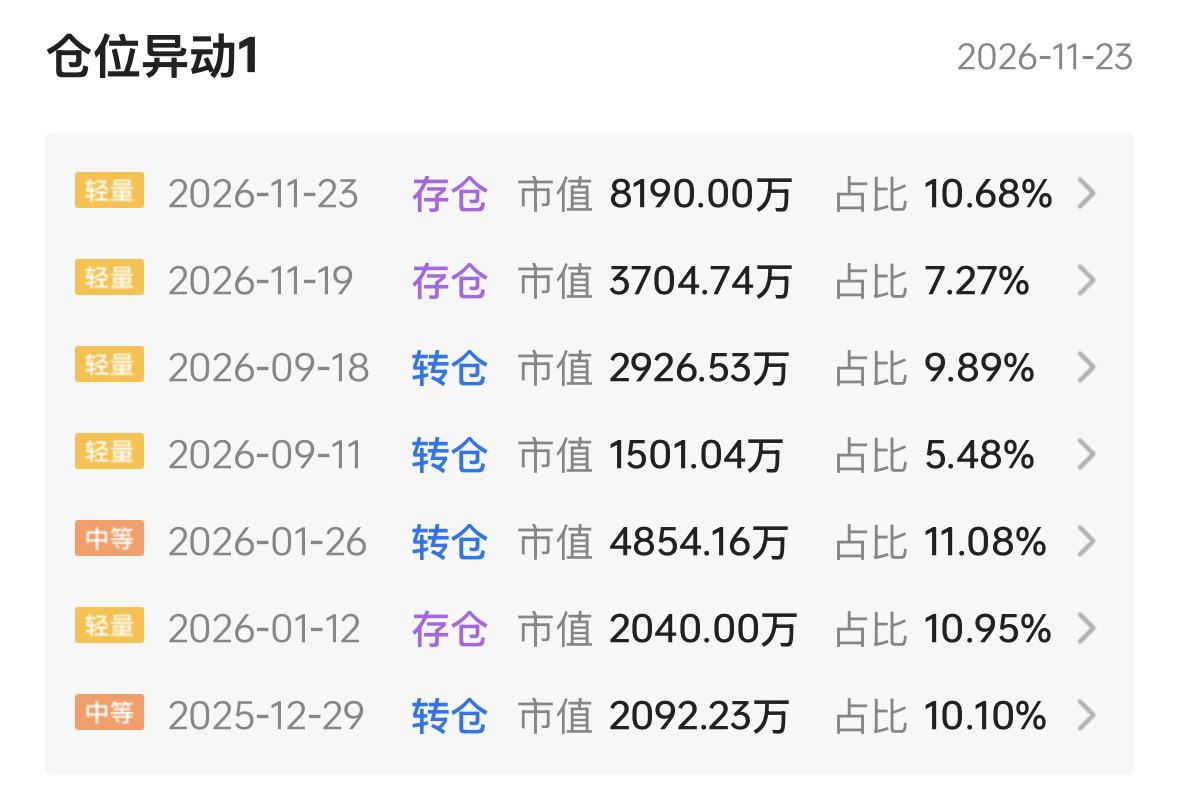
(Data source: Zhitong Finance)
It is no coincidence that the transfer occurred on the same day as the placement. A shift in position is like a shift in gear; it is a circuit operated by capital. The brokerage channel switch means that subsequent placement and delivery, equity arrangements, and funding routes are in an enforceable state. Technically, this is a pre-project for capital action to move from “idea” to “implementation.”
After about three weeks, this round of placement was voluntarily terminated on October 8 due to unstable market conditions. According to conventional logic, the lack of financing should have been pressured, but the stock price did not fall. Instead, it stabilized at around 0.30 in late October, then suddenly gained strength in November.
In fact, Omori terminated an already-discounted placement, which simply prevented it from further diluting its shares in a weak environment — instead of issuing at a low discount and diluting shareholders' rights, it is better to remain flexible and wait for a more controlled way of operating capital. At the same time, it also left room for the announcement. “The company may consider additional fund-raising activities after considering future developments and market conditions”, which undoubtedly also means that Omori's operations have not stopped.
What really closed the loop on chip leads was November's storage and boosting.
On November 17, the stock price rose 26.87% to HK$0.425; on November 19, it was revealed that 796.719 million shares were deposited into Future Finance on the same day, with a market value of about HK$37.474 million, accounting for 7.27%; on November 23, another 117 million shares were deposited, with a market value of about HK$81.9 million, accounting for 10.68%, and the stock price closed at HK$0.75 on the same day. In just a few days, about 17.94% of positions were collected in the same channel, and the stock price just completed the main rise period during this time.
Behind this 117 million chips, Li Liang, a new equity party, surfaced. It holds the shares through SuntiAlpte.Ltd., a wholly-owned Singaporean entity. As the second-largest shareholder independent of the actual controller, Wong Chun-han, there are no announcements indicating that the two form a concerted actor and are the core undertakers in this round of rounding.

(Data source: Futu)
Collecting chips is often an invisible foundation in capital chess games. A deposit is by no means a simple transfer of shares between seats; it essentially transforms scattered floating funds into a backcard for scheduling. The targeted collection of large amounts of equity to the same channel is intended to reduce the noise of subsequent games and consolidate the equity chassis; while the simultaneous rise in stock prices will reverse anchor market value and raise the chips for subsequent capital negotiations. This combination of “boost+collection” is more like a set of active rhythms rather than a passive response that goes with the flow.
On October 15, Wong Chun-han reduced his holdings by 13.68 million shares, each at HK$0.365. After the reduction, he still held about 537 million shares, with a shareholding ratio of 48.99%. He reduced his holdings by a small amount without increasing his controlling interest. Meanwhile, Omori's stock price pushed all the way from HK$0.365 to above HK$0.75, which also shows that the reduction in holdings has not shaken the market's expectations for subsequent actions.
Cang first got together, then momentum began. As can be seen, for Omori Holdings, collecting chips has never been the goal, but rather paves the way for capital action ahead of time: first, collect floating funds, reduce game costs, and then restart financing, introduce war investment, and promote mergers and acquisitions with a clearer equity structure and a more favorable market capitalization anchor — when the chips are straightened out and the structure is clear, the capital game in front of the company's platform has the strength to start.
Four major layouts close the loop to unlock a new path of platform reengineering
Simply moving chips is just an empty shell; it is necessary to inject an industrial narrative to give Omori Holdings room to imagine revaluing its value.
Zhitong Finance observed that for the year ended March 31, 2026, Omori earned about 7.1 million yuan and lost 10.06 million yuan, or 0.97 points per share. The traditional plywood industry is fiercely competitive, demand in the mid-range furniture and building materials market is shrinking, and the profit margins of the old model are being compressed. It is true that the performance is not good, but this has also reserved a window for the revaluation of its capital operations and expectations.
It is worth noting that Omori Holdings' capital operations are not a single point, but a chain.
The first step is settling down the industry, mergers and acquisitions of shares at a cost, and turning sellers into peers. On January 18, the company acquired all of Chance Rich's issued share capital for approximately HK$9.5 million, at the cost of issuing shares, with an issue price of HK$0.17 per share; the main business is the procurement and sale of plywood and building materials. The customer base covers many countries and industries, and the management has experience in overseas operations.
This acquisition costs no cash, binds shares to counterparties, and becomes shareholders in exchange for overseas customer groups and channels to find exports for mainland production capacity — the original main industry is intense and profit margins are under pressure. This merger and acquisition just made up for Omori's most lacking overseas customer base and management experience.
The second step is to take over production capacity and exchange transformation for profit. After the acquisition was completed, the company modernized and upgraded its existing production base in Heze, Shandong, making it a production center for new plywood products, covering most of the products currently purchased and sold by the target company. It is expected to complete the transformation and start production of new products by mid-2026. The senior management of the target company remained in office and joined the group, saving preparation time and costs for starting the upgrade of production facilities.
The double wheel of “overseas channels+mainland production capacity” took shape: the Hong Kong standard is a procurement and sales window, and the Heze base is a production center; overseas orders are received, and mainland manufacturing can be received. Leading traditional plywood from low price competition to new wood products with higher profit margins is the real purpose of upgrading production capacity.
The third step is platform wiring. In-house digital platforms have come to an end, and new shareholders have become industrial interfaces.
On the one hand, it is underpinned through an existing digital joint venture platform in the body. MicroPay is 51% owned by Omori. It specializes in hotel virtual room card systems and e-commerce membership club platforms, which are typical asset-light operating tools. If the B-side customer network of overseas plywood is connected to the data capabilities of the member platform, the plywood business will no longer be just a linear “production-sales” chain, but may grow added value from customer operations and supply chain services. Digital platforms may not immediately contribute to profits, but they provide a layer of “user gripper” for industrial upgrading.
On the other hand, it is through an industrial interface brought by new shareholders. Behind the 117 million chips, Li Liang, a new equity holder, emerged as the second-largest shareholder independent of actual controller Wong Chun-han. Li Liang is also in the position of Omori Board of Directors and General Manager of SMIC. What needs to be objectively explained is that SMIC is not currently investing in Omori Holdings. This status constitutes a reasonable industrial resource interface rather than a completed transaction. According to reports, SMIC focuses on R&D, production and application of cathode materials for new energy batteries. It is a “little giant” enterprise specializing in materials research and development, production, sales, and recycling of decommissioned battery materials.
The fourth step is to shift financing, exchanging time for pricing power. On September 18, Omori plans to place up to 219 million shares at HK$0.241 per share, ending on October 8. Termination is not about abandoning; it is about avoiding inefficient dilution at a low level. After the stock price rose to 0.76 in November, the same financing scale, dilution ratio, and willingness to undertake it were completely different. After the upgrade, finance, buy less dilution for the same amount of money.
If you look at the above four steps together, the logic gradually becomes clear — plywood mergers and acquisitions have been completed, Heze production capacity has taken over, the MicroPay platform has bottomed out, Li Liang's industrial background is connected, and the refinancing capacity of the listed platform has come to an end.
As can be seen from this point, Omori Holdings is not following the old path of an IPO, but rather a “not an IPO, it is better than an IPO” path of stock platform reengineering: using existing listed platforms to securitize overseas assets, using director-level industry figures to access external resources, and controlling dilution with the pace of stock issuance under high control.
Summarize
The return of chips, platform wiring, industrial settlement, and financing shift are intertwined in four steps. Omori Holdings' complete capital “pre-project project” has already been settled.
Its core logic is to complete the connection between industry and capital in the most efficient way through the platform of listed companies at the right time. This is not only common capital wisdom in the Hong Kong stock market, but also a forward-looking response to “time costs” and “certainty.”
The next key is to keep an eye on whether Omori Holdings has new shareholder disclosures, further financing announcements, or more detailed industrial integration plans. Each of these items has the potential to become a catalyst for the company's stock price to rise to the next level. However, how the stock price will be interpreted in the future, whether it will continue to rise violently, or whether it will continue to stand still, is worth looking forward to by the market.