


EN
Is Oracle Stock Underperforming the Nasdaq?
Founded in 1977, Oracle Corporation (ORCL) has evolved from a Silicon Valley startup into one of the world's leading enterprise technology giants. Headquartered in Austin, Texas, the company provides a comprehensive portfolio of technology solutions that help businesses manage data, streamline operations, and accelerate digital transformation. Oracle's offerings span database management systems, cloud infrastructure through Oracle Cloud Infrastructure (OCI), enterprise software applications, and AI-powered solutions.
Its product portfolio also includes enterprise resource planning (ERP), human capital management (HCM), customer experience (CX), and supply chain management tools, alongside hardware and consulting services. With a market capitalization of approximately $323.86 billion, Oracle comfortably ranks among the market’s mega-cap stocks, a category reserved for companies valued at $200 billion or more. With its expanding cloud and AI capabilities, Oracle plays a pivotal role in powering the digital infrastructure and mission-critical operations of businesses across industries worldwide.
Despite its formidable position in the technology industry, Oracle has had a remarkably difficult run on Wall Street, with its shares coming under significant selling pressure. After touching a 52-week high of $250.25 in June, ORCL has plunged approximately 58.5%, reflecting a sharp deterioration in investor sentiment. The recent weakness has been particularly pronounced, with the stock tumbling 28.2% over the past three months, substantially underperforming the Nasdaq Composite ($NASX), which has declined 9.8% over the same period.
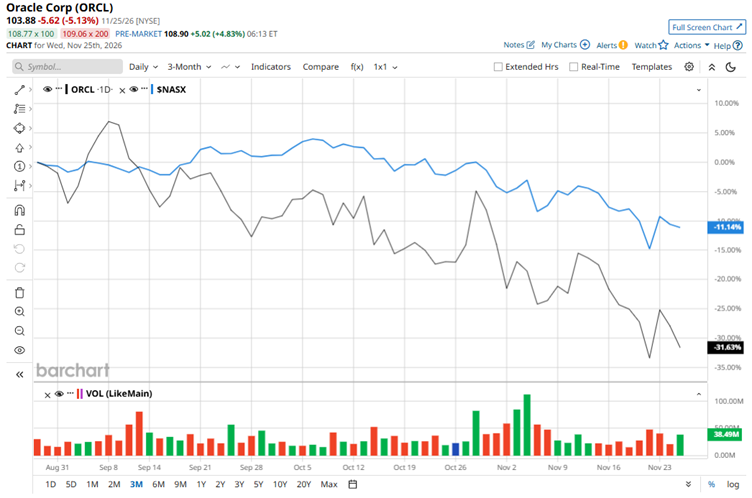
The broader performance picture is even more concerning. Oracle shares have lost nearly 47.3% of their value over the past 12 months and are down another 46.7% in 2026, highlighting the extent of the pressure on the stock. In stark contrast, the Nasdaq Composite has managed to stay in positive territory, advancing 2.4% over the past year and 1.5% year to date.
Oracle’s technical outlook remains firmly bearish, with the stock struggling to regain upward momentum. Shares have consistently traded below their 200-day moving average since mid-June and have also remained largely beneath their 50-day moving average over the same period despite a few intermittent fluctuations in between.
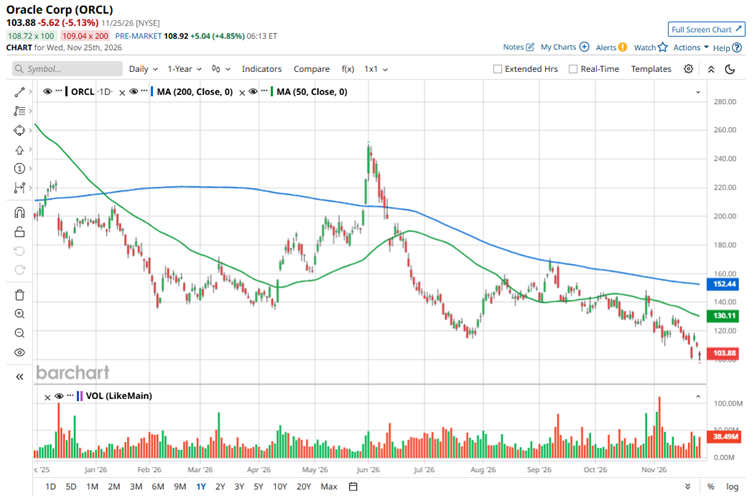
Oracle’s steep share price decline over the past year reflects growing investor concerns over the company’s aggressive AI infrastructure spending and its rising debt burden. Oracle has committed substantial capital to building AI data centers to capitalize on surging demand for computing power. However, investors are increasingly questioning whether these massive investments will generate returns substantial enough to justify the associated costs and borrowing.
These concerns came into sharper focus on Nov. 25, when Oracle shares tumbled approximately 5.2% as fears of an AI bubble, persistent inflation, and mounting credit risks across the technology sector triggered a broader Wall Street sell-off. Adding to the pressure, credit default swap (CDS) spreads for Oracle, Alphabet, SpaceX, and SoftBank surged to multi-year or record highs.
Oracle’s recent struggles stand in sharp contrast to the relatively resilient performance of its technology peers. Microsoft Corporation (MSFT), for instance, has managed to stay in positive territory, with its shares advancing 2.7% over the past 12 months and gaining another 1.3% so far in 2026.
Despite Oracle’s steep share price decline, Wall Street analysts remain remarkably bullish on its recovery prospects. The stock commands a consensus “Strong Buy” rating from the 43 analysts covering it, reflecting continued confidence in the company’s long-term growth potential. Adding to the optimism, the Street’s average price target of $242.37 implies a substantial upside of approximately 133.3% from current levels, suggesting analysts believe the recent sell-off may have created a significant opportunity for a rebound.
On the date of publication, Anushka Mukherji did not directly have a position in any of the securities mentioned in this article. All information and data in this article is solely for informational purposes. For more information please view the Barchart Disclosure Policy here.