


EN
Inflation in France and Spain has cooled far more than expected, yet consumer inflation expectations have risen sharply! The ECB's monetary policy path is in a dilemma
The Zhitong Finance App learned that with the easing of pressure on energy prices, inflation in France and Spain has cooled far more than expected, bringing some breathing room for the ECB, which is considering whether to raise interest rates further. However, according to a survey released on the same day, consumer inflation expectations in the Eurozone have risen sharply, which may put the ECB's monetary policy path in a dilemma.
According to the data, France's harmonized CPI rose 3.2% year on year in November, down from 3.7% in October, and far lower than market expectations of 3.6%; Spain's November harmonized CPI rose 4.1% year on year, down from 4.9% in October, which is also significantly lower than the 4.7% expected by the market.
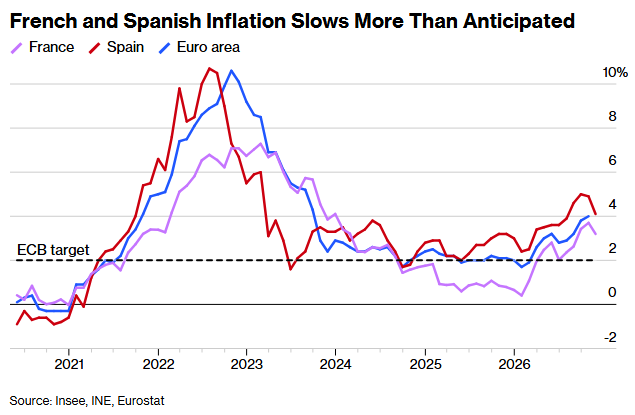
Inflation in France and Spain cooled more than expected
Among them, France's inflation report attributed the fall in inflation to energy prices; the much-publicized increase in service prices also slowed, from 2.6% to 2.3%. The Spanish statistics agency said that the slowdown in inflation was mainly due to falling fuel prices, followed by falling clothing and footwear prices.
Stephan Kolyak, senior economist at BNP Paribas, said that lower than expected inflation in France was mainly due to food and service prices. Miguel Cardoso, chief economist at BBVA Research, said that service prices may also be the reason why Spanish inflation is lower than expected.
Economist Jean Dalbar said, “The sharp drop in fuel prices at gas stations explains why inflation in France slowed in November. Looking at the present, we expect inflation to pick up only moderately in the next few months, as the impact of the previous rise in energy prices will gradually be transmitted to the price index. After that, inflation should gradually decline in 2027. Under our benchmark scenario for oil and gas prices, the average inflation rate is expected to be 2.3% in 2027.”
Inflation and rising interest rates are posing difficult challenges for France, the second-largest economy in the Eurozone. France is facing the risk of a recession, while also dealing with huge budget deficits, increasingly uneasy investor sentiment, and social unrest, all of which will occur before a critical presidential election next spring.
Despite recent deceleration in French and Spanish inflation, the Eurozone inflation rate is still far above the ECB's 2% target as the effects of the Middle East war continue to spread. Policymakers have raised borrowing costs twice before and are expected to raise interest rates again in December. Some officials have signalled that more action may be taken in the future.
ECB officials concluded at a recent policy meeting in October that the price outlook has deteriorated, which supports “continuing to adopt prudent and moderate policy responses, while pointing out that further tightening of monetary policy may be necessary.” Bank of Austria Governor Martin Koch pointed out in an interview this week that inflation faces “significant upward risks” and warned that the ECB “should not lag behind the situation.”
However, after the release of French and Spanish inflation data on Friday, traders cut their bets on interest rate hikes before the end of 2027. Before the inflation data was released, the market believed that the ECB had a 35% chance of raising interest rates three times. After the data was released, this probability was reduced to 25%.
The data released on Friday is the first batch of inflation data released by major Eurozone economies this month. The Eurozone, which consists of 21 countries, will release November inflation data next Tuesday. The market is currently expecting the inflation rate to fall back to 3.9%. However, according to data from France and Spain, Daniel Hartman, the chief economist at Bantleon, the fall in inflation in November is likely to be even greater, falling to 3.8%.
However, according to a survey released by the ECB on Friday, consumer expectations for future inflation have risen sharply, and perceptions of past inflation have also risen markedly. This may provide a reason for the ECB to raise interest rates again.
Specifically, as of October, Eurozone consumers expect prices to rise 3.5% in the next 12 months, up from 3.1% a month ago; prices are expected to rise 3% in the next three years, which is also higher than the previous 2.9; expectations for the inflation rate for the next five years remain unchanged at 2.5%. At the same time, consumer perception of inflation over the past year also soared from 3.6% to 4.1%, making it roughly in line with the 4.0% increase in consumer prices measured by Eurostat.
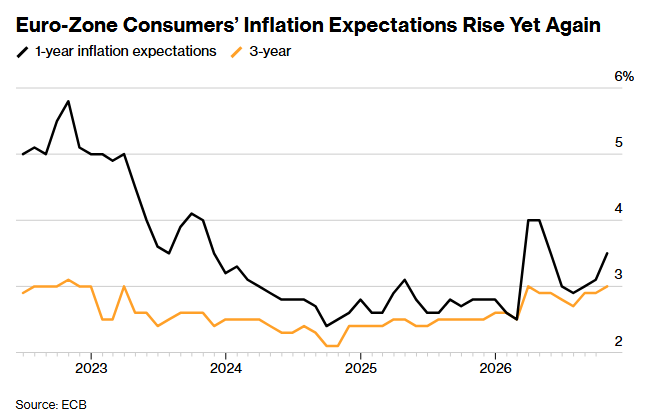
Eurozone consumer inflation expectations rise again
While considering further tightening monetary policy, the ECB has been keeping a close eye on consumer inflation expectations, fearing that a sharp rise in energy prices may trigger a second round of inflation that is difficult to contain, especially as households begin to demand higher wages. Although these second-round effects have yet to be observed in the data, policymakers have been arguing the need to raise interest rates early.
However, consumers don't think their actual revenue losses can be covered because they expect nominal revenue to grow by only 0.6% over the next year, lower than the 1.1% forecast in September. The ECB added that the expected decline in income was most pronounced among the lowest-income quintile. Consumer expectations of inflation may also drive higher wage claims. Bank of Lithuania Governor Gediminas Simkus said in an interview this week that he expects the union to demand compensation for previous losses in purchasing power.