


EN
Unpacking Q3 earnings: AGCO in the context of other agricultural machinery stocks

The end of an earnings season can be a great time to discover new stocks and assess how companies are handling the current business environment. Let’s take a look at how AGCO NYSE:AGCO and the rest of the agricultural machinery stocks fared in Q3.
Agricultural machinery companies are investing to develop and produce more precise machinery, automated systems, and connected equipment that collects analyzable data to help farmers and other customers improve yields and increase efficiency. On the other hand, agriculture is seasonal and natural disasters or bad weather can impact the entire industry. Additionally, macroeconomic factors such as commodity prices or changes in interest rates–which dictate the willingness of these companies or their customers to invest–can impact demand for agricultural machinery.
The 5 agricultural machinery stocks we track reported a softer Q3. As a group, revenues missed analysts’ consensus estimates by 5.6% while next quarter’s revenue guidance was 0.5% below.
Amidst this news, share prices of the companies have had a rough stretch. On average, they are down 7.6% since the latest earnings results.
AGCO NYSE:AGCO
With a history that features both organic growth and acquisitions, AGCO (NYSE:AGCO) designs, manufactures, and sells agricultural machinery and related technology.
AGCO reported revenues of $2.26 billion, down 8.6% year on year. This print fell short of analysts’ expectations by 2.7%. Overall, it was a sluggish quarter for the company with full-year revenue and full-year EPS guidance missing analysts’ expectations.
"AGCO delivered resilient third-quarter results in what is the weakest global industry demand environment in more than a decade," said Eric Hansotia, AGCO's Chairman, President and CEO. "While elevated input costs and uncertainty around commodity markets and the trade environment pushed industry demand below the last cyclical trough, we aligned production with demand, managed dealer inventories and maintained cost discipline. We also advanced our Farmer-First strategy by strengthening the market position of our premium brands and expanding precision agriculture solutions that help farmers automate tasks, address labor constraints and get more from their equipment."
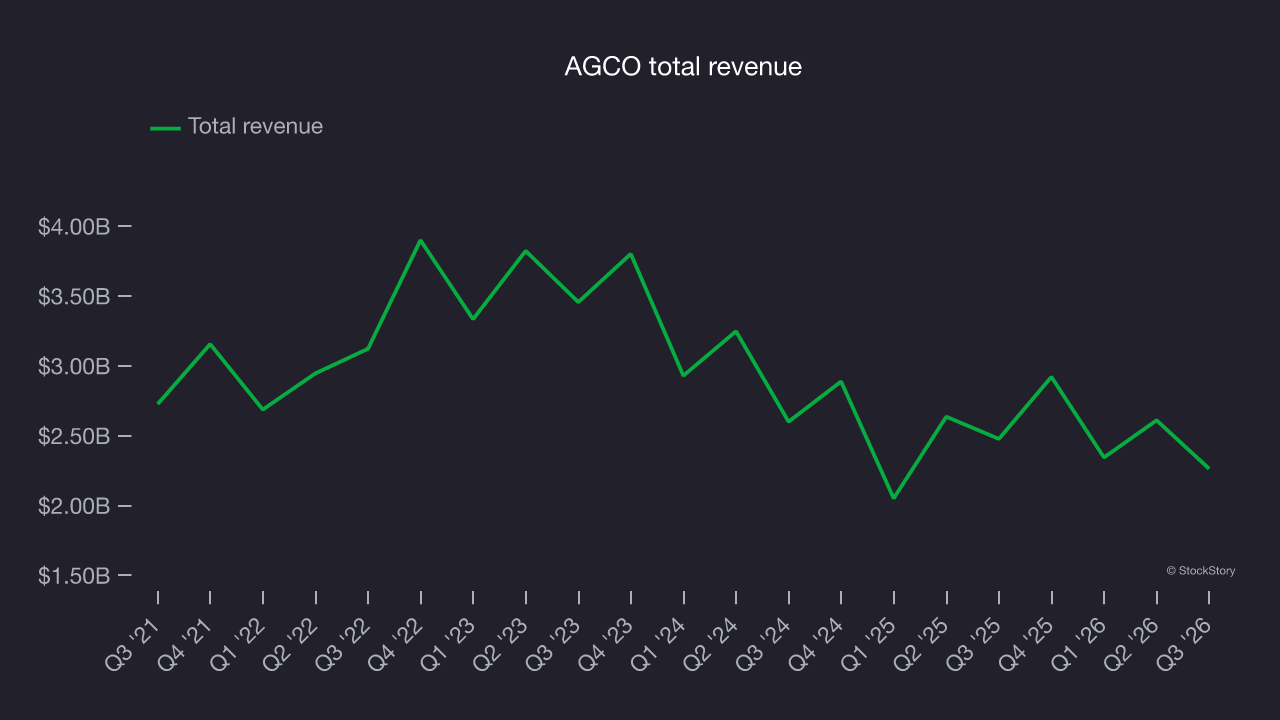
AGCO delivered the slowest revenue growth and weakest full-year guidance update in the group. Interestingly, the stock is up 4.4% since reporting and currently trades at $106.62.
Read our full report on AGCO here, it’s free.
Best Q3: Lindsay (NYSE:LNN)
A pioneer in the field of center pivot and lateral move irrigation, Lindsay (NYSE:LNN) provides a variety of proprietary water management and road infrastructure products and services.
Lindsay reported revenues of $161.6 million, up 5.2% year on year, outperforming analysts’ expectations by 7.3%. The business had a very strong quarter with a beat of analysts’ EPS estimates.
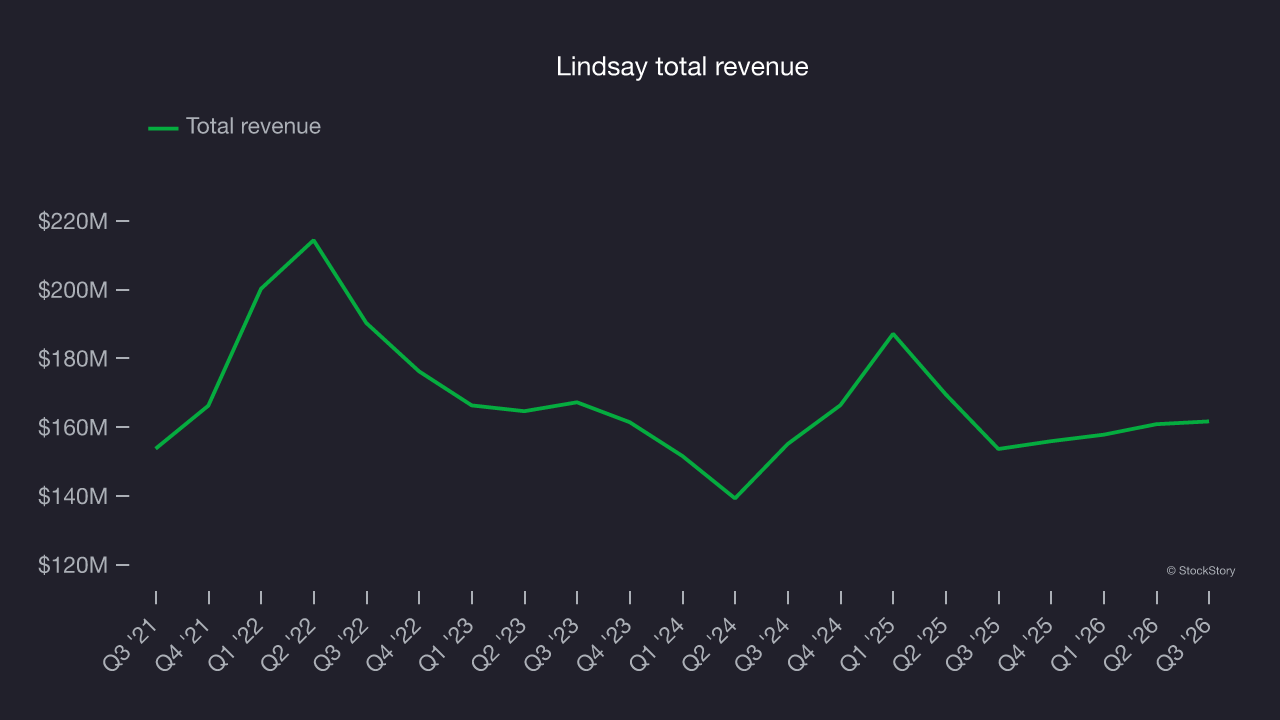
Lindsay pulled off the biggest analyst estimate beat and fastest revenue growth among its peers. Although it had a fine quarter compared to its peers, the market seems unhappy with the results as the stock is down 6.2% since reporting. It currently trades at $100.
Is now the time to buy Lindsay? Access our full analysis of the earnings results here, it’s free.
Weakest Q3: Alamo (NYSE:ALG)
Expanding its markets through acquisitions since its founding, Alamo (NYSE:ALG) designs, manufactures, and services vegetation management and infrastructure maintenance equipment for governmental, industrial, and agricultural use.
Alamo reported revenues of $403.1 million, down 4% year on year, falling short of analysts’ expectations by 7.8%. It was an underwhelming quarter as it posted a significant miss of analysts’ EBITDA and EPS estimates.
As expected, the stock is down 9.4% since the results and currently trades at $138.40.
Read our full analysis of Alamo’s results here.
Deere (NYSE:DE)
Revolutionizing agriculture with the first self-polishing cast-steel plow in the 1800s, Deere (NYSE:DE) manufactures and distributes advanced agricultural, construction, forestry, and turf care equipment.
Deere reported revenues of $12.12 billion, down 2.3% year on year. This number met analysts’ expectations. Taking a step back, it was a softer quarter as it logged a significant miss of analysts’ EPS estimates.
The stock is up 4.9% since reporting and currently trades at $644.
Read our full, actionable report on Deere here, it’s free.
Titan International (NYSE:TWI)
Acquiring Goodyear’s farm tire business in 2005, Titan (NYSE:TWI) is a manufacturer and supplier of wheels, tires, and undercarriages used in off-highway vehicles such as construction vehicles.
Titan International reported revenues of $335.2 million, down 6.2% year on year. This print lagged analysts’ expectations by 25.3%. Overall, it was a softer quarter as it also recorded EBITDA guidance for next quarter missing analysts’ expectations and full-year EBITDA guidance missing analysts’ expectations.
Titan International achieved the highest full-year guidance raise but had the weakest performance against analyst estimates of the whole group. The stock is down 31.7% since reporting and currently trades at $4.52.
Read our full, actionable report on Titan International here, it’s free.
Market update
Over the past year, investors have been forced to repeatedly answer the same question: What is the market’s biggest risk? The answer has changed several times, and each shift has reshaped market leadership.
Late in 2025 and early 2026, artificial intelligence became the market’s primary uncertainty. Investors questioned whether AI would erode software pricing power and weaken competitive moats as AI made it easier to replicate once-differentiated products.
By the spring, technology took a back seat to geopolitics. The U.S. conflict with Iran briefly became the market’s dominant narrative, raising concerns about oil prices, inflation, and global growth. But as energy markets remained orderly and fears of a prolonged supply disruption faded, investors quickly turned their focus back to fundamentals.
Want to invest in winners with rock-solid fundamentals? Check out our 9 Best Market-Beating Stocks and add them to your watchlist. These companies are poised for growth regardless of the political or macroeconomic climate.