


EN
Is Energy Transfer (ET) Fairly Priced For Its Earnings Today?
Energy Transfer has put up a powerful long term share performance record, yet the question many investors now circle back to is whether the current price around US$18.81 still lines up with what the partnership earns. With so much of the recent story anchored in its earnings power, the key issue is how that profit stream relates to where the units trade today.
- Over the past 5 years, Energy Transfer has delivered a total return of about 239.9%, which now puts real weight on whether the earnings profile can support that kind of value creation going forward.
- The purchase of Vaquero Midstream brings additional Delaware Basin processing and pipeline capacity into the fold, which can influence future earnings by changing volume throughput, operating leverage and the timing of cash flows tied to the enlarged midstream network.
- Your read on Energy Transfer is one view; the desks covering it have another. See what analysts think Energy Transfer's shares could be worth.
For investors, the debate is whether Energy Transfer's current unit price is adequately explained by the earnings it generates today and is expected to produce in the years ahead.
If you are weighing Energy Transfer's 5 year return of 239.9% against what its earnings justify today, it can help to compare that question across 37 high quality undervalued stocks.
Does Energy Transfer Look Undervalued on Earnings?
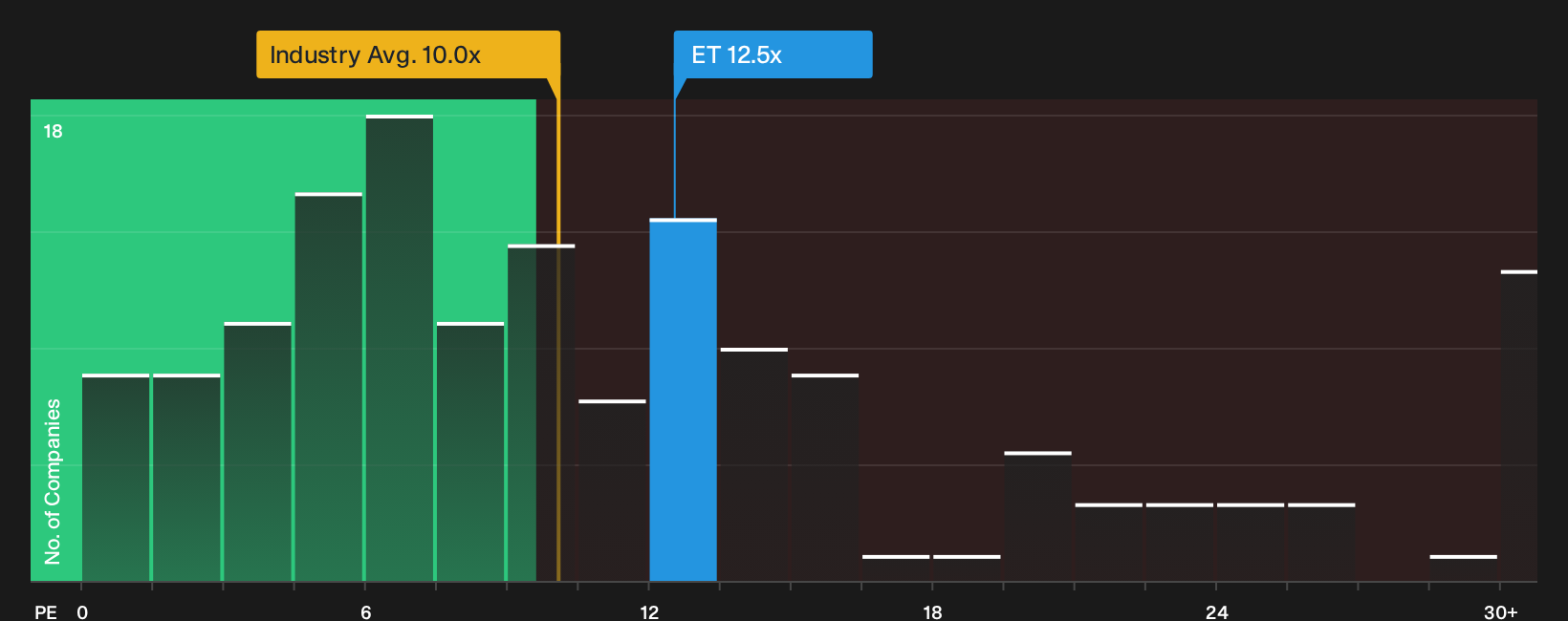
The P/E ratio works well for Energy Transfer because earnings are a central part of how investors frame large, mature pipeline partnerships. On this measure, the units trade on a P/E of about 12.5x, which sits above the Oil and Gas sector average of around 10.0x but below the broader peer group at roughly 19.6x.
Because the completed Vaquero Midstream acquisition adds more Delaware Basin throughput into the system, recent enthusiasm has not pushed Energy Transfer anywhere near the multiple that a fundamentals based model suggests would be typical for its profile. That framework, which factors in the partnership's growth prospects, profitability, scale and risk, points to a higher P/E than where the units change hands today. As a result, the current 12.5x screens as undervalued relative to those fundamentals. For anyone weighing whether that gap is wide enough to matter, the next step is to compare the present earnings yield with what the model implies over the longer term. Explore the numbers behind Energy Transfer's P/E valuation.
The Energy Transfer Narrative: What Would Justify Today's Price?
Simply Wall St Narratives for Energy Transfer pick up where the valuation puzzle leaves off and explain what would need to happen to growth, margins and earnings for the units to justify a meaningfully higher or lower price than today, based on scenarios that live on the Community page. Rather than relying on a single multiple or model output, each narrative sets out the assumptions behind its view of fair value so you can track those against future reported results.
One of the top narratives on Energy Transfer: 23% undervalued
This Narrative is the analyst consensus Narrative on Simply Wall St, which compiles analysts' consensus price target and revenue and earnings forecasts, not one person's view.
"Recent long term customer commitments on multi billion dollar projects are now supported by more than 6 Bcf/d of contracted pipeline capacity with demand pull customers…"
Discover why this Narrative puts Energy Transfer at 23% undervalued.
For Energy Transfer, the unanswered piece is who is steering the ship
Valuation only tells you what the units might be worth today. The real story depends on who sets priorities, allocates capital and gets rewarded for those choices. See who runs Energy Transfer and how they are paid.
Have feedback on this article? Concerned about the content? Get in touch with us directly. Alternatively, email editorial-team@simplywallst.com