


EN
Is Mastercard Stock Outperforming the Nasdaq?
Some names have become so deeply woven into everyday life that you hardly stop to think about them, and Mastercard is one of them. Every time someone taps a card, pays online, or makes a digital transaction, there is a good chance Mastercard's network is working behind the scenes. Mastercard Incorporated (MA) is a global payments technology company connecting consumers, merchants, businesses, and financial institutions across more than 210 countries and territories. Beyond processing payments, it offers services in cybersecurity, fraud prevention, risk management, and digital payment solutions, helping make transactions faster, safer, and more convenient.
With a market capitalization of approximately $545 billion, Mastercard comfortably qualifies as a “mega-cap” stock, a category generally reserved for companies valued above $200 billion. Its journey to this scale has been powered by its extensive global payment network, growing adoption of cashless transactions, strong brand recognition, and expanding digital commerce. As more consumers and businesses move away from cash, Mastercard continues to benefit from the shift, while its value-added services provide additional avenues for growth beyond traditional payment processing.
That strength has been reflected in Mastercard’s stock performance, which has largely stayed ahead of the broader market. Although shares have eased 3.2% from their 52-week high of $681.99, reached on Nov. 5, the bigger picture remains impressive. MA has climbed 10.1% over the past three months, even as the Nasdaq Composite ($NASX) has slipped 9.8%.
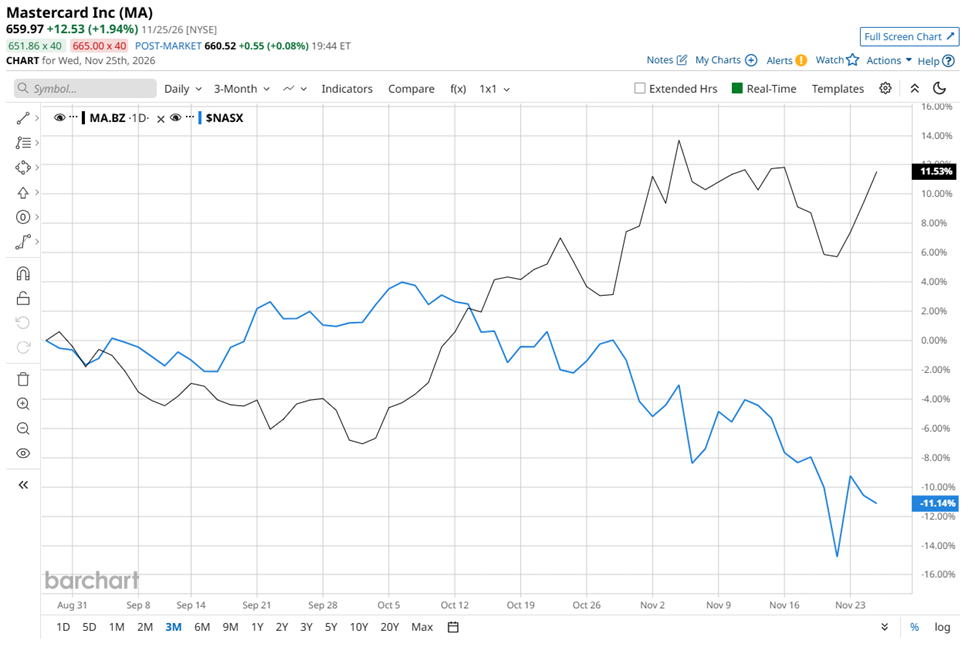
The outperformance becomes even clearer when looking at the longer-term numbers. Mastercard is up 15.6% on a year-to-date (YTD) basis, compared with the Nasdaq’s modest 1.5% gain. Over the past 52 weeks, the stock has advanced 20.8%, comfortably beating the index’s 2.4% return.
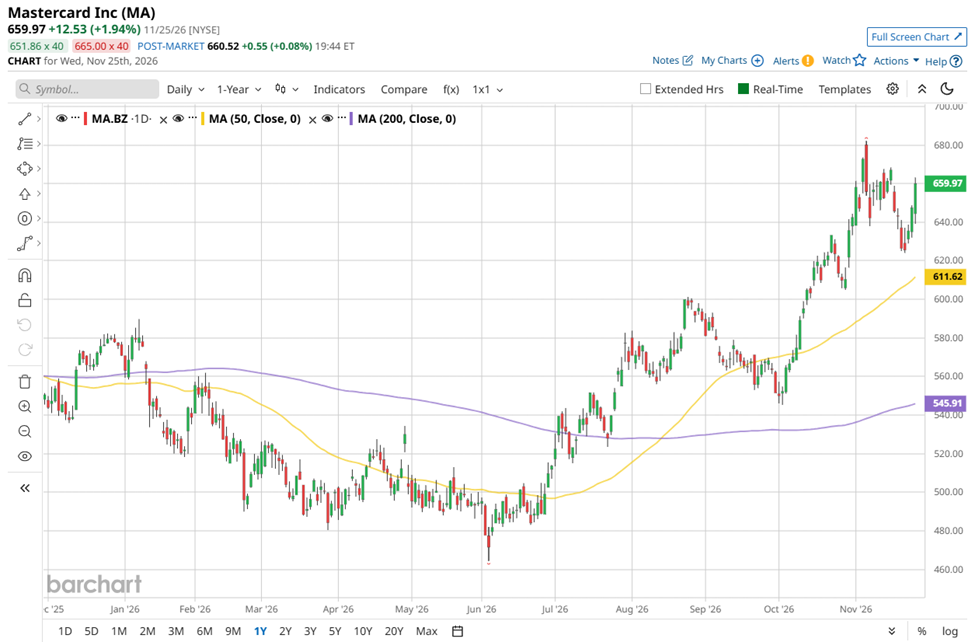
MA has largely maintained its upward trend, trading above its 50-day moving average since June, apart from a brief dip in late September and early October. The stock has since regained momentum and moved higher, while remaining comfortably above its 200-day moving average since July, signaling continued underlying strength.
Mastercard’s strong run in 2026 has had plenty of fuel behind it, and the biggest driver has been a business that continues to grow on several fronts. The payments giant got another boost after reporting better-than-expected third-quarter results, with adjusted earnings of $5.31 per share and revenue climbing 14% year over year (YOY) to $9.8 billion. Consumers kept spending, cross-border transactions remained healthy, and demand for its value-added services stayed strong, even as economic and geopolitical uncertainty lingered. As CEO Michael Miebach put it, consumers are still spending, businesses are investing, and commerce is expanding.
There is also more happening under the hood. Mastercard has widened its reach by 20% through the first half of 2026, adding acceptance options such as Pay Local and Tap on Phone. It now connects with more than 200 million merchant locations and another 300 million digital access points. Meanwhile, its high-margin value-added services business grew 19%, supported by demand for data, security and other payment-related solutions. Growth in affluent consumer spending and major wins across Germany, China, India and the Nordics have added further momentum. And Mastercard is already laying the groundwork for its next growth chapter, investing in agentic commerce and stablecoins while aiming for high-single to low-double-digit revenue growth.
In comparison, MA stock has lagged behind its rival, Visa Inc. (V). Shares of Visa have risen 26.9% over the past 52 weeks and 21% on a YTD basis.
Wall Street remains firmly bullish on Mastercard, with MA having an overall “Strong Buy” rating from 42 analysts covering MA stock. Their average price target of $719.78 points to a potential upside of 9.1% from current levels, suggesting analysts believe MA still has room to climb.
On the date of publication, Sristi Suman Jayaswal did not directly have a position in any of the securities mentioned in this article. All information and data in this article is solely for informational purposes. For more information please view the Barchart Disclosure Policy here.