


EN
Don’t Give Up on Alibaba (BABA) Stock Just Yet: The Math May Be More Compelling Than You Think
For those interested in wild speculation following Thanksgiving, Chinese tech giant Alibaba (BABA) just might fit the bill. Sure, BABA stock isn’t exactly a confidence-inspiring name right now. Barchart’s Technical Opinion indicator rates the ticker as a 100% Strong Sell — and it’s hardly an arbitrary assessment. Since the start of the year, BABA has lost over 41% of value.
Still, the contrarian argument is that Alibaba stock is starting from an extreme low point. Should BABA manage to catch a bullish wave, the ensuing wave could be stronger than normal. Mechanically, the concept of mean reversion is often powered by an overbalancing of sentiment. In this case, the bears obviously dominate proceedings, making pessimism overcrowded. As such, even a modicum of good news could aggressively swing the needle in the opposite direction.
Fundamentally, this idea runs into some challenges. As Google Finance’s summary sheet points out, Alibaba stock suffers from persistent non-GAAP earnings target misses. In addition, stricter compute controls stymies the tech juggernaut’s cloud business. This headwind stems from the U.S. Commerce Department's decision to tighten export restrictions on key AI components.
So, why bother considering the bullish argument for BABA stock? In my opinion, it comes down to the quantitative argument. Based on historical share price data over the trailing five years, BABA has a tendency of transitioning from a bearish state to a bullish one. Here, we’re not just talking about garden-variety pessimism — Alibaba almost appears to be in desperate technical straits.
Nevertheless, we’ve seen such aggressive bearishness in the past, only to generate a higher propensity for a reactionary move northward. Of course, this observed pattern isn’t guaranteed to play out this time around. But if it does, a case exists for swinging for the fences.
Why Bullishness Toward BABA Stock Might Not Be Entirely Irrational
It’s only natural that a security slipping nearly 14% in the past month would arouse skepticism. With questions rising about the true state of China’s economy, those concerns are only going to be exacerbated. Despite the obvious problems with the contrarian position, the historical data demonstrates that optimism for Alibaba stock is not entirely irrational.
Again, I’m looking at the quantitative picture. Specifically, in the past two months, BABA stock has printed 10 weekly candlesticks — and a quick look at the technical chart will reveal that a whopping eight of the sessions were negative (where Friday’s close was lower than Monday’s open). In other words, there’s currently an eight-to-ratio comparing bearish weekly candlesticks to bullish.
Thanks to this assessment, we may confidently declare that BABA stock is presently structured in a bearish state. On the surface, this may sound like bad news. However, history (over the past five years) demonstrates that whenever the 8-to-2 ratio flashes in the charts, there is an observed tendency for BABA to rise higher.
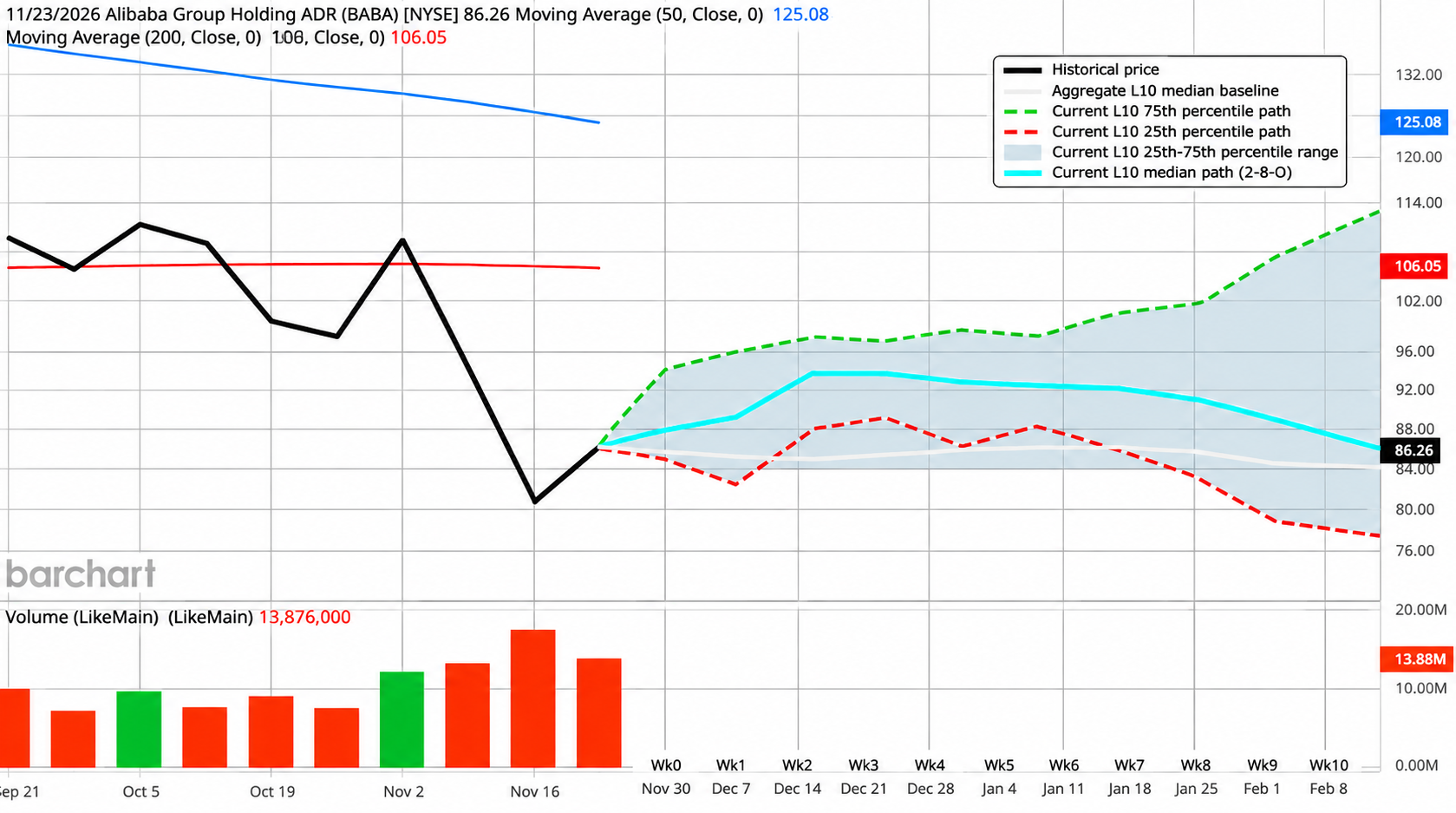
In terms of calculating odds with this transitional logic, there’s a median probabilistic range between 26.7% and 40% that BABA stock will exceed the $95 price level by the end of the December monthly options chain (which features a Dec. 18 expiration date).
As you might expect, if the median probability is decent at $95, it should be much better at the more forgiving $90 level. In fact, I’m calculating a median exceedance ratio of 66.7% at the lower target. Still, an expected value (EV) calculation implies that the higher (and thus riskier) price should be the focus.
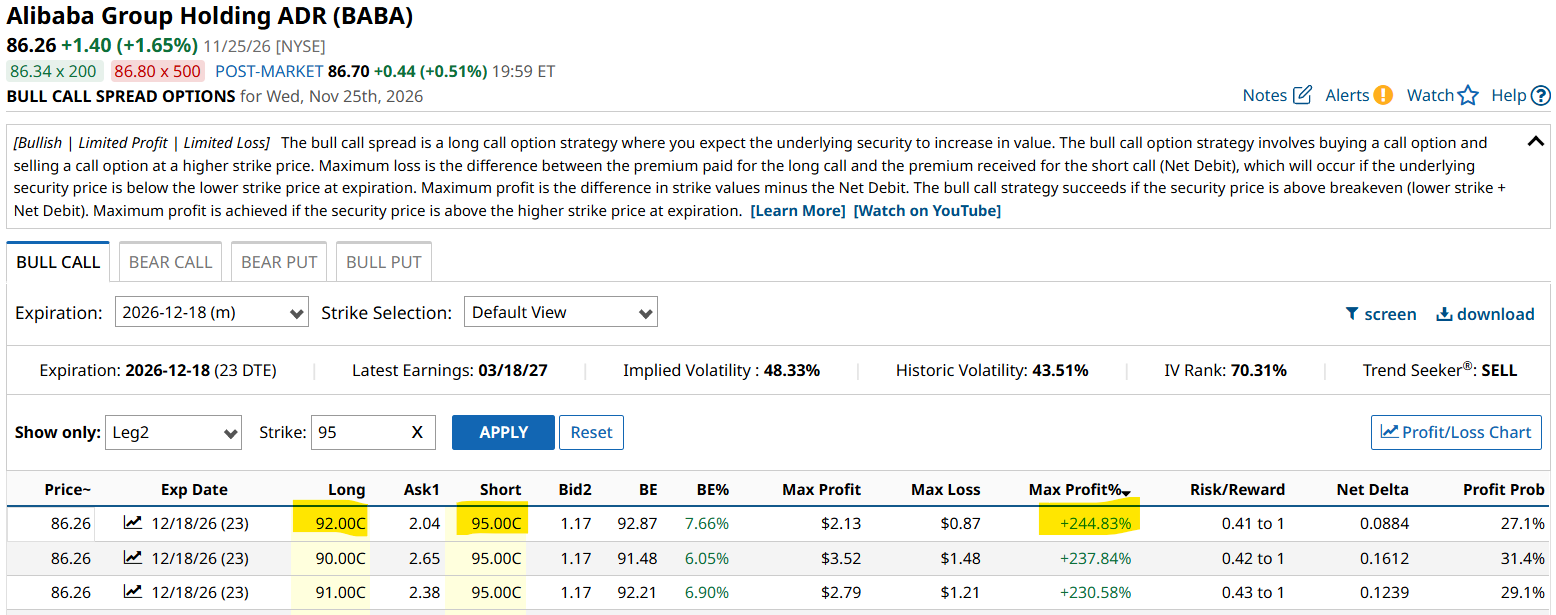
To that end, options traders may be incentivized to consider the 92/95 bull call spread expiring Dec. 18.
EV Settles the Debate on Alibaba Stock
It might seem counterintuitive to have more confidence in the 40% trade than in the 67% trade but this is a result of individual frameworks. If you’re just placing a single wager, you’re likely better off focusing on higher probability. But if you’re a frequent trader? Your focus should be on EV.
Let’s consider the key states for the above 92/95 bull spread:
- Net debit (wager) of $87.
- Maximum payout (American-style odds) of 244.83%.
- Win probability between 26.7% and 40%.
Admittedly, when you plug these figures with the lowest win probability, the EV slips to $6.90 below zero or a return on capital (ROC) of -7.93%. That’s not great. However, at the highest win rate, the EV jumps to $33, commanding an ROC of 37.93%.
Now, consider the 88/90 bull spread. At a win rate of 66.7%, along with a wager of $109 and a payout of $83.49, the EV comes out to $24.40 or an ROC of 22.38%. As I stated earlier, if you’re just placing a single bet, this lower second-leg strike is arguably the more favorable one. Unfortunately, the risk is that the probability definitely must be as good as advertised or better.
If, for example, the actual probability slips to $55, the EV falls dramatically to a buck. That would mean an ROC of just under 1% — not exactly the most efficient use of capital.
In other words, if you’re placing frequent wagers, it’s mathematically superior to focus on low cost, outsized reward potential and decent-enough probability. Yes, you’ll likely lose more frequently but your profits should overcome your losses — assuming that you practice careful risk management.
Bottom line? Alibaba stock at $90 is highly risky but there may be a legitimate case for near-term optimism.
On the date of publication, Josh Enomoto did not directly have a position in any of the securities mentioned in this article. All information and data in this article is solely for informational purposes. For more information please view the Barchart Disclosure Policy here.