


EN
Wall Street Is Suffering a $2 Trillion Huangover. Is It Time to Buy Nvidia Stock?
Wall Street's artificial intelligence (AI) hangover was supposed to end with the return of Jensen Huang as CEO of Nvidia (NVDA), the world's leading AI chipmaker. Instead, investors are discovering that the problems confronting the technology sector run deeper than the fate of one executive.
The relief rally that followed Huang's reinstatement evaporated within two trading sessions, with S&P 500 ($SPX) futures retreating more than 3% from their post-announcement peak — equivalent to roughly $2 trillion in stock market wealth.
Yet the underlying business of Nvidia continues to grow at a remarkable pace. For investors who missed the AI chipmaker's earlier gains, the selloff presents another opportunity to reassess NVDA stock. Whether it's a buying opportunity is another matter.
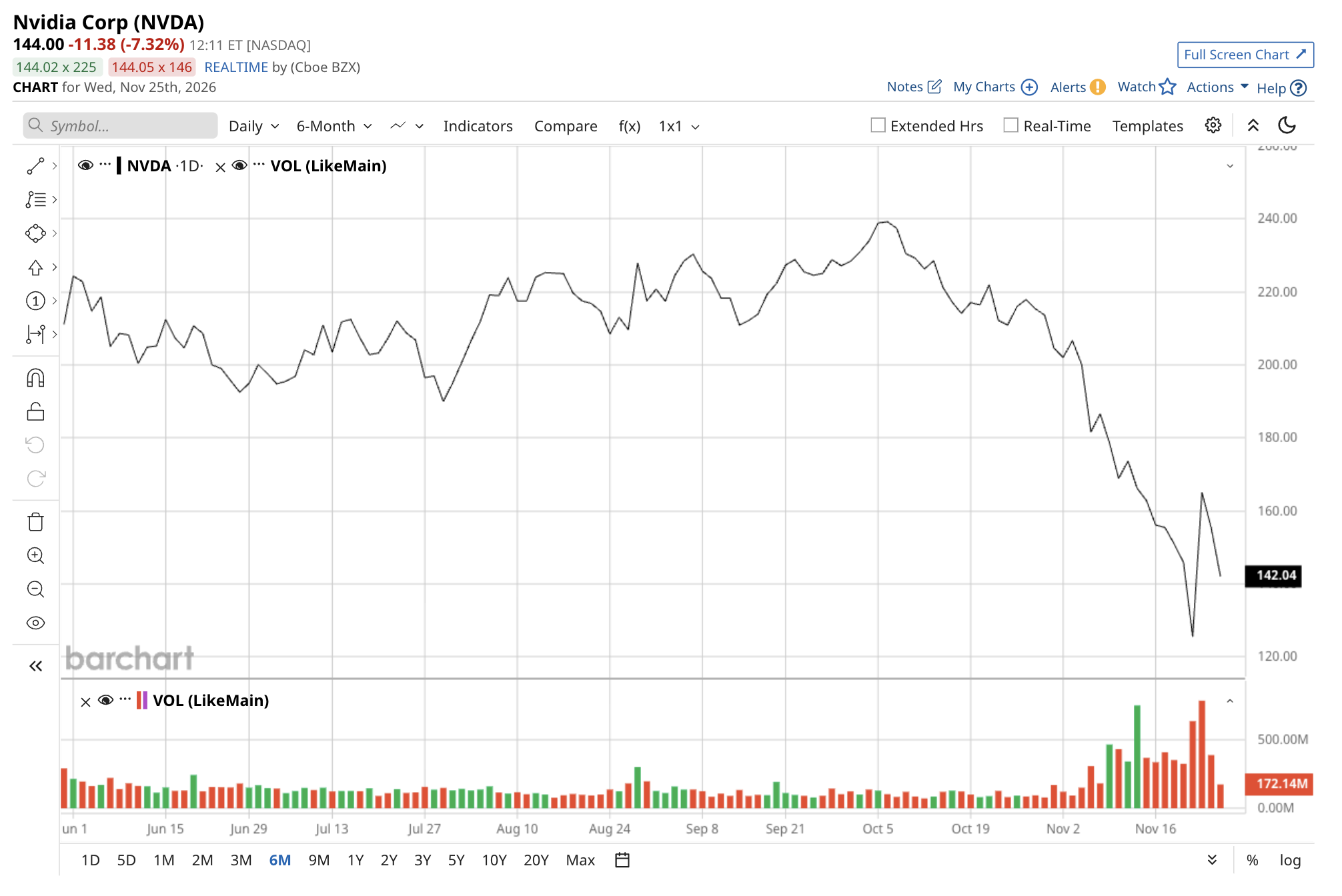
The ‘Huangover’ Is Bigger Than Huang
Nvidia stock jumped more than 31% on Nov. 23 following Jensen Huang's return as CEO, helping the S&P 500 gain 4.7% and the Nasdaq Composite ($NASX) advance 6.5%.
But reinstating the man who built Nvidia into a multitrillion-dollar business didn't resolve the investigations surrounding his departure. President Donald Trump's subsequent comments about a potential pardon and government ownership introduced additional uncertainty.
More importantly, Huang's return does nothing to improve the economics of building AI data centers.
On Nov. 25, the U.S. Bureau of Economic Analysis reported that inflation — measured by the Federal Reserve's preferred Personal Consumption Expenditures (PCE) price index — accelerated to 3.8% in October. Higher interest rates could increase financing costs for the companies purchasing Nvidia's chips.
Nvidia doesn't necessarily need to lose market share for its stock to suffer. Its customers merely need to slow the pace of their spending.
Nvidia Stock Is Cheaper for a Reason
The disconnect between Nvidia's financial performance and its stock price is striking. According to its third-quarter fiscal 2027 earnings report, Nvidia generated $115.8 billion in revenue during the quarter, up 103% year-over-year (YOY). Adjusted earnings also more than doubled to $2.68 per share. The data-center business accounted for roughly 93% of quarterly revenue.
Nvidia's Vera Rubin product cycle provides another avenue for growth as customers upgrade their AI infrastructure. Management forecast Q4 revenue of $130 billion, without factoring in data-center computing sales to China.
Yet there is a potential warning buried in that outlook. Nvidia expects adjusted gross margins of 71% to 72% in Q4, down sequentially from 74.9% in Q3.
At Nvidia's projected quarterly revenue, each percentage point of gross margin represents $1.3 billion in gross profit. Higher production costs, changing product mix, or increased competition could erode earnings growth even as sales expand.
Investors need to consider how much of Nvidia's profitability is sustainable rather than simply extrapolating its recent success.
Finding Nvidia's Buying Opportunity
Nvidia stock closed at $149.30 on Nov. 25, approximately 39% below its October peak of $243.37.
Annualizing its latest quarterly adjusted earnings of $2.68 puts Nvidia at about 14 times earnings. While that isn't a forward earnings forecast, it provides a useful starting point for evaluating NVDA stock.
Consider three hypothetical scenarios:
| Annual EPS | P/E ratio at $150 per share |
$12 |
12.5 times |
$10 |
15 times |
$8 |
18.8 times |
Even with annual earnings declining to $8 per share from the latest quarter's annualized EPS of $10.72, Nvidia wouldn't necessarily look outrageously expensive.
Interestingly, New York University finance professor Aswath Damodaran recently identified $140 per share as his potential entry point, incorporating a 30% discount to his estimated fair value. Nvidia fell to an intraday low of roughly $141 per share on Wednesday, Nov. 25, the day before the Thanksgiving holiday. On Friday, Nov. 27, the market will close early and likely see lighter than normal trading activity.
Investors don't need to share Damodaran's assumptions to appreciate his approach. Establish what a business is worth, then demand a discount that compensates for the possibility of being wrong.
The Bottom Line
Nvidia's November selloff has created its most interesting investment opportunity in months, but I'm not convinced investors need to rush in. The chipmaker remains dependent on customers sustaining unprecedented infrastructure spending while navigating rising financing costs and regulatory uncertainty.
For investors with limited Nvidia exposure, establishing a small position around $140 and reserving cash for subsequent purchases could make sense. Existing shareholders should watch gross margins and customer spending commitments before adding to their holdings.
The “Huangover” will eventually pass. Smart investors should make sure the price they're paying doesn't leave them with another headache.
On the date of publication, Rich Duprey did not directly have a position in any of the securities mentioned in this article. All information and data in this article is solely for informational purposes. For more information please view the Barchart Disclosure Policy here.