


EN
IonQ Has Delivered 6 Consecutive Record Quarters. The Bull Case Is Getting Stronger
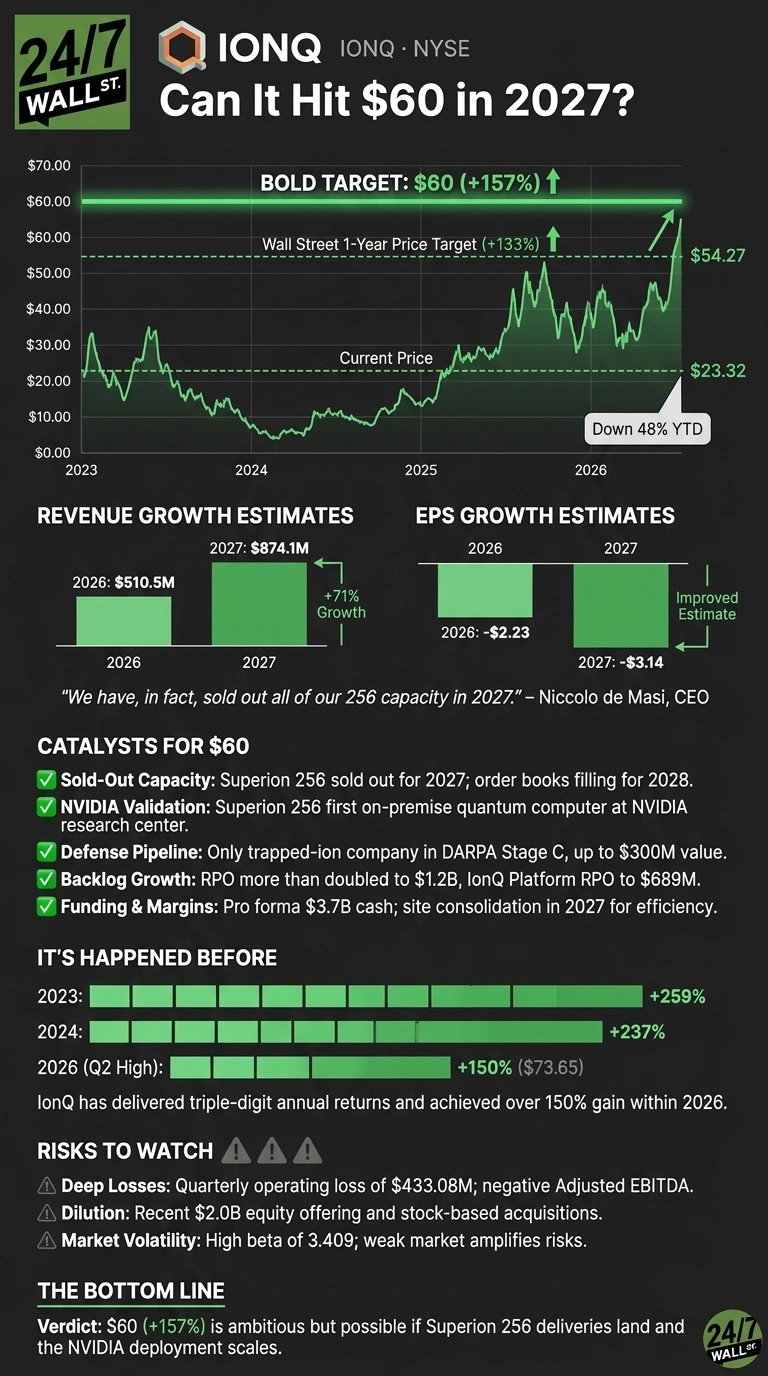
IonQ (NYSE:IONQ) just delivered its sixth consecutive quarter of record results, yet shares sit at $23.32, down 48.03% year to date. Investors have focused on a $2 billion equity offering and a $433.08 million quarterly operating loss. Meanwhile, the business keeps expanding.
Third-quarter revenue reached $173.83 million, up 336% year over year, and CEO Niccolo de Masi told analysts, “We have, in fact, sold out all of our 256 capacity in 2027.” Let’s look at what IonQ needs to do to hit $60 per share in 2027.
Wall Street Already Sees 133% Upside in IonQAnalysts’ average 1-year target is $54.27, meaning roughly 133% upside. Coverage includes one Strong Buy, 11 Buy and two Hold ratings, with zero Sells.
Growth drives that optimism. Consensus revenue rises from $510.47 million in 2026 to $874.13 million in 2027, a 71% jump. Management raised 2026 guidance to $505 million to $515 million, up from $450 million to $460 million. The 2027 EPS estimate of -$3.1421 improved from -$3.3983 30 days ago.
IonQ has also exceeded revenue estimates in each of the past six quarters; its latest report showed $173.83 million, ahead of the $141.20 million consensus. That run suggests 2027 forecasts could prove conservative.
Can IonQ Really Hit $60? Let’s Do the MathWith losses still deep, price-to-sales is the right yardstick. At today’s price, IonQ trades at about 12x 2027 revenue estimates. At $60, that multiple rises to roughly 32x. That’s a premium, but shares closed May at $72.07 when the revenue base was far smaller.
 24/7 Wall St. What Could Push IonQ to $60?
- Sold-out capacity: Superion 256 is sold out for 2027, and de Masi said, “we are beginning to fill the order books into 2028 pretty comfortably.”
- NVIDIA validation: NVIDIA (NASDAQ:NVDA) will install Superion 256 as the first on-premise quantum computer at its Accelerated Quantum Research Center. De Masi expects success there to open doors across NVIDIA’s other data centers.
- Defense pipeline: IonQ is the only trapped-ion company in DARPA Stage C, a program worth up to $300 million.
- Backlog: Remaining performance obligations more than doubled to $1.2 billion, with IonQ Platform RPO rising from $485 million to $689 million.
- Funding and margins: A pro forma $3.7 billion cash position funds growth, while site consolidation in 2027 targets operating efficiency.
A beta of 3.409 means a stronger Nasdaq would amplify gains, while a weak market makes $60 harder.
IonQ’s History Shows a 157% Gain Is Within ReachHitting $60 requires a 157% gain. IonQ has done it before. Shares rose 259% in 2023 and 237% in 2024.
This year, the stock rises 150% between the end of March and the end of May, reaching a 52-week high of $73.65. With a market cap now near $10.79 billion, moves that large require real execution, but volatility clearly runs in both directions.
$60 Is a Stretch, and Here’s Why It’s PossibleReaching $60 means IonQ must more than double in 2027. Wall Street already sees 133% upside, revenue is forecast to grow 71%, and IonQ keeps beating revenue estimates.
Dilution and a widening adjusted EBITDA loss of $133.61 million remain hurdles. If Superion 256 deliveries land on schedule and the NVIDIA deployment scales, sentiment could swing quickly. Gains of this size are rare, and we reverse-engineered what the biggest tech winners looked like early in a free Next Nvidia playbook that lays out the traits to look for.