


EN
Home builders stocks Q3 highlights: NVR

As the craze of earnings season draws to a close, here’s a look back at some of the most exciting (and some less so) results from Q3. Today, we are looking at home builders stocks, starting with NVR NYSE:NVR.
Traditionally, homebuilders have built competitive advantages with economies of scale that lead to advantaged purchasing and brand recognition among consumers. Aesthetic trends have always been important in the space, but more recently, energy efficiency and conservation are driving innovation. However, these companies are still at the whim of the macro, specifically interest rates that heavily impact new and existing home sales. In fact, homebuilders are one of the most cyclical subsectors within industrials.
The 9 home builders stocks we track reported a softer Q3. As a group, revenues missed analysts’ consensus estimates by 1.7%.
Thankfully, share prices of the companies have been resilient as they are up 6.3% on average since the latest earnings results.
Weakest Q3: NVR NYSE:NVR
Known for its unique land acquisition strategy, NVR (NYSE:NVR) is a respected homebuilder and mortgage company in the United States.
NVR reported revenues of $2.40 billion, down 7.9% year on year. This print fell short of analysts’ expectations by 6.4%. Overall, it was an underwhelming quarter for the company with a significant miss of analysts’ EPS estimates.
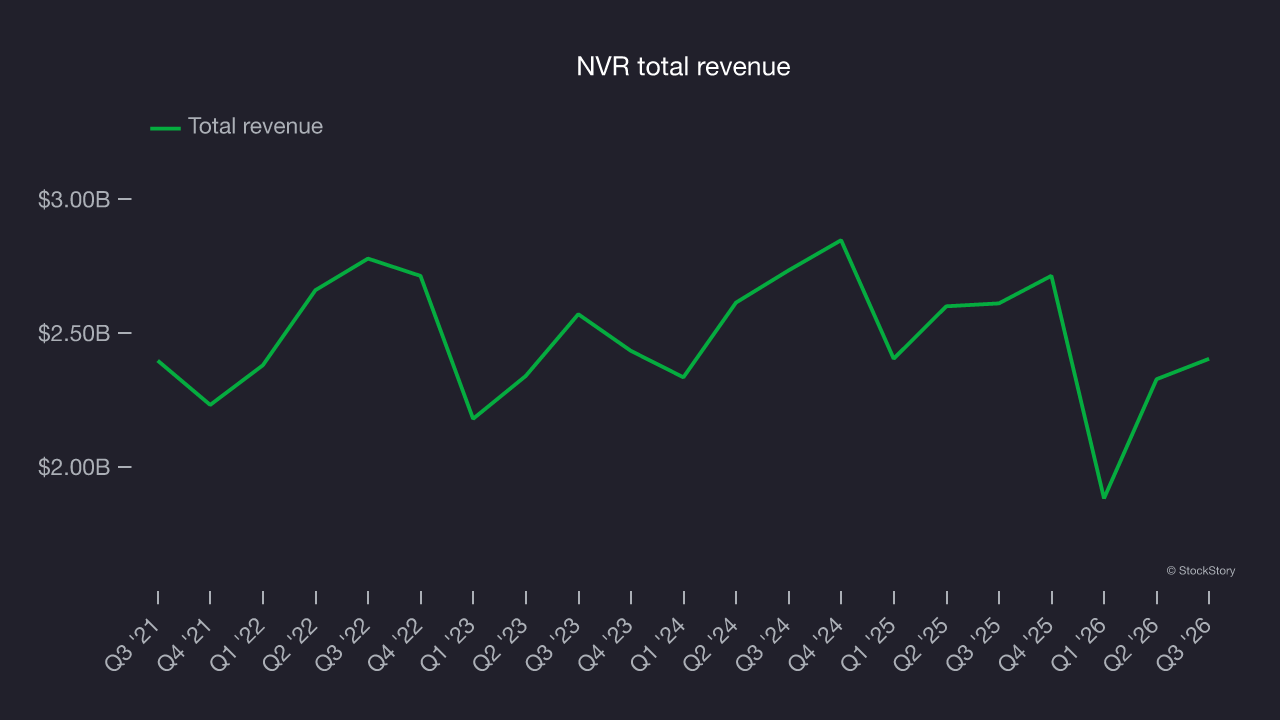
The market was likely pricing in the results, and the stock is flat since reporting. It currently trades at $5,865.
Read our full report on NVR here, it’s free.
Best Q3: LGI Homes (NASDAQ:LGIH)
Based in Texas, LGI Homes (NASDAQ:LGIH) is a homebuilding company specializing in constructing affordable, entry-level single-family homes in desirable communities across the United States.
LGI Homes reported revenues of $437.5 million, up 10.3% year on year, outperforming analysts’ expectations by 1%. The business had a very strong quarter with a beat of analysts’ EPS estimates.
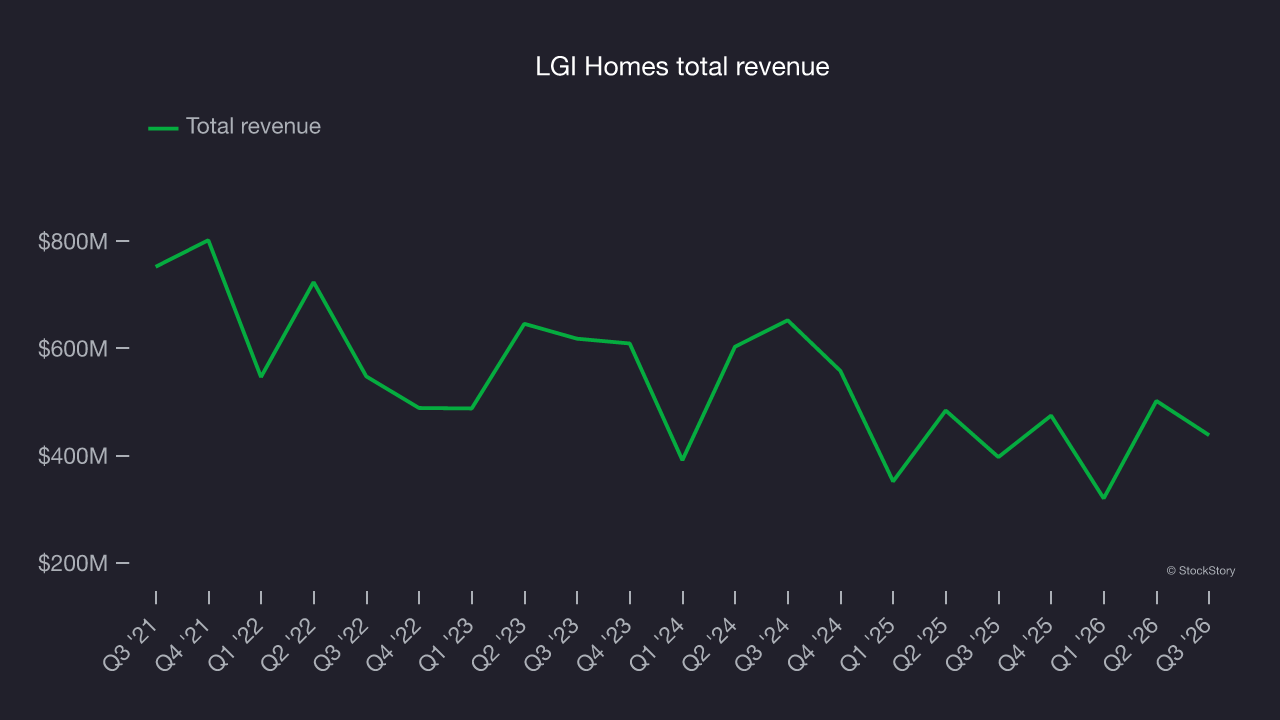
LGI Homes pulled off the fastest revenue growth among its peers. Although it had a fine quarter compared to its peers, the market seems unhappy with the results as the stock is down 8.2% since reporting. It currently trades at $43.53.
Is now the time to buy LGI Homes? Access our full analysis of the earnings results here, it’s free.
Lennar (NYSE:LEN)
One of the largest homebuilders in America, Lennar (NYSE:LEN) is known for constructing affordable, move-up, and retirement homes across a range of markets and communities.
Lennar reported revenues of $8.05 billion, down 8.7% year on year, falling short of analysts’ expectations by 3.2%. It was an underwhelming quarter as it posted a significant miss of analysts’ EPS estimates.
Interestingly, the stock is up 11% since the results and currently trades at $86.95.
Read our full analysis of Lennar’s results here.
KB Home (NYSE:KBH)
The first homebuilder to be listed on the NYSE, KB Home (NYSE:KBH) is a homebuilding company targeting the first-time home buyer and move-up buyer markets.
KB Home reported revenues of $1.30 billion, down 20% year on year. This number met analysts’ expectations. Zooming out, it was a mixed quarter as it also produced a beat of analysts’ EPS estimates but full-year revenue guidance missing analysts’ expectations.
KB Home scored the highest full-year guidance raise but had the slowest revenue growth in the group. The stock is up 2.9% since reporting and currently trades at $50.
Read our full, actionable report on KB Home here, it’s free.
PulteGroup (NYSE:PHM)
Having delivered over 850,000 homes since its founding in 1950, PulteGroup (NYSE:PHM) is one of America's largest homebuilders, constructing single-family homes, townhouses, and condominiums for first-time, move-up, and active adult buyers across 46 markets in 25 states.
PulteGroup reported revenues of $3.97 billion, down 9.8% year on year. This print came in 4.2% below analysts’ expectations. Overall, it was an underwhelming quarter as it also recorded a significant miss of analysts’ EPS estimates.
The stock is up 21% since reporting and currently trades at $136.61.
Read our full, actionable report on PulteGroup here, it’s free.
Market update
Over the past year, investors have been forced to repeatedly answer the same question: What is the market’s biggest risk? The answer has changed several times, and each shift has reshaped market leadership.
Late in 2025 and early 2026, artificial intelligence became the market’s primary uncertainty. Investors questioned whether AI would erode software pricing power and weaken competitive moats as AI made it easier to replicate once-differentiated products.
By the spring, technology took a back seat to geopolitics. The U.S. conflict with Iran briefly became the market’s dominant narrative, raising concerns about oil prices, inflation, and global growth. But as energy markets remained orderly and fears of a prolonged supply disruption faded, investors quickly turned their focus back to fundamentals.
Want to invest in winners with rock-solid fundamentals? Check out our 9 Best Market-Beating Stocks and add them to your watchlist. These companies are poised for growth regardless of the political or macroeconomic climate.