


EN
SpaceX (SPCX.US) reversed the market and closed higher! Musk promises to double the “Trump Account” stock giveaway, and children across the US will receive two shares
The Zhitong Finance App learned that as of the close of trading on November 25, EST, the rebound in technology stocks driven by Huang Renxun's reinstatement on Monday was once again under pressure, but in the end, it almost closed with a “deep V” curve rally driven by dips buying forces and quantitative strategy fund purchases such as CTA. The S&P 500 and Nasdaq Composite Index fell 3.2% and 4.6%, respectively, during the intraday period, and narrowed the decline to 0.25% and 0.62% at the end of the session. SpaceX (SPCX.US) pulled back from an intraday low of $112.93 to $127.44, bucking the trend and closing up 1.30%. Another Tesla (TSLA.US), also headed by Musk, surged 11.46% on Monday, fell slightly on Tuesday, and fell 1.18% to $380.14 on Wednesday.
Also on Wednesday, SpaceX, the “AI+ Space Exploration” leader founded and headed by Musk, an American supertech giant with a market capitalization of about 1.75 trillion US dollars, made a big announcement that it plans to donate a newly issued Class A common share to every currently active “Trump account”. Musk will allocate the same amount of personal holdings to raise his share giveaway promise last month from one share to two shares. At Wednesday's closing price, the two shares were worth $254.88. Some agencies estimate that there are about 72 million children across the US, which corresponds to a stock market value of about 18.4 billion US dollars. SpaceX President Gwen Shortwell also promised to donate more than 2 million shares.
The issuance of new shares by SpaceX will expand the total share capital, while Musk's allotment will transfer existing holdings to the grantees. The White House announced in October that it had created nearly 70 million Trump accounts. Using 70 million grantee accounts as a scenario, SpaceX would need to issue about 70 million new shares, which is equivalent to about 0.52% of the total number of Class A and B common shares issued on October 15. This ratio only calculates the additional distribution portion of the company. The actual amount of dilution depends on the number of active accounts that are finally allocated, and SpaceX has yet to announce this figure.
For the market, the immediate changes in this arrangement are the distribution of shares and the holding period. If implemented on a large scale, SpaceX will add a group of young beneficiaries who indirectly hold shares through tax-benefit accounts. For American households, the long-term value of the two shares fluctuates with SpaceX's stock price. Ultimately, it still depends on how much cash flow Starlink, space AI data centers, terrestrial AI computing power leasing, and the entire AI application business can generate.
Musk says children across the US will each receive two SpaceX shares, and the stock giveaway promise can be described as doubling
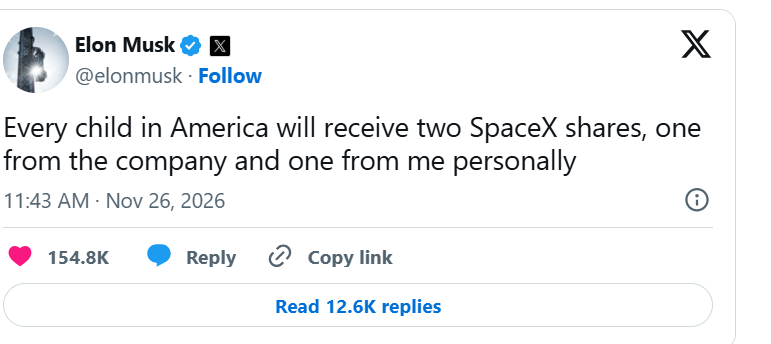
Elon Musk and SpaceX will give away two shares of the space exploration company to every child in the US. The richest man in the world made a stock giveaway promise last month, and now the number of stock giveaways has doubled.
SpaceX said in a statement Wednesday that the company will donate one newly issued Class A common share to every currently active Trump account. As part of a commitment to donate one SpaceX share to every child in the US, Musk will personally distribute donations in the same amount as the number of shares officially donated by SpaceX. In other words, SpaceX plans to give each currently active “Trump account” a newly issued Class A common share, with Musk allocating the same amount of personal shareholding.
According to US Census Bureau estimates, there are approximately 72 million children in the US. Based on current stock prices, this donation is worth approximately $18.4 billion.
SpaceX President Gwen Shortwell announced separately that she will donate more than 2 million SpaceX shares. The statement didn't say how those shares would be distributed.
According to the Bloomberg Billionaires Index, Musk is at the top of the list of the world's richest people with a net worth of around $820 billion. His SpaceX shares are worth around $650 billion and account for the vast majority of his wealth. The rest of the wealth comes from Tesla, The Boring Company, and Neuralink.
According to reports, the so-called “Trump account” is a tax-beneficial individual retirement account (IRA) established by the US for eligible minors. The system stems from the 2025 tax legislation and was officially launched in July 2026. The Ministry of Finance will automatically open accounts for eligible children from October 1. Account eligibility usually requires a valid Social Security number and being under 18 at the end of the year the account was opened. The federal government's one-time injection of $1,000 has additional eligibility requirements for eligible US citizen children born between 2025 and 2028.
Individual SpaceX shares can be accessed through a dedicated channel for eligible charitable donations. During the child's development, ordinary funds in the account are usually invested in eligible US stock index funds. Interim rules from the Treasury Department and the IRS allow eligible donors to distribute shares of approved listed companies to accounts through the Department of the Treasury. According to general rules, granted shares can be sold as early as five years after receipt of the shares or the end of the year in which the beneficiaries reach the age of 17, whichever is earlier. This also explains why large-scale stock giveaways can expand SpaceX's shareholding base, but they don't necessarily bring about instant circulation on the same scale.
Musk and Trump have recently had a public meeting over stock giveaways and Hwang In-hoon's reinstatement, but the political relationship between the two sides is still divided. According to US media reports, Musk invested more than 400 million US dollars to support Republican midterm election candidates who agree with Trump, but after the election, he publicly distanced himself from the MAGA label.
Trump still called him a friend on November 19. Regarding Hwang In-hoon's reinstatement, Musk previously compared Hwang In-hoon's departure to driving out Michael Jordan during the team's winning streak. After the reinstatement news was announced, he also claimed that “the error has been corrected.” Other media attributed intervention in board decisions to Trump and Vice President Vance. According to reports, the two believe that Hwang In-hoon will help maintain America's Open Weight Models (Open-weight Models) ecosystem.
At a time when stock giveaway promises are doubling, Musk's ambition for bagewatts has welcomed significant support! SpaceX obtains first US license for space orbital AI computing power cluster
As of the close of trading on November 25, EST, the S&P 500 and Nasdaq Composite Index both closed down after breaking out of intraday lows, while SpaceX (SPCX.US) rebounded from an intraday low of $112.93 to $127.44, reversing the market and up 1.30%. On the same day, the US Federal Communications Commission (FCC) authorized the deployment of a data center constellation in space for the first time. StarMind, which is to be built by SpaceX, can deploy up to 1 million orbital computing power satellites. SpaceX also announced that it plans to give away a newly issued Class A common share to each currently active “Trump account”, with Musk allocating the same amount of personal shareholding.
2027 is the first batch of orbital verification windows targeted by SpaceX, and 2040 is the deployment period for all constellations set by the FCC. According to the license terms, SpaceX must put the first satellite into orbit and operate by November 25, 2033, reaching 100,000 and 500,000 satellites in the same period of 2035 and 2038, respectively. The authorized constellation will be deployed and operated by November 25, 2040, and the license will expire if the node is not reached. Satellites that intend to operate at more than 600 km must also submit an application for a revised license containing a final debris mitigation plan prior to deployment. However, Amazon Leo questions the progress of the deployment of one million units, and the astronomical community is concerned about satellite reflection interference observations.
If SpaceX reaches the minimum threshold of 500,000 units by 2038, it will need to add an average of about 250,000 units and put into operation for the next two years. Compared to SpaceX's current approximately 11,000 orbiting Starlink satellites, this requirement means that manufacturing, launch, and in-orbit operation and maintenance must exceed orders of magnitude.
As for the ambition of the space AI data center, what Musk wants to solve is the power supply bottleneck of expanding computing power. Even if a GPU is purchased for a terrestrial project, it may have to wait for power generation, transformation, and grid access before the device can be turned into marketable computing power. A part of the sun-synchronous orbit close to the morning and sunset line allows the solar array to obtain nearly continuous sunlight, enable the computing power unit to generate electricity in orbit, and reduce dependence on terrestrial power grids and energy storage.
SpaceX's unique advantage is that it can use Starships to carry out launches, use Starlink's laser communication and ground stations to return data, and then use xAI's model and computing power business to absorb capacity. Musk predicted in Davos that space could become the lowest-cost AI computing power deployment site within two to three years. SpaceX also gave the physical scale of this ambition in its prospectus: if 100 gigawatts of orbital computing power were to be added every year, based on a payload of about 100 kilowatts per ton, it would be necessary to transport about 1 million tons of equipment to orbit every year.
Solar energy solutions determine how much of this batch of electricity can be converted into effective computing power for power supply, heat dissipation, and interconnection. The StarMind design announced by SpaceX has an average computational load of about 175 kilowatts and a peak of about 250 kilowatts. There is no air convection in the vacuum, and the heat generated by the chip is transferred to the heat sink through the cooling circuit and then discharged with infrared radiation. The increased quality of cooling panels, solar wings, and radiation protection will all be reflected in the orbital cost per kilowatt of computing power. The interplanetary laser link determines how large the load can be disassembled. Local screening of satellite images, uploading only alarms and results, or batch inference that can be executed independently is more suitable for first verification.
Frontier models for cross-star training require frequent synchronization of gradients and exchange of intermediate results, and the requirements for bandwidth, delay, and link stability are higher. Google Project Suncatcher has achieved 800 Gb/s in each direction of a single pair of optical transceivers on a bench, but its research estimates that to get close to the performance of large-scale training clusters on the ground, the interstellar link still needs to reach tens of Tb/s.
SpaceX's recent AI revenue depends on ground-based computer rooms, and the valuation of orbital computing power depends on cost verification. Its super-smart division's third-quarter revenue reached $7.6 billion, and terrestrial computing power customers include Anthropic and Google. The company also plans to invest more than $74 billion to build supercomputing parks in Texas and Arizona, and has reached a financial lease commitment of approximately $40 billion for Nvidia Vera Rubin equipment for ground deployment. According to the Financial Times, the lender sought to limit the entry of collateral chips because it was difficult to withdraw and sell after default, and it is still unclear whether the relevant provisions were included in the final document.
BCG estimates that under current conditions, the 20-year total cost of ownership of an orbital data center per megawatt is about 2.5 to 3 times that of a terrestrial solution. Therefore, the most traceable data for the first batch of satellites in 2027 is the cost per kilowatt of orbiting, the computing power that can be continuously used in orbit, and the lifetime of the chip. These three factors determine whether the electricity savings from solar energy can cover the costs of transmission, cooling, and hardware replacement when delivering the same quality of inference services.