


EN
Accelerating commercialization of AI agents+taking over the demand for enterprise-level reasoning! Strong demand supports growth fundamentals, and Dell (DELL.US) is viewed by analysts as high as $711
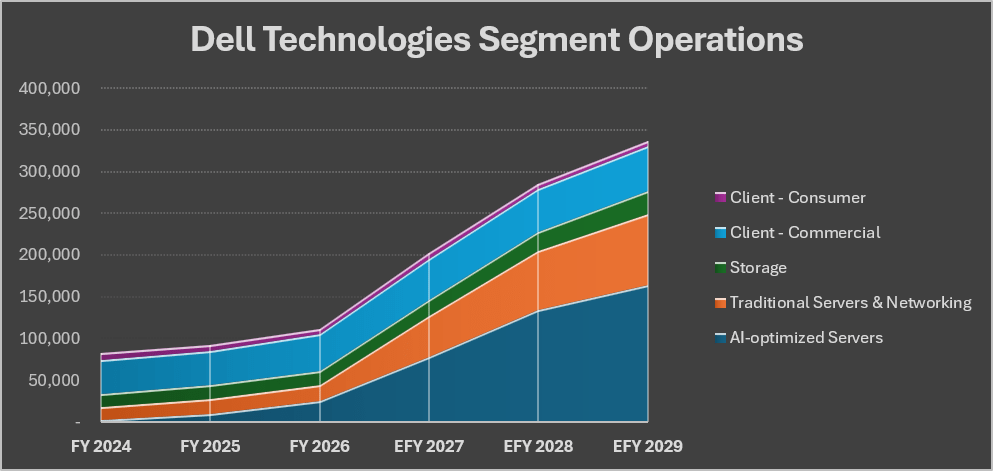
The Zhitong Finance App learned that Dell Technology (DELL.US) delivered strong results for the third quarter of the 2027 fiscal year, driven by the continued explosion in demand for artificial intelligence (AI) servers and the accelerated upgrading of traditional data center infrastructure. Michael Del Monte, a senior analyst at Seeking Alpha, believes that Dell is expected to achieve a three-digit percentage increase in Infrastructure Solutions Group (ISG) revenue by the end of the 2027 fiscal year, and this growth will be supported by continued strong demand for traditional servers and AI-optimized servers. As enterprises begin to deploy AI agents and gradually implement large-scale inference applications, Dell is expected to maintain steady growth in the next few years with the joint support of emerging cloud service providers (neoclouds) and enterprise customers. While infrastructure demand will be strong, Client Solutions Group (CSG) may be under pressure due to rising costs of components and memory chips, as well as corporate customers allocating more of their budgets to servers rather than end devices.
Given that demand is expected to remain stable over the next few years, analysts raised Dell's rating to “Strong Buy (Strong Buy),” with a target price of $711 per share, corresponding to the 2028 corporate value/adjusted EBITDA (eV/AEBITDA) ratio of 11.65 times. This target price has room for an increase of about 139% from the stock's closing price of $297.06 on Wednesday.
Strong Q3 results
Dell recorded record revenue and earnings per share for the third quarter of fiscal year 2027. Revenue for the quarter reached $54.937 billion, up 103% year on year and 17% month on month; adjusted earnings per share were $9.45, up 265% year over year. Among them, AI server business revenue increased 291% year over year, and the volume of undelivered orders climbed to US$132.3 billion. Meanwhile, the company raised its full-year revenue guidance by $10 billion to $2020 billion, and announced an additional $25 billion share repurchase authorization.
Dell received orders for AI servers worth 60 billion US dollars. By the end of the third quarter of fiscal year 2027, the total backlog of orders had increased to more than US$132 billion, an increase of 39% over the previous month. For AI servers alone, Dell reported an order to shipment ratio (book-to-bill ratio) of 2.73 times, indicating that market demand far exceeds the company's ability to supply AI infrastructure to the market.
Dell will now review each AI customer's ability to obtain funding, credit quality, and access to land and power resources, and confirm that the customer complies with export restrictions. Based on this, analysts believe that these protections stem from growing market concerns over the high debt problems of emerging cloud service providers. For example, CoreWeave's debt size has increased to $47 billion, and the net debt/adjusted EBITDA leverage ratio has reached 7 times, raising market concerns about whether the GPU's economic benefits can support its debt repayment.
Given the risk of default, Dell is prudent in taking this approach. Despite CoreWeave's worrying debt situation, analysts don't expect the company to default because its backlog of orders has grown to $104.2 billion and GPU rental prices are rising, helping to support higher-margin revenue. As rental prices rise, the payback period for short-term leasing businesses can be as short as 6 months, while the payback period for long-term contracts is about 1 year. By the end of the third quarter of fiscal year 2026, CoreWeave's total active computing power capacity reached 1.7 gigawatts, and the total contracted computing power capacity reached 4.6 gigawatts, supporting the rapid growth of its computing power capacity.
Enterprise customers will be growth catalysts
Enterprise adoption of intelligent AI is accelerating, but the deployment of multi-agent systems is still in the early stages. KPMG (KPMG) indicated in its 2026 third quarter update report that 62% of organizations are currently piloting, deploying or expanding the application scale of AI agents, up from 53% in the previous quarter. The share of organizations developing or deploying multi-agent systems rose to 25% in the third quarter of 2026, compared to just 6% in the first half of 2026.
As these projects appear to be still in the early stages of development, analysts expect broader enterprise-wide applications to gradually take shape over the next few years and lay the foundation for large-scale infrastructure construction.
The widespread application of intelligent AI will provide strong support for Dell's traditional server business and Dell's own intellectual property (IP) storage business. The analysts' logic is that complex inference applications require more computing power and storage resources connected to different data repositories. Increased usage of AI inference applications will also require systems to be connected to larger storage capacity to support larger data sets and storage requirements for output data.
In the third quarter of fiscal year 2027, traditional server sales increased 235% year-on-year to reach US$15 billion. This was mainly due to corporate customer needs, server upgrades, and technological transformation to meet the deployment of AI inference applications.
One factor that may drive the continued growth in demand for traditional servers is the emerging risk brought about by AI-related security breaches. As AI applications can identify and exploit system vulnerabilities more quickly and with greater intensity, AI cyber attacks are becoming an increasingly common threat. As cybersecurity threats continue to increase, businesses may speed up the decommissioning and renewal of old servers to reduce risk.
Cybersecurity risks and AI inference applications may also drive enterprise client computing devices into the renewal cycle. Compared with the same period last year, Dell's commercial client computing business increased 6% in the third quarter of fiscal year 2027, but the consumer business declined 15%. The main drag on the consumer-grade business is rising memory chip and component prices, which are causing price-sensitive consumers to delay their purchase plans.
Financial Status and Forecasts
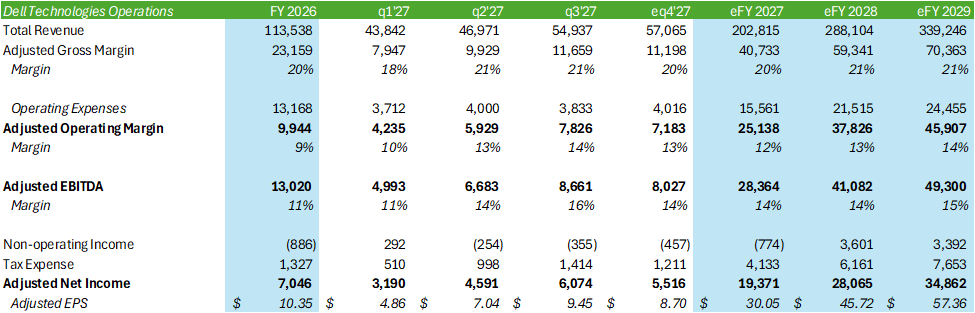
Analysts expect Dell to achieve total revenue of US$2030 billion in fiscal year 2027, with adjusted earnings per share of US$30.05.
For the fourth quarter of fiscal year 2027, analysts expect ISG's profit margin to fall from a high of close to 17% in the third quarter of fiscal year 2027, but it will still expand by 100 basis points year over year. This will be the result of a balance between AI-optimized servers and traditional server sales structures, reflecting that AI-optimized servers with lower profit margins account for a higher share of the product portfolio than traditional servers. Analysts also expect that CSG's revenue will increase by 1% year over year, and that commercial customer business will provide support, but continued contraction in the consumer-grade business will offset some of the growth.
For the 2028 fiscal year, analysts expect ISG to continue to perform strongly, and both AI-optimized servers and traditional server business growth will be the driving force.
Assuming that the growth of Dell's AI server business will be close to the 75% revenue growth rate of Nvidia's (NVDA) AI server business in the 2028 fiscal year, analysts expect Dell AI optimized server revenue to increase by about 72%.
As of the end of the third quarter of fiscal year 2027, Dell held $16 billion in cash and cash equivalents on its balance sheet, with debt of $38 billion, and a net leverage ratio (net debt/adjusted EBITDA) of 0.87 times. Dell's leverage level improved compared to the previous quarter due to increased profitability.
Overall, Dell's financial position is strong, its balance sheet is solid, and its operating business continues to grow. As the demands of emerging cloud service providers and enterprise customers drive the growth of AI servers and traditional server businesses, Dell is expected to achieve steady revenue growth in the next few years.
Scenario analysis
Optimistic scenario
The popularity of AI inference applications and agents will support Dell's long-term investment logic and drive strong growth in demand for traditional server upgrades and AI optimized servers. Given that AI applications are still in the early stages of popularity, analysts expect Dell's revenue to reach a compound annual growth rate (CAGR) of 44% before FY2029, based on FY2026. As demand expands further, Dell and other infrastructure vendors may gain room for price increases in the future to support the profit margins of the AI server business.
pessimistic scenario
The prices of components and memory chips have been rising, and may not return to normal until at least 2028. If Dell is unable to pass on the cost increase to customers, its profit margins will be squeezed. Rising component prices may present significant resistance to the Dell client computing market, particularly among more price-sensitive customer groups.
As the debt scale of emerging cloud service providers continues to expand and potential credit risk rises, the market is increasingly concerned about whether these companies can convert their contracted electricity capacity into actual computing power capacity. If emerging cloud service providers slow down data center construction, Dell's growth may fall short of expectations as a result.
Valuation and shareholder returns

Dell's stock price has continued to be under pressure in recent weeks, falling 49% from the October 2026 high. Analysts believe that this round of sell-off is mainly related to the overall AI investment theme, rather than the company's own operational risks. Considering the risk management mechanism adopted by the company when confirming the backlog of AI optimization server orders, analysts do not believe that Dell faces a significant negative impact from credit risk in the emerging cloud service provider market. Although the market may continue to sell off, given the long-term growth trajectory of Dell and the emerging cloud service provider industry, analysts believe that the further weakening of the stock price does not reflect the company's fundamentals.
In the third quarter of fiscal year 2027, Dell repurchased 9 million shares at an average price of 488 US dollars per share, at a cost of about 4.4 billion US dollars. There was still about 5.4 billion US dollars left in the previous repurchase authorization amount. In the third quarter of fiscal year 2027, Dell management increased the share repurchase authorization amount by $25 billion. This may be the result of strong cash flow brought about by the server upgrade cycle and AI-optimized server sales, as well as recent market pullbacks. Dell remains committed to returning at least 80% of the adjusted free cash flow to shareholders through share repurchases and dividends.
In view of the company's strong operating fundamentals and impressive shareholder returns, analysts upgraded Dell's stock rating to a “strong buy” with a target price of $711 per share, corresponding to the 2028 corporate value/adjusted EBITDA (eV/AEBITDA) ratio of 11.65 times.
