


EN
Missed Out On FedEx's Run? Here's The Bet Holders Made
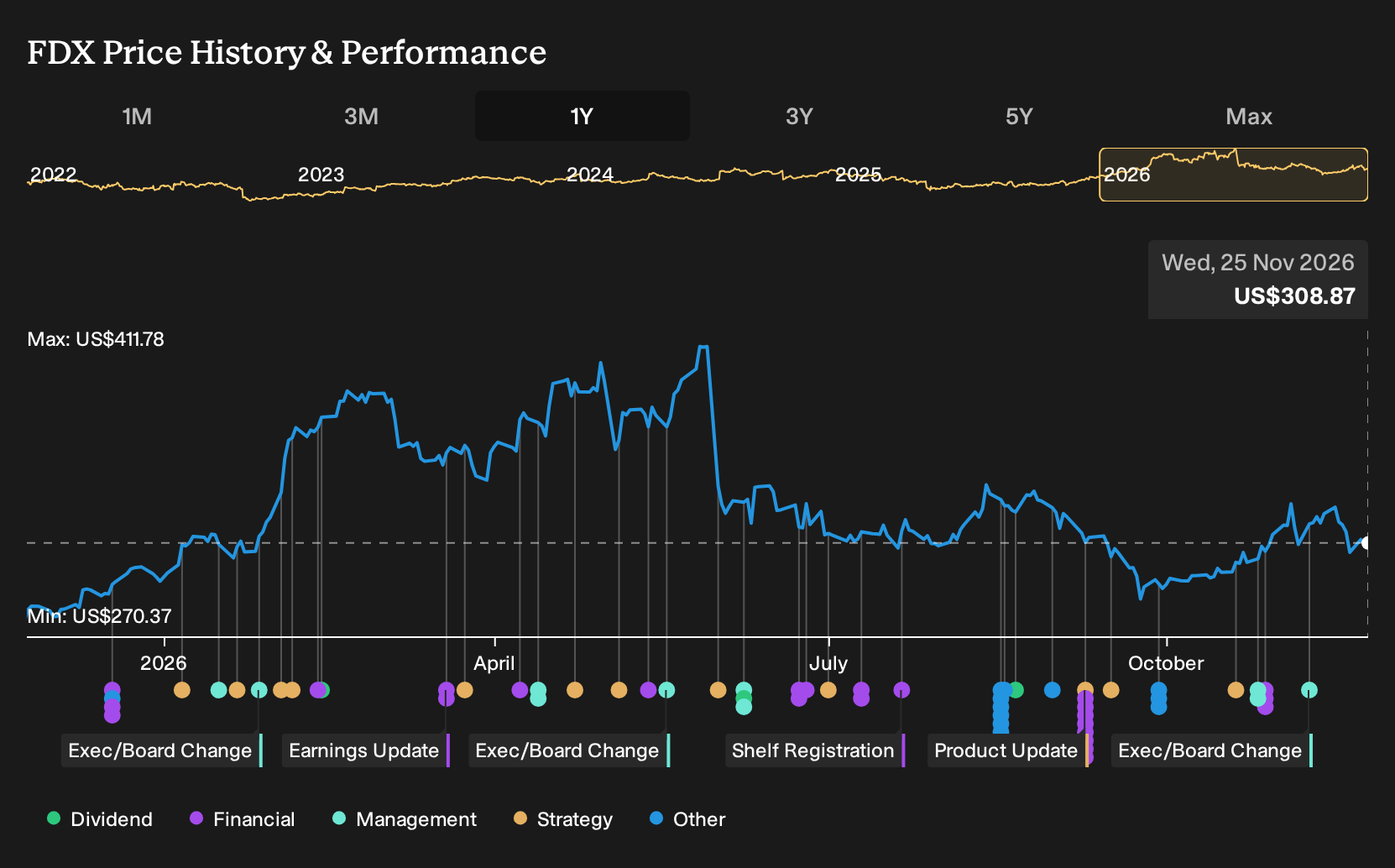
If FedEx was only on your watchlist rather than in your account, the past year may feel like a painful what if. Investors who held FedEx over the past year are up 41.4%, including dividends. That outcome sits between bulls who leaned into e-commerce and urban logistics, and bears who worried digitalization and higher costs would squeeze parcel volumes. If you rewind to late 2025, what would you have needed to believe about DRIVE and Network 2.0 to spot that risk reward skew?
FedEx has already moved. See which of 36 high quality undervalued stocks still trade below our estimates.
The Two FedEx Stories Investors Were Arguing About
FedEx shares cost US$274 at the start of the period, and investors were effectively choosing between two very different stories about where DRIVE and Network 2.0 might lead.
The bullish narrative put Fair Value at US$320, a price implied by assumptions that DRIVE could structurally lower the cost base and that healthcare logistics and global e-commerce would support stronger margin expansion.
The bearish view set Fair Value at US$200, built on concerns that digitalization would gradually reduce parcel volumes and that rising labor and environmental costs would keep pressuring profitability.
What The FedEx Evidence Actually Tested
FedEx’s Network 2.0 and DRIVE ambitions met real-world data when Q3 and Q4 2026 results showed revenue around US$25b and more than US$1b in cost savings tied to optimization. That outcome supported the bullish cost narrative, while cautious guidance, insider selling and the Amazon Supply Chain launch raised questions about whether e-commerce and urban logistics would translate cleanly into higher future earnings. Overall, the period had mixed implications.
The useful takeaway is straightforward. When a logistics thesis hinges on efficiency and mix, it can be helpful to track reported cost savings, segment margins and any comments on competitive pressure, rather than focusing solely on headline revenue or the FedEx share price.
What FedEx’s Price Now Asks You To Believe
FedEx changes hands at US$309 today, after a 41.4% gain over the past year from US$274. The analyst consensus Narrative on Simply Wall St places its Fair Value above that level, based on a view that cost discipline and tech driven efficiency still matter more than the freight spin story.
This Narrative leans on DRIVE, Network 2.0 and AI tools, turning FedEx’s data and automation push into stronger margins and free cash flow. The key question for anyone paying US$309 is whether FedEx can keep translating that technology and cost program into sustained improvements in operating efficiency.
"FedEx's DRIVE and Network 2.0 programs continue to reshape the cost base, with billions of dollars already removed and a further US$2b of Network 2.0 savings targeted by the end of 2027, which could support higher net margins and earnings."
That disagreement has a full argument behind it. → Uncover the higher Fair Value this Narrative argues for
Find Your Own Contrarian Opportunity
By the time a rally makes headlines, you are reading about returns someone else has already earned. Why not go straight to the source and look for your own contrarian opportunity? These three companies trade below our estimated value.
- Company 1 - 36% below our estimate - runs AI-focused cloud infrastructure unifying subscription and usage-based workloads on one platform.
- Company 2 - 45% below our estimate - secures integrated subsea contracts that bundle equipment and services for faster brownfield tiebacks.
- Company 3 - 32% below our estimate - manages AI-driven airfreight and customs workflows that challenge traditional forwarding and brokerage systems.
Three companies from the same screener. Open every one of the 23 solid balance sheet companies →
Have feedback on this article? Concerned about the content? Get in touch with us directly. Alternatively, email editorial-team@simplywallst.com