


EN
Lower Revenue Outlook Could Be A Game Changer For Intuit (INTU)
- Intuit reported higher first quarter revenue of US$4,354 million and net income of US$695 million year on year, reaffirmed profit guidance while cutting fiscal 2027 revenue expectations due to softer Credit Karma trends, and raised its quarterly dividend by 15% to US$1.38 per share after agreeing to sell Mailchimp for about US$3.68 billion.
- The shift toward AI powered tools, weaker Credit Karma performance, and the planned Mailchimp divestiture together show Intuit reallocating capital and product focus toward its core tax, small business, and personal finance ecosystem while still committing cash to dividends and share repurchases.
- We will now see how Intuit's trimmed revenue outlook tied to Credit Karma reshapes the investment narrative around cash flow resilience.
Intuit Investment Narrative Recap
To own Intuit today, you need to believe its tax, small business and personal finance platforms can keep converting a large installed base into resilient cash flow, even as AI reshapes how customers work. According to Ivoed, an investor in the Simply Wall St Community, the key question is whether AI becomes a monetisation engine rather than a pure pricing threat.
Recent news leaves that debate finely balanced. Management cut fiscal 2027 revenue guidance tied to Credit Karma and flagged a softer TurboTax season, yet reaffirmed profit targets and reported higher Q1 earnings. In the short term, the main catalyst is execution on AI powered products. The biggest risk is AI compressing pricing power faster than new features support engagement.
The 15% dividend increase to US$1.38 per share is the announcement that really matters here. It signals that Intuit’s board sees current free cash flow as strong enough to support a higher regular payout while Credit Karma slows and Mailchimp is prepared for sale, which directly connects to Ivoed’s focus on cash flow resilience.
For you as a shareholder, that higher dividend interacts with other moving parts. Management is simultaneously guiding to trimmed revenue, maintaining earnings targets and planning Mailchimp sale proceeds for buybacks, all while pushing deeper AI into QuickBooks, TurboTax and ProTax workflows. That mix keeps execution on AI monetisation and Credit Karma stabilisation firmly in the spotlight.
Ivoed values Intuit at US$390.00 a share, based on a model that applies 15.2% annual revenue growth and a future profit margin of 21.9%, and then discounts that cash flow profile while still applying a haircut for AI execution and disruption risk.
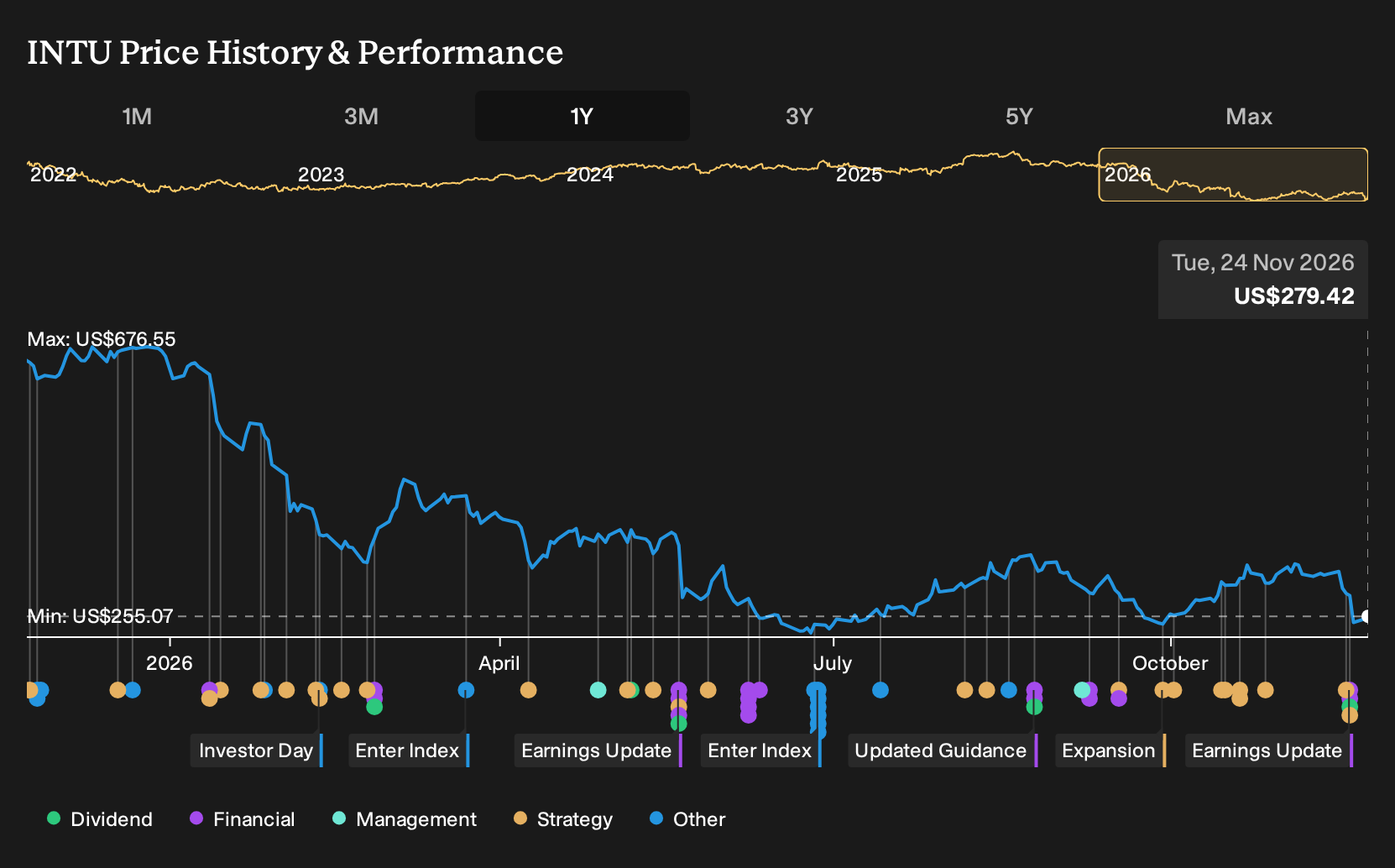
Uncover why Intuit's fair value indicates a 40% potential upside to its current price, which could narrow quickly.
Exploring Other Perspectives
One alternate read on Intuit leans heavily on AI cost risk rather than cash flow resilience. The most pessimistic analysts were only pencilling in about 5.4% annual revenue growth and earnings of roughly US$6.1b by 2029 before this dividend hike and refreshed guidance. That more cautious script could shift, and you are invited to compare both stories side by side.
Explore 15 other Intuit fair value estimates, including one that suggests it could be worth just $361.05!
The Verdict Is Yours
Don't just follow the ticker; dig into the data and build a conviction that's truly your own.
- A great starting point for your Intuit research is our analysis highlighting 5 key rewards that could impact your investment decision.
- See our latest analysis for Intuit. The report includes a comprehensive fundamental analysis summarized in a single visual, the Snowflake, making it easy to evaluate Intuit's overall financial health at a glance.
Looking for more investment ideas beyond Intuit?
Once you have a view on Intuit, it helps to line that thesis up against a wider watchlist so you can judge risk, income and value across a broader set of businesses.
- If capital preservation is high on your list, start with sturdier balance sheets and use our 31 resilient stocks with low risk scores as a filter for resilience first, returns second.
- For investors who care most about quality at a sensible entry price, scan the 37 high quality undervalued stocks to see which companies combine fundamentals with room in the valuation.
- If you want to go off the beaten path and hunt for underfollowed opportunities, our 19 high quality undiscovered gems can surface stocks that rarely make headlines but still show strong underlying numbers.
Have feedback on this article? Concerned about the content? Get in touch with us directly. Alternatively, email editorial-team@simplywallst.com