


EN
Nvidia Is Facing a Potential Criminal Case in California. NVDA Investors Should Brace for Another Drawdown.
Jensen Huang is back as CEO of Nvidia (NVDA). Nvidia investors and the market in general reacted positively to news of the return of the artificial intelligence (AI) industry leader, who has been endorsed by none other than President Donald Trump himself. Yet, the legal troubles are far from over for the most famous leather jacket-clad executive in the world right now, specifically in Nvidia's home state of California.
The Attorney General for the state of California recently revealed that Nvidia may be facing charges over possible violations of U.S. chip export rules. Announcing an investigation into the company, California Attorney General Rob Bonta said, “The basic legal framework that we’re looking at is the prohibitions in California law — both civil and criminal — against misleading investors and the public. And there are multiple different laws that provide prohibitions in that space.” Bonta noted that Nvidia could face financial penalties if found guilty, depending on “what was done, what the facts show, who knew what when, what the intent and state of mind was, and what the conduct was.”
Nvidia Faces a Wave of Concerns
As the excitement around Huang's return eventually dies down, investors should realize that the legal overhang around NVDA stock will continue to linger for a while. The company both directly and indirectly faces a number of investigations and inquiries involving federal agencies, national security matters, and congressional oversight.
Last week, the U.S. Department of Commerce and the U.S. Department of Justice confirmed an investigation into Megaspeed that began in 2024 after authorities identified suspicious activity involving potential semiconductor diversion. In June 2025, Nvidia placed Megaspeed on its “no sell” list, but that reportedly did not stop the company from acquiring Nvidia chips after the fact.
Meanwhile, the U.S. Securities and Exchange Commission (SEC) is reportedly investigating Nvidia's accounting amid concerns involving financing arrangements with AI customers and whether those arrangements could obscure revenue quality and financial exposure.
Reportedly, the DOJ is also reviewing Nvidia's acquisitions, sales practices, customer pressure, and the possible tying of AI chips to networking equipment. Reporting on the matter has also referenced Nvidia's Hugging Face deal and Groq technology agreement.
Finally, Congressional scrutiny is inevitable for Jensen Huang, who has agreed to appear before numerous House committees on Dec. 1. Notably, the political situation could also become considerably more difficult for Nvidia once Democrats take control of Congress in January.
Persisting Legal Issues Do Not Dull the Bull Case
Remove all these legal tangles from Nvidia's fundamentals, however, and the financials appear as healthy as ever.
Nvidia delivered another clean double beat and guidance that topped expectations in the third quarter of fiscal 2027. CFO Colette Kress also increased the company’s revenue growth outlook for fiscal 2028 to 75% from the prior 70%.
Revenue totaled $115.8 billion in Q3, marking a 103% increase from the year-ago period and exceeding consensus estimates. Data-center revenue advanced 110% year-over-year (YOY) to $107.6 billion, supported by a $20 billion contribution from the newest Vera Rubin rack-scale system, which management described as the fastest product ramp in the company’s history.
One key development during the quarter was Nvidia’s decision to halt licensed Hopper GPU sales to China. Q4 revenue guidance of $130 billion, plus or minus 3%, excluded any China Hopper contribution. During Q3, the company recorded $2.4 billion in Hopper sales to China.
Gross margin came in better than expected at 74.9% compared with 73.5% a year ago. Meanwhile, net income more than doubled YOY to $64.9 billion while EPS rose to $2.68 from $1.27 in the prior year and beat the consensus estimate of $2.47.
On the earnings call, Kress outlined stricter limits on vendor financing. Guarantees will now be linked to measurable project progress, completion of required data-center infrastructure, and actual purchases and deployment of Nvidia equipment. The change reflects a measured approach from Kress — who has since returned to serving solely as CFO after a brief stint as interim CEO — particularly given the uncertain pace of data-center construction in the years ahead amid shifting political conditions.
Cash generation followed the same robust pattern. Net cash from operating activities increased to $48.3 billion in Q3 from $23.8 billion a year earlier. Nvidia ended the period with $29.1 billion in cash and no short-term debt on its balance sheet.
From a valuation perspective, NVDA stock looks reasonably priced. For example, Nvidia's forward price-to-earnings (P/E) multiple of 13 times sits below the sector median of 18.8 times.
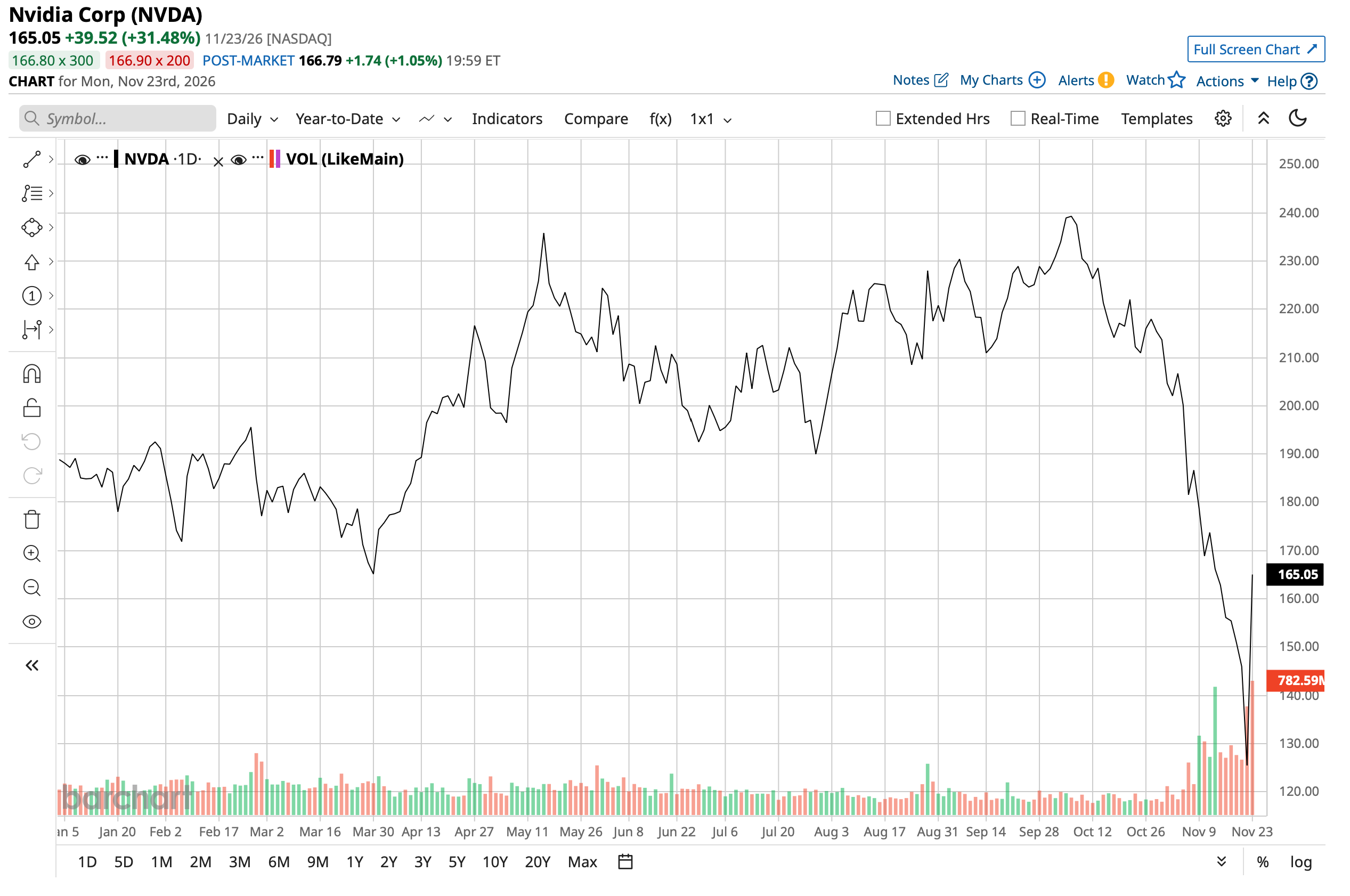
NVDA stock is down 17% on a year-to-date (YTD) basis. Shares have also fallen 26% over the past month amid Huang's scandal and a broader AI selloff.
What Do Analysts Think of Nvidia Stock?
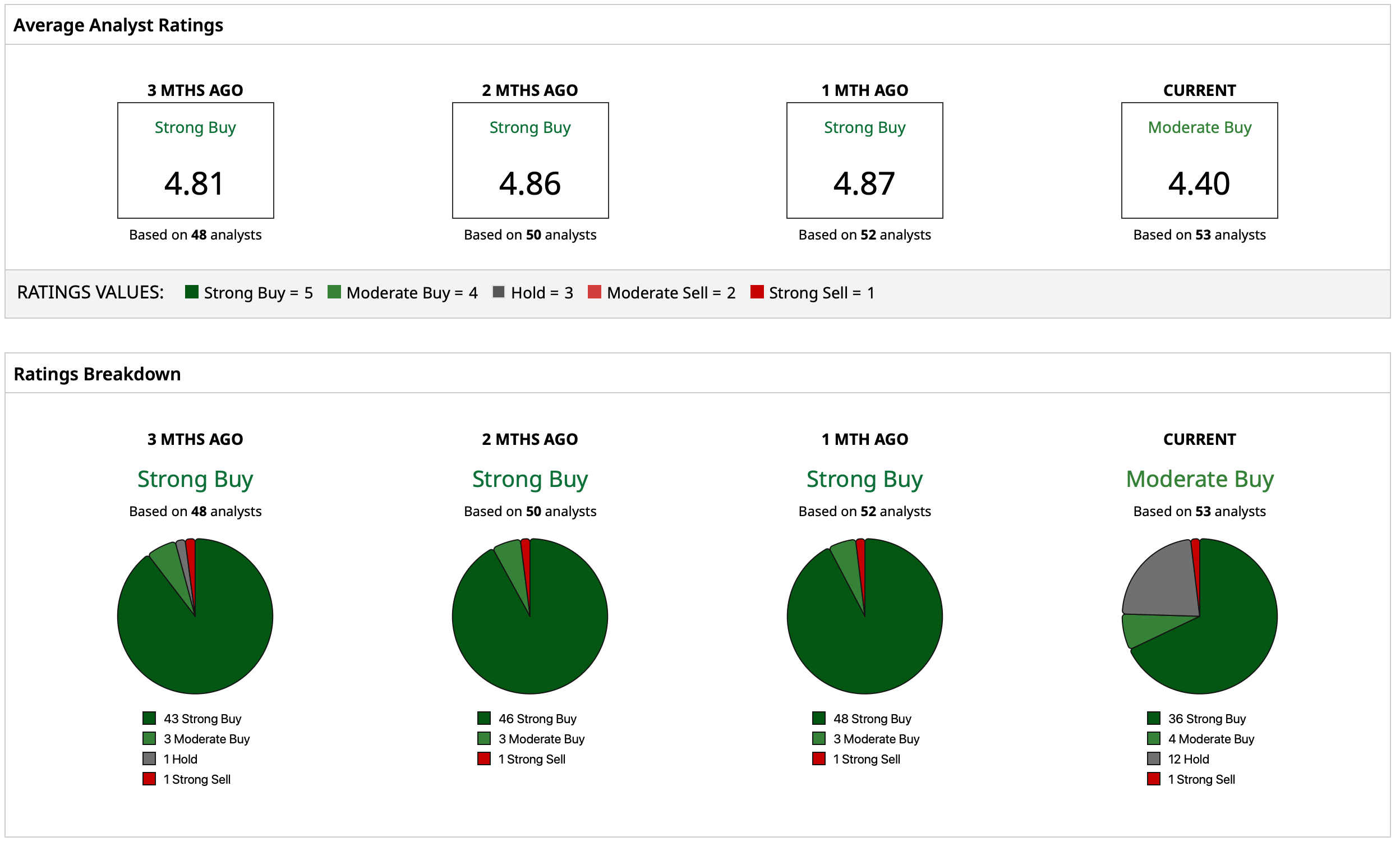
Overall, Wall Street analysts give NVDA stock a consensus “Strong Buy” rating. Out of 53 analysts covering the stock, 40 have a “Strong Buy” rating, four have a “Moderate Buy” rating, eight have a “Hold” rating, and one analyst has a “Strong Sell” rating. The mean target price of $243.21 indicates potential upside of 57% from current levels.
On the date of publication, Pathikrit Bose had a position in: NVDA . All information and data in this article is solely for informational purposes. For more information please view the Barchart Disclosure Policy here.