


EN
Is the market starting to trade “the supercycle peaked”? The target price of the Big Three storage companies was greatly exploited: Micron cut the target price, Goldman Sachs slashed SK Hynix and Samsung
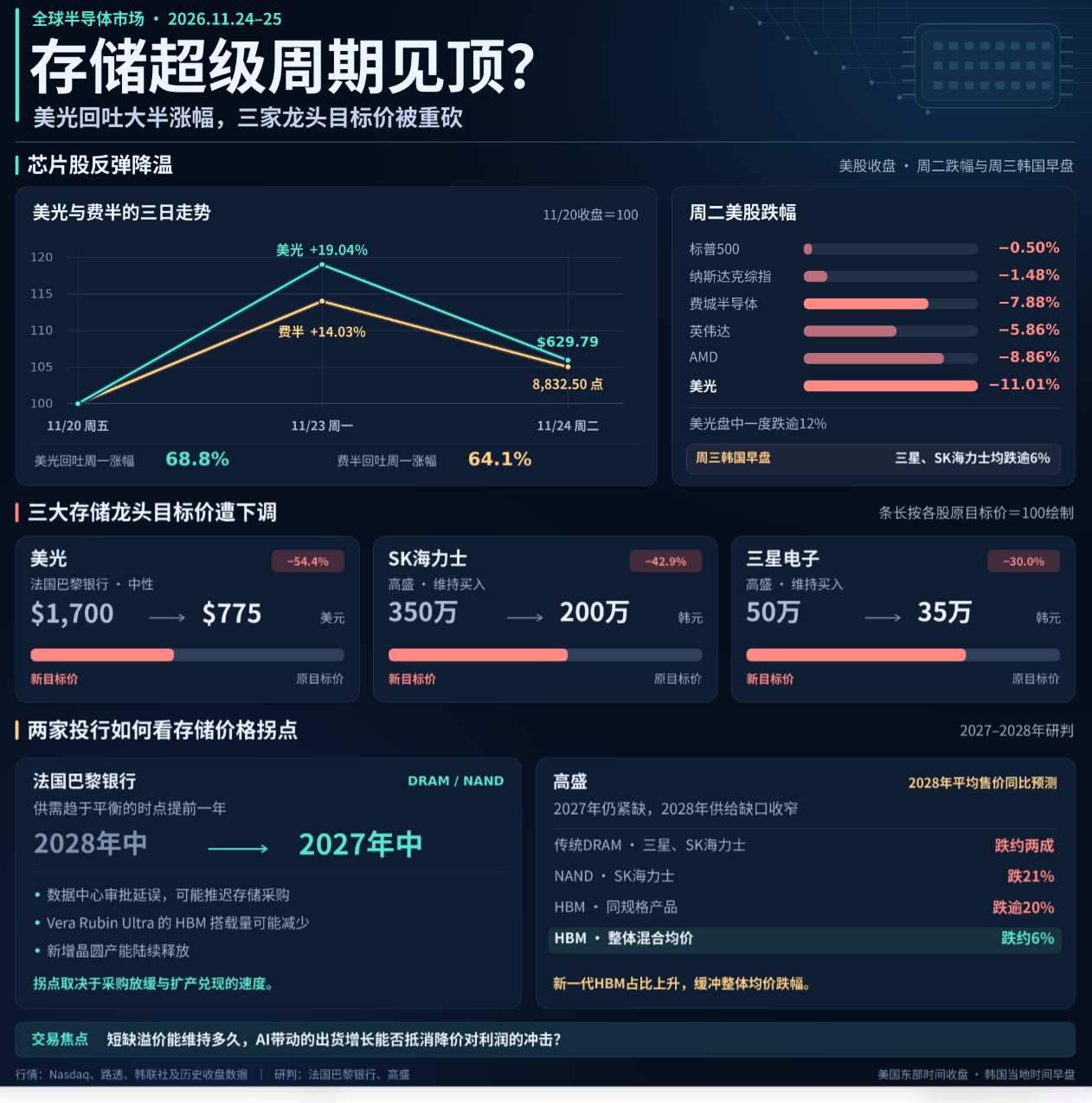
The Zhitong Finance App learned that by the end of the US stock market on November 24, EST, the rapid upward trend in AI computing power and semiconductor boards caused by Huang Renxun's return to Nvidia can be described as rapidly cooling down. The S&P 500 fell 0.50%, the Nasdaq Composite Index fell 1.48%, and the Philadelphia Semiconductor Index plummeted 7.88% to 8,832.50 points in a single day, taking back nearly two-thirds of Monday's counterattack points. Nvidia and AMD declined 5.86% and 8.86%, respectively. American memory chip leader Micron Technology (MU.US), which surged 19.04% on Monday, once fell more than 12% intraday on Tuesday, and eventually fell 11.01% to $629.79. A senior analyst from BNP Paribas on Tuesday described Micron's price target as “falling short” — the target price dropped from $1,700 to $775, while downgrading the Micron rating from “outperforming the market” to “neutral.”
As BNP Paribas (BNP Paribas, hereinafter referred to as “France and Pakistan”) drastically cut Micron's target price and stock ratings, and Wall Street financial giant Goldman Sachs drastically lowered storage prices in 2028 and drastically lowered the target stock price expectations for the next 12 months of the world's two largest supermemory chip giants — SK Hynix and Samsung Electronics — it can be said that the market is becoming more cautious about the “memory chip supercycle” that has taken the stock market by storm in recent years. Even some investors are convinced that this round of unprecedented memory chip industry bullish trajectory and storage trajectory. The “supercycle” itself It has peaked.
Carl Ackman, a senior analyst at BNP Paribas, who accurately predicted the cloud computing frenzy in 2018 and the bullish market for memory chips in 2025, downgraded Micron's rating from “outperforming the market” to “neutral”. The target price dropped from $1,700 to $775, a surprising drop of 54.4%. Based on the closing price of the US stock market on Tuesday, the target price implied an overall reduction in upward space from 169.9% to only 23.1%.
The sales pressure surrounding memory chips spread to the Asian market on Wednesday. South Korea's KOSPI Composite Index, where SK Hynix and Samsung account for 50% of the market capitalization weight, plummeted by 3.94% at the opening of the market and fell 4.61% at 9:12 local time. Afterwards, the intraday decline widened to more than 5%. Samsung Electronics and SK Hynix both fell more than 6% in early trading. The Korea Exchange triggered a sell sidecar mechanism (Sell Sidecar) when KOSPI 200 futures fell 5.12%, suspended programmatic sell orders for five minutes, and continued trading in the spot market.
Data center expansion faced delays and pressure on stand-alone memory usage. France and Pakistan downgraded Micron's rating
France and Pakistan brought the DRAM and NAND supply and demand close to balance from mid-2028 to mid-2027. After the Democratic Party won the midterm elections, major delays in the construction process and licensing of large-scale AI data centers in the US may push back server installation and storage procurement, but additional wafer production capacity may be released one after another in excess of expectations, further driving the balance between supply and demand for memory chips and even broader AI infrastructure hardware. Meanwhile, Faba determined that Vera Rubin Ultra's HBM configuration may be reduced.
For memory chip manufacturers around the world, HBM demand depends on the number of accelerators actually delivered and the capacity of a single accelerator. Even if GPU shipments continue to increase, the decline in the usage of individual GPUs will weaken the growth rate of HBM's total demand. Coupled with weakening PC and mobile phone shipments, France and Pakistan expect the average selling price (ASP) to be under pressure earlier. Micron's profit forecast for 2028 is already about 45% lower than the market's consensus forecast.
Overall, BNP Paribas downgraded the Micron rating to “neutral” and cut the target price from $1,700 to $775. It believes that delays in data center approval, the HBM load capacity of Vera Rubin Ultra may be reduced, and the release of additional wafer production capacity may advance the balance between DRAM and NAND supply and demand to mid-2027.
Franco-Palestinian analyst Carl Ackman wrote in Tuesday's report: “Micron's stock price has indeed fallen 42% from its peak in June. However, the risks faced by hyperscale cloud vendors in their 2028 expansion plans are increasing, further threatening the fundamentals of supply and demand. At the same time, Vera Rubin Ultra's HBM capacity is declining, PC and mobile phone shipments will decline in 2026 and 2027, and additional wafer production capacity is being put into operation one after another.”
He added: “We believe the downside risk of oversupply is rising. Delays in data center approval pose an increasing risk to new capacity in 2028. The storage capacity of AI servers, PCs, and mobile phones has been reduced, and storage vendors are also expanding production at an accelerated pace. We anticipate that supply and demand for DRAM and NAND may balance starting in mid-2027, leading to a decline in average selling prices, earlier than we had anticipated in mid-2028.”
France and Pakistan currently anticipate that DRAM memory and storage costs associated with NAND technology will peak at 40% in 2027, and may drop sharply to 27% by 2030 due to the balance between supply and demand.
The target price of Korea's storage duo has been lowered! Goldman Sachs lowered storage prices in 2028. Whether the stock price rebound in the AI computing power industry chain can continue depends on the credit market and order trajectory
Goldman Sachs, on the other hand, expects that there will still be a shortage in 2027, and the price pressure will only increase significantly in 2028. At that time, the price of traditional DRAM, NAND, and HBM with the same specifications may drop by about 20%, but an increase in the share of new products can limit the overall average price drop of HBM to about 6%. Goldman Sachs maintained SK Hynix and Samsung's “buy” ratings, while drastically reducing target prices to 2 million won and 350,000 won, respectively. The target prices of the three leading companies were lowered ahead of the spot price, reflecting that the market has begun to recalculate how long the shortage premium can last, and whether the increase in shipments brought about by AI can offset the impact of price cuts on profits.
Judging from verifiable public records, this is the first time that Goldman Sachs simultaneously lowered the target prices of Samsung Electronics and SK Hynix during this round of drastic adjustments in AI computing power and semiconductors in November. Morgan Stanley was the first to cut the target price of two shares on November 9. Goldman Sachs, on the other hand, lowered Samsung's target price from 500,000 to 350,000 won and lowered SK Hynix from 3.5 million to 2 million won in a major memory chip research report released this week, all maintaining a “buy” rating.
Goldman Sachs expects to remain in short supply in 2027, and bargaining rights will begin to loosen in 2028. The bank expects that from 2027 to 2028, the traditional DRAM supply gap will shrink from 5.1% to 1.2%, and NAND from 2.2% to 0.3%. Corresponding to the 2028 sales price, the average price of Samsung and SK Hynix traditional DRAM is expected to drop by 20% and 19%, respectively, and SK Hynix NAND by 21%.
Goldman Sachs's forecast for HBM to fall by more than 20% indicates products with the same specifications. As the share of high-priced new products such as HBM4E and HBM5 increases, the average mixed price of the entire HBM market is expected to drop by only about 6%. Demand for capacity will still increase by 25%, and the market size can increase from 200 billion to 237 billion US dollars. This is where storage stocks are most likely to be misinterpreted: AI server usage can continue to grow, but shortage premiums for similar products will fall as supply catches up.
The Goldman Sachs analyst team believes that in 2028, the storage market is expected to move from an extreme shortage in 2027 to a rebalance between supply and demand. At that time, Samsung Electronics' traditional DRAM market price may drop 20%, SK Hynix NAND prices are expected to drop 21%, and the price of HBM products with the same specifications is expected to drop 20% year-on-year in the context of a high base.
Goldman Sachs maintained the “buy” ratings of the two South Korean storage giants, but lowered profit expectations for 2028. Samsung Electronics reduced its target price from 500,000 to 350,000 won, and SK Hynix dropped from 3.5 million to 2 million won. Using the closing price of Korean stocks on November 24 as the same benchmark, Samsung's potential increase fell from 164.0% to 84.8%, and SK Hynix fell from 202.2% to 72.7%. Goldman Sachs maintained the purchase on the basis that its stress tests showed that the stock price at the time was close to the valuation under the “zero increase in AI capital expenditure in 2028, and the average storage price fell another 40% from the benchmark” scenario. Furthermore, with regard to another memory chip giant Micron's current drop from 1,700 US dollars to 775 US dollars from France and Pakistan, Goldman Sachs can verify that the target price of Micron in early November is 1,250 US dollars, and the rating is still “neutral.”
The crazy one-day rise in the US stock market on Monday mainly reflects capital recovery power. The credit market and orders can better test how far this round of global AI computing power and global technology stock rebound dominated by semiconductor market capitalization weights can go. Richy Privorodsky, head of the Goldman Sachs trading desk, believes that credit market recovery was lagging behind when the stock market surged on Monday, and the trend was more like bears concentrating on making up. The person who proposed “the current market may replicate the 2018 market script” was Frank Flett, head of macro strategy at Castle Securities. He is concerned about the strengthening of the US dollar, the relative weakening of cyclical stocks, and the simultaneous occurrence of monetary contraction.
BTIG's chief technical strategist Jonathan Klinsky traced back to 12 precedents where the NASDAQ 100 index fell by at least 5% in a single day and rose at least 5% the next day. Of these, 11 closed lower on the third trading day, with an average drop of 5.4%, and a maximum retracement of about 16% over the next 30 trading days. For AI computing power topics, especially stock pricing related to memory chips, the continued rise requires that data center deliveries be fulfilled on schedule, long-term contract prices remain stable, credit spreads narrow, and project financing costs improve simultaneously.
Klinsky from BTIG went back to all the historical data of the NASDAQ since its establishment in 1985, and found 12 precedents where it plummeted 5% in a single day and then immediately rebounded 5% or more the next day. The conclusion is clear and alarming. He emphasized that the huge rebound triggered by Hwang In-hoon's return to Nvidia is a window to reduce positions, not a sign of chasing more. “Our statistics show that investors should use the strong market over the next day or two to lower their positions rather than chase risk exposure to the broader market, especially in the technology and AI sectors.”