


EN
Boss Energy (ASX:BOE) Shares Look Stretched Even After A 69% Fall
Boss Energy has seen its share price under pressure over recent years, which puts fresh attention on what investors are really paying for in terms of the company’s sales today. With the stock now closing at A$1.35, the key issue is how that market value lines up with the revenue the business is generating.
- Over the past 3 years the Boss Energy share price has fallen 69.5%. This puts the focus squarely on whether the current valuation can still be explained by its sales base.
- The business model and cost structure matter more than ever now, because revenue quality and the timing of cash inflows can influence how much investors are prepared to pay for each dollar of Boss Energy’s sales.
- There is a second opinion on Boss Energy worth weighing. See what analysts think Boss Energy's shares could be worth.
The stock’s next move may depend on whether Boss Energy’s current share price is well supported by the level and profile of its sales.
If you are weighing Boss Energy against other options that also focus on revenue power, a focused stock screen built around 3 high quality undervalued stocks can be a useful next step.
Does Boss Energy Look Pricey on Sales?
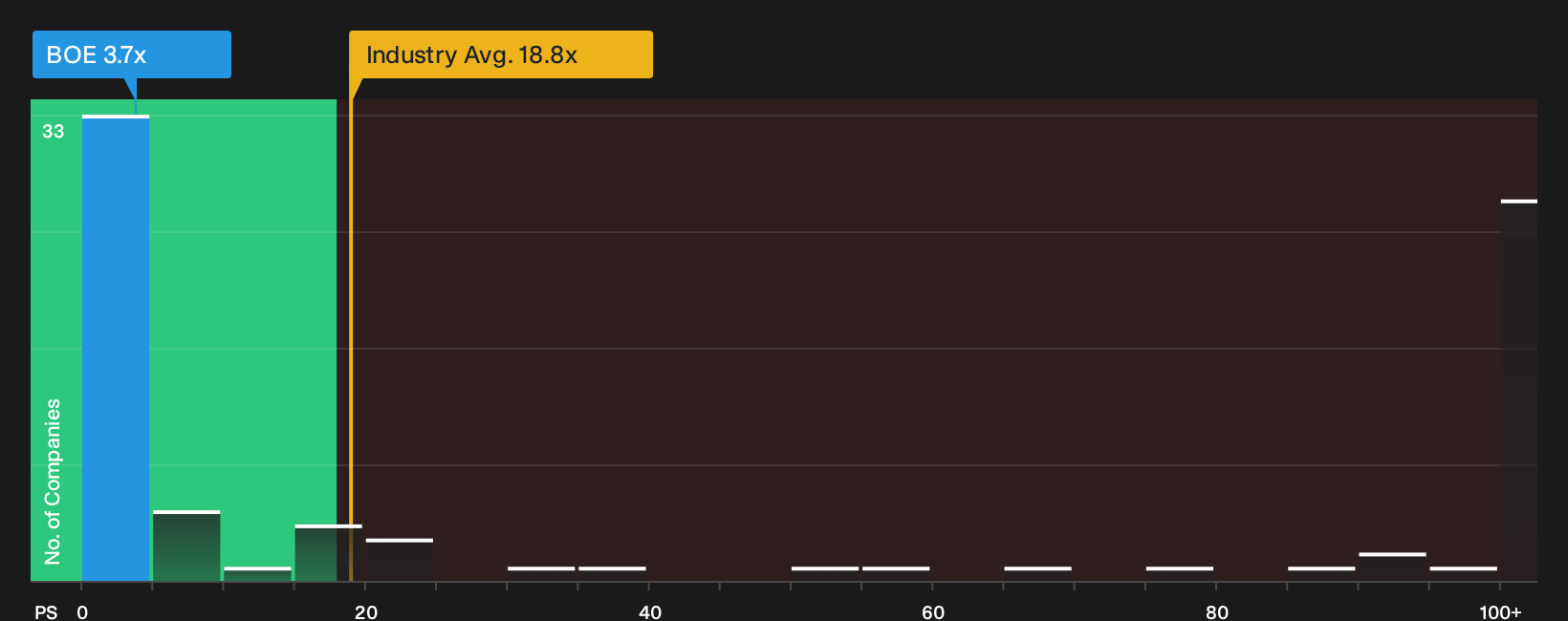
The P/S ratio suits Boss Energy because investors are currently focused on what they are paying for each dollar of revenue. On this lens, Boss Energy trades on a P/S of 3.7x, which is below both the Oil and Gas industry average of 18.8x and a peer group average of 10.1x. That gap tells you the market is not assigning the same revenue value multiple to this business as to many others in the sector.
The fair-value framework that blends Boss Energy’s growth profile, margins, size and risk points to a higher P/S than where the shares currently change hands. On this specific metric, the model therefore reads the stock as overvalued. The key message for you is that the lower headline P/S needs to be weighed against the company’s own revenue quality, contract structure and execution record rather than treated as a simple bargain signal on its own. Explore the numbers behind Boss Energy's P/S valuation.
The Boss Energy Narrative: What Would Justify Today's Price?
Boss Energy Narratives on Simply Wall St pick up where the P/S discussion leaves off, by spelling out what would need to happen to the company’s growth, margins and earnings for the current share price to look materially higher or lower over time. Rather than relying on a single multiple or model output, each Narrative lays out the key assumptions behind its view of value so you can compare those expectations with actual results as they are reported.
Bullish and bearish Narratives on Boss Energy focus on the same Honeymoon hub plan, yet reach very different conclusions about what current pricing reflects.
Bull case: 45% undervalued
The bullish analyst Narrative on Simply Wall St leans heavily on Honeymoon’s wellfield design and regional hub optionality.
"The transition to wider spaced ISR wellfields at Honeymoon, supported by reactive transport modelling and early pattern performance, creates room for Boss Energy to reconfigure capital and wellfield intensity…"
Discover why this Narrative puts Boss Energy at 45% undervalued.
Bear case: 17% overvalued
The bearish analyst Narrative on Simply Wall St argues that the same mine plan carries meaningful execution and resource risk.
"Although the New Feasibility Study points to lower life of mine unit costs from the wider spaced wellfield design at Honeymoon, the roughly 35% reduction in contained uranium versus the prior resource estimate and the roughly 26% cut to planned life of mine production mean that any shortfall in field performance could leave revenue and net margins below what current plans imply…"
Explore why this Narrative puts Boss Energy at 17% overvalued.
Boss Energy's valuation is only part of the story
Before treating the current pricing as the full picture, it helps to know that Simply Wall St's broader checks on Boss Energy have flagged specific concerns that sit outside the sales multiple and Narratives already discussed. Take a closer look at 1 warning sign before settling on a valuation.
Have feedback on this article? Concerned about the content? Get in touch with us directly. Alternatively, email editorial-team@simplywallst.com