


EN
Dick's surprises with Q3 2026 sales, stock soars
Sporting goods retailer Dick’s Sporting Goods (NYSE:DKS) beat Wall Street’s revenue expectations in Q3 2026, with revenue up 23.2% year on year to $5.13 billion. The company expects the full year’s revenue to be around $22.1 billion, close to analysts’ consensus estimates. Its non-GAAP profit of $1.94 per share was 37.6% above analysts’ consensus estimates.
For more on Dick's, read our free full research report.
Dick's Q3 2026 highlights:
- Revenue $5.13 billion vs. analysts' consensus estimates of $5.07 billion, according to S&P (23.2% year-on-year growth, 1.3% beat)
- Adjusted EPS $1.94 vs. analysts' consensus estimates of $1.41, according to S&P (37.6% beat)
- Revenue guidance The company slightly lifted its revenue guidance for the full year to $22.1 billion at the midpoint from $22.05 billion
- Adjusted EPS guidance Management raised its full-year adjusted EPS guidance to $11.88 at the midpoint, a 3.3% increase
- Operating margin 4.7%, in line with the same quarter last year
- Free cash flow -$382.8 million compared to -$515.6 million in the same quarter last year
- Locations 3,097 at quarter end, down from 3,230 in the same quarter last year
- Same-store sales edged higher 1.8% year on year, in line with the same quarter last year
- Market capitalization $11.89 billion
"We're proud of our company's Q3 results. We delivered another strong quarter in the DICK'S Business and saw encouraging progress at Foot Locker. Comp sales for the DICK'S Business increased 2.6%, including a very strong back-to-school season. Athletes are responding to newness and innovation, and our increasingly differentiated assortment gives them more reasons to choose DICK'S. We're continuing to invest behind our long-term growth opportunities. House of Sport has delivered strong sales, profitability and returns, while GameChanger continues to scale and deepen our relationship with millions of youth athletes and families. Given our continued confidence in the DICK'S Business, we are raising the low end of our full-year 2026 comp sales outlook and increasing our operating income expectations."
Revenue growth
Reviewing a company’s long-term revenue performance reveals insights into its quality. Any business can experience short-term success, but top-performing ones sustain growth for years.
With $22.11 billion in revenue over the past 12 months, Dick's is one of the larger companies in the consumer retail industry and benefits from a well-known brand that influences purchasing decisions.
Dick’s revenue grew at a strong 20.3% compounded annual growth rate over the last three years as it opened new stores and increased revenue at existing, established locations.
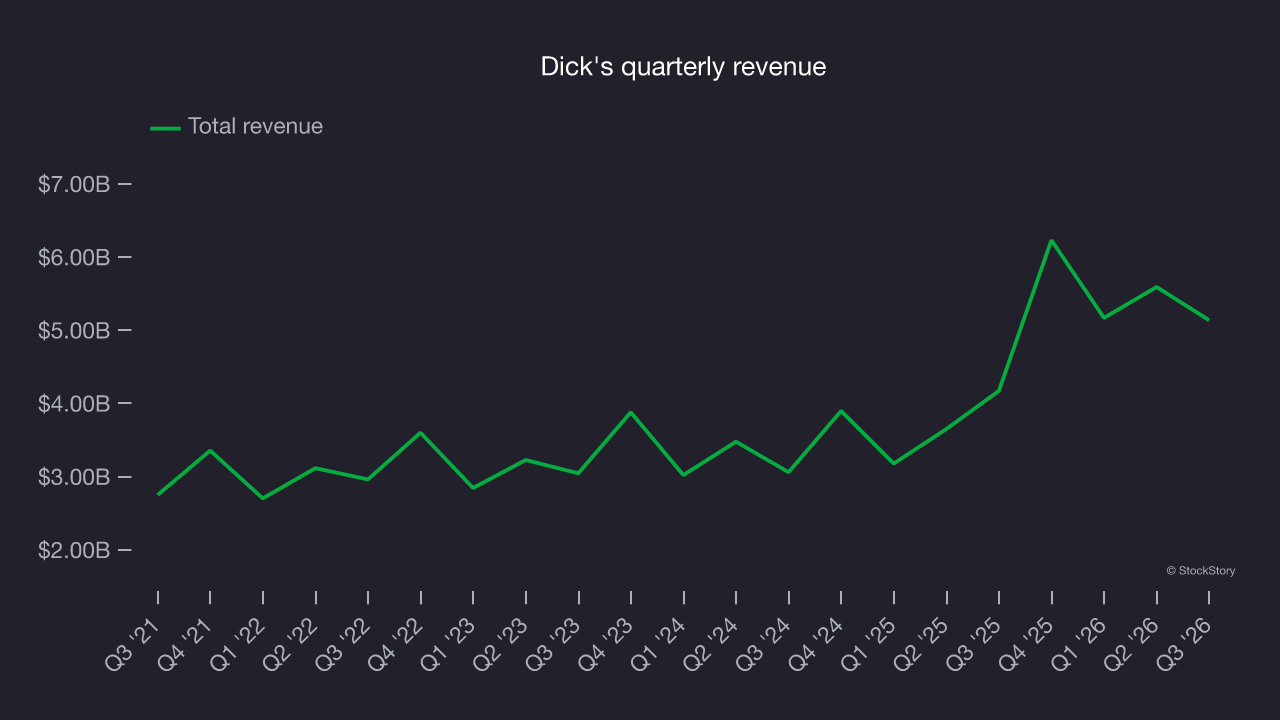
This quarter, Dick's reported strong year-on-year revenue growth of 23.2%, and its $5.13 billion of revenue topped Wall Street’s consensus estimates by 1.3%.
Looking ahead, sell-side analysts expect revenue to grow 1.4% over the next 12 months, according to S&P, a deceleration versus the last three years. This underwhelming projection indicates its products will face some demand headwinds. Still, the company is performing well on other measures of financial health.
Store performance
Number of stores
The number of stores a retailer operates is a critical driver of how quickly company-level revenue can grow.
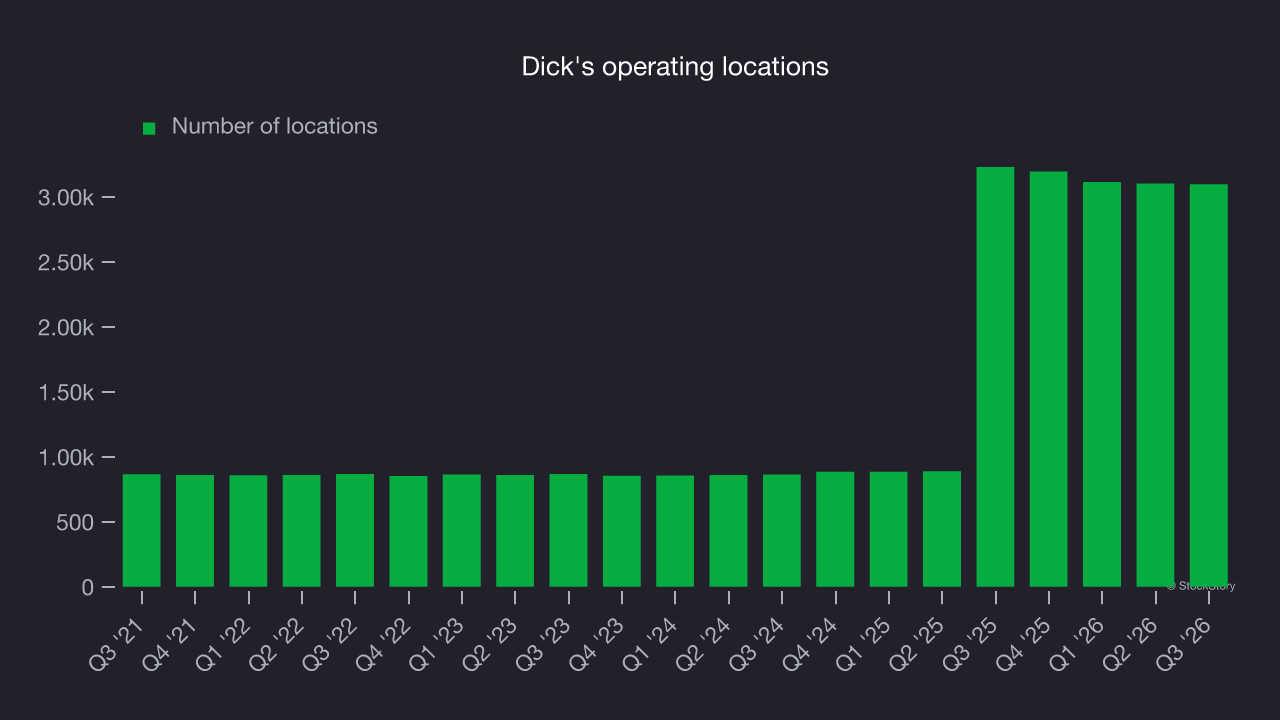
Dick's operated 3,097 locations in the latest quarter. It has opened new stores at a rapid pace over the last two years, averaging 130% annual growth, much faster than the broader consumer retail sector.
When a retailer opens new stores, it usually means it’s investing for growth because demand is greater than supply, especially in areas where consumers may not have a store within reasonable driving distance.
Same-store sales
The change in a company’s store base only tells one side of the story. The other is the performance of its existing locations and e-commerce sales, which informs management teams whether they should expand or downsize their physical footprints. Same-store sales is an industry measure of whether revenue is growing at those existing stores and is driven by customer visits (often called traffic) and the average spending per customer (ticket).
Dick’s demand has been strong for a retailer over the last two years. On average, the company has increased its same-store sales by 3.3% per year. This performance, along with its substantial expansion of new stores, suggests it’s pursuing growth aggressively.
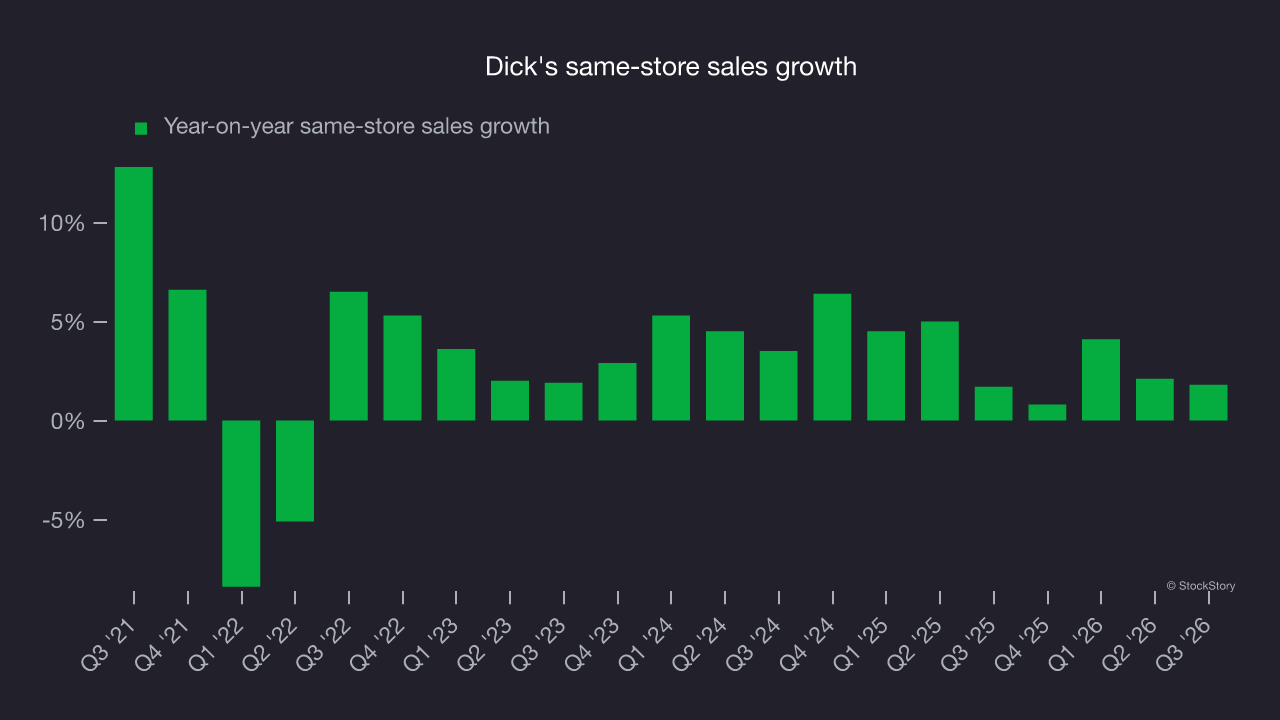
In the latest quarter, Dick’s same-store sales rose 1.8% year on year. This growth was a deceleration from its historical levels, showing the business is still performing well but slowing somewhat.
Key takeaways from Dick’s Q3 results
An EPS beat and full-year EPS guidance above Wall Street’s consensus gave Dick’s quarter some clear positives. Shares surged 5.1% to $140.54 immediately after the results.
Dick's reported solid earnings, but one quarter doesn’t necessarily make the stock a buy. If you’re making that decision, you should consider the bigger picture of valuation and business quality, as well as the latest earnings. For more on those factors, read the full research report here (it’s free).