


EN
Dycom delivers strong Q3 CY2026 numbers, stock soars

Telecommunications company Dycom (NYSE:DY) reported calendar Q3 2026 [fiscal Q3 2027] results topping the market’s revenue expectations, with revenue up 41.6% year on year to $2.06 billion. The company expects next quarter’s revenue to be around $1.67 billion, close to analysts’ consensus estimates. Its non-GAAP profit of $5.23 per share was 14.5% above analysts’ consensus estimates.
For more on Dycom, read the full research report for free.
Dycom Q3 CY2026 highlights:
- Revenue $2.06 billion vs S&P analysts’ consensus estimates of $1.95 billion (41.6% year-on-year growth, 5.7% beat)
- Adjusted EPS $5.23 vs S&P analysts’ consensus estimates of $4.57 (14.5% beat)
- Adjusted EBITDA $311.7 million vs analysts’ consensus estimates of $292.8 million (15.2% margin, 6.4% beat)
- Revenue guidance $1.67 billion at the midpoint for Q4 CY2026, roughly in line with what analysts were expecting
- Adjusted EPS guidance $2.63 at the midpoint for Q4 CY2026, below analysts’ consensus estimates of $2.82
- EBITDA guidance $211 million at the midpoint for Q4 CY2026, below analysts’ consensus estimates of $217.9 million
- Operating margin 13.7%, up from 10.4% in the same quarter last year
- Backlog $12.91 billion at quarter end, up 57.5% year on year
- Market capitalization $6.59 billion
“We delivered another strong quarter, with record revenue and backlog and continued margin expansion. Our results exceeded the high end of our guidance across all metrics, driven by our market leadership in digital and critical infrastructure and disciplined project selection,” said Dan Peyovich, Dycom’s President and Chief Executive Officer.
Revenue growth
A company’s long-term performance is an indicator of its overall quality. Any business can post a good quarter or two, but many enduring ones grow for years. Over the last five years, Dycom grew its revenue at a strong 19.1% compounded annual growth rate. Its growth surpassed the average industrials company and shows its offerings resonate with customers.
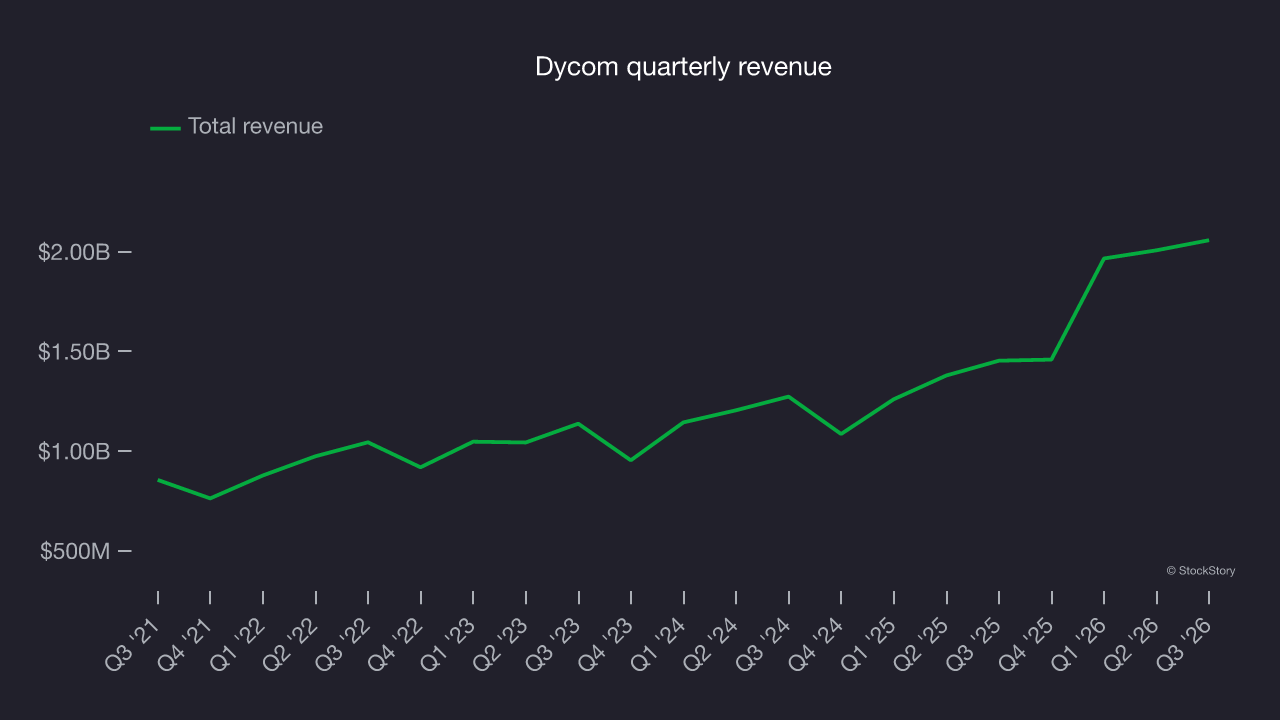
Long-term growth is the most important, but within industrials, a half-decade historical view may miss new industry trends or demand cycles. Dycom’s annualized revenue growth of 28% over the last two years is above its five-year trend, suggesting its demand was strong and recently accelerated. Dycom isn’t alone in its success as the engineering and design services industry experienced rapid growth, with many similar businesses also posting double-digit growth. 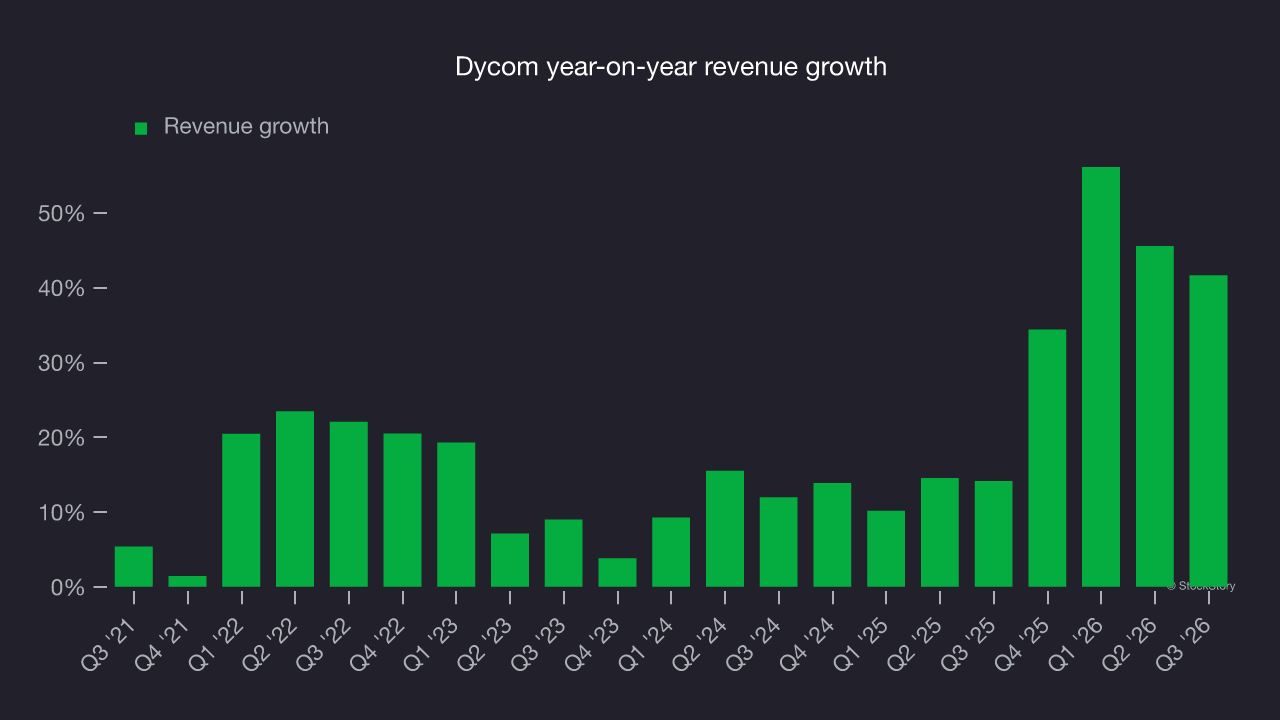
This quarter, Dycom reported strong year-on-year revenue growth of 41.6%, and its $2.06 billion in revenue beat Wall Street’s consensus estimates by 5.7%. Company management is guiding for a 14.2% year-on-year increase in revenue next quarter.
Looking further ahead, sell-side analysts expect revenue to grow 9.1% over the next 12 months, according to S&P, a deceleration versus the last two years. Still, this projection is healthy and indicates the market is forecasting success for its products and services.
Operating margin
Over the last five years, Dycom’s operating margin rose by 4.2 percentage points. This improvement shows its costs declined relative to revenue. Its trailing 12-month operating margin was 8.9%.
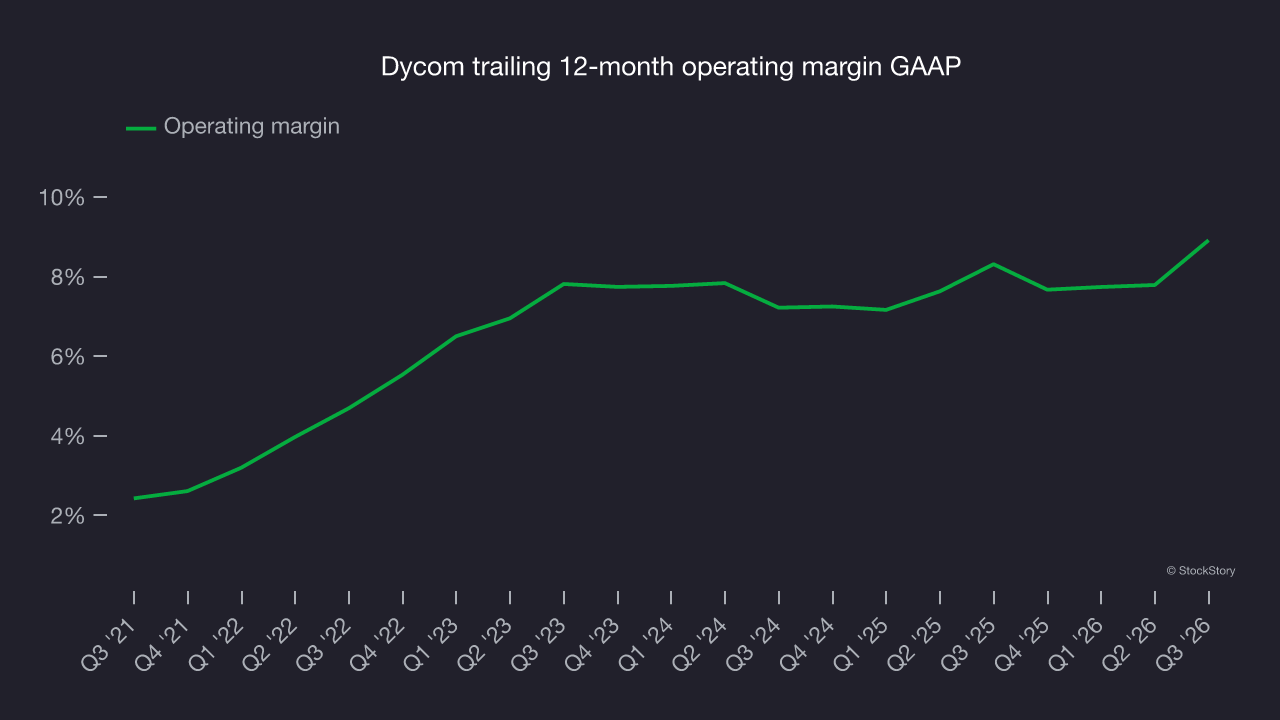
In Q3, Dycom generated an operating profit margin of 13.7%, up 3.3 percentage points year on year. The increase was a positive sign and, given the decline in gross margin, suggests Dycom became more efficient as operating expenses such as marketing, R&D and administrative overhead grew more slowly than revenue.
Earnings per share
We track the long-term change in earnings per share, or EPS, for the same reason as long-term revenue growth. Compared to revenue, however, EPS highlights whether a company’s growth is profitable.
Dycom’s EPS grew at a 63.8% compounded annual growth rate over the last five years, higher than its 19.1% annualized revenue growth. This indicates the company became more profitable on a per-share basis as it expanded.
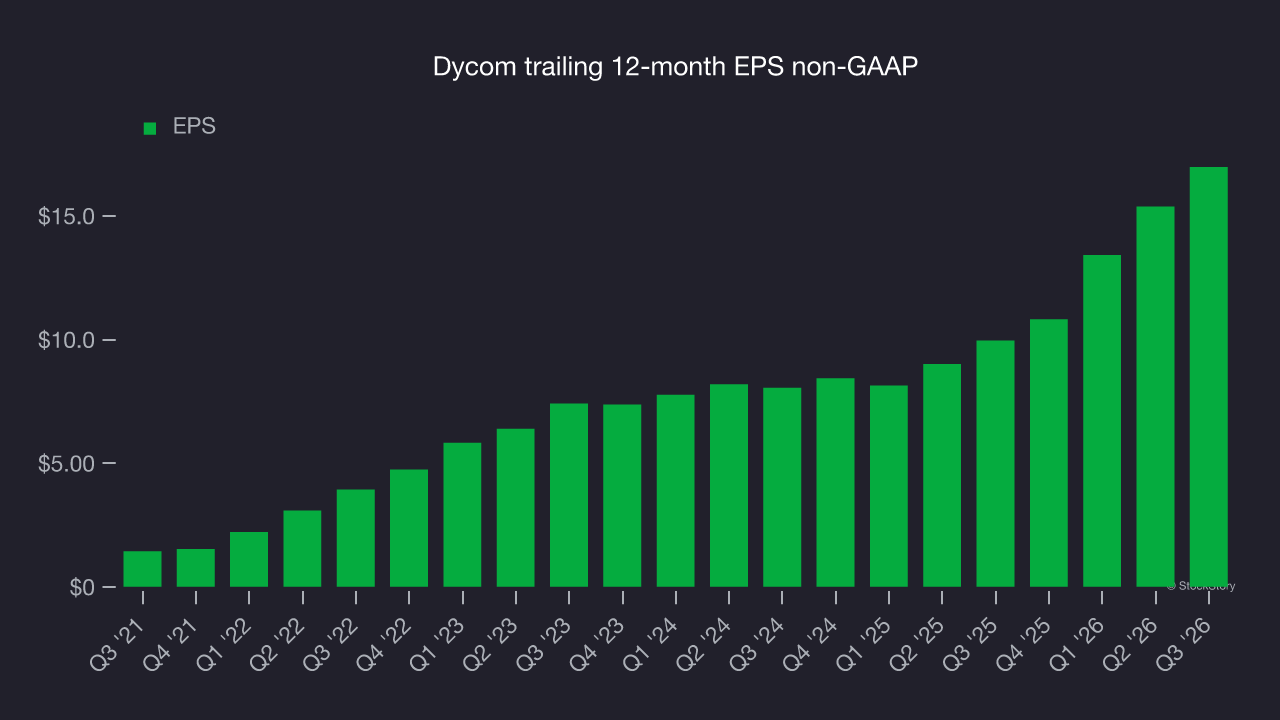
A closer look at Dycom’s earnings helps explain the drivers of its performance. As mentioned earlier, Dycom’s operating margin expanded by 4.2 percentage points over the last five years. On top of that, its share count shrank by 1.3%. These are positive signs for shareholders because improving profitability and share buybacks boost EPS growth relative to revenue growth. 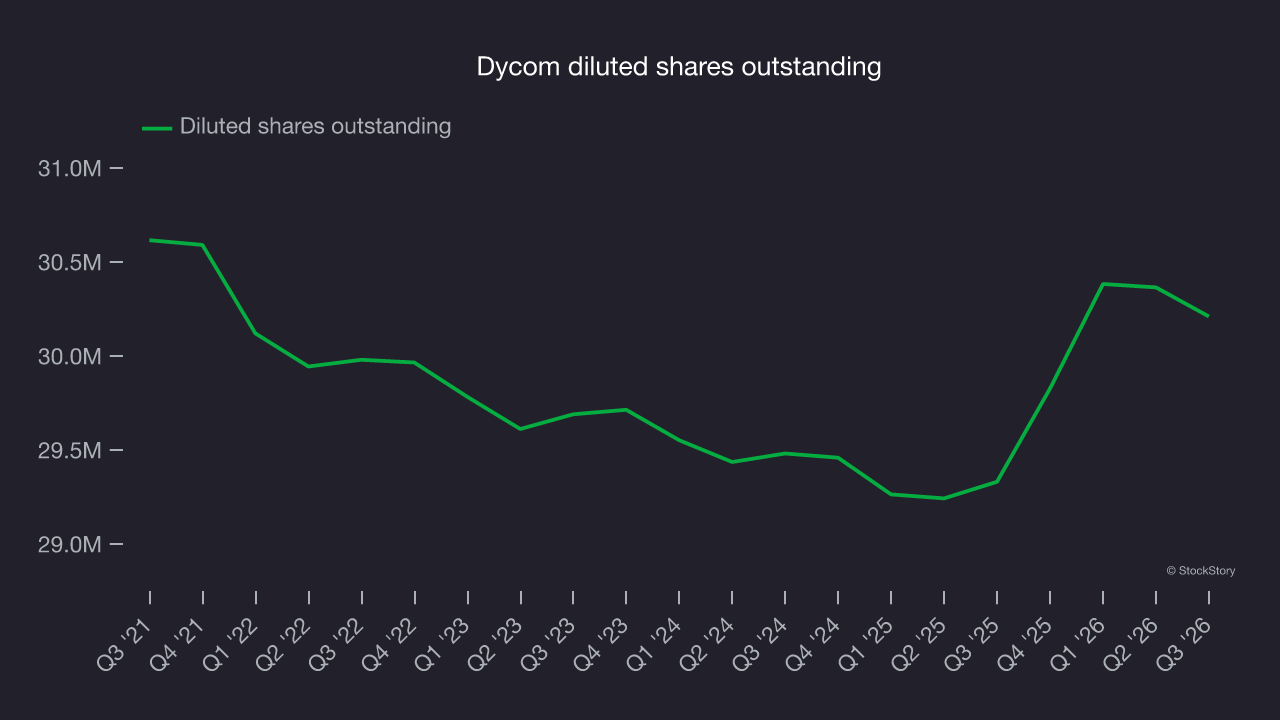
As with revenue, we analyze EPS over a more recent period because it can provide insight into an emerging theme or development for the business.
For Dycom, its two-year annual EPS growth of 45.2% was lower than its five-year trend. That was still a good pace, but an acceleration would be welcome.
In Q3, Dycom reported adjusted EPS of $5.23, up from $3.63 in the same quarter last year. EPS easily beat analysts’ consensus estimates, a positive result for shareholders. Over the next 12 months, Wall Street expects Dycom’s full-year EPS to grow 14.4% from $16.97 to $19.42, according to S&P.
Key takeaways from Dycom’s Q3 results
Dycom delivered a solid quarter, with revenue well ahead of analysts’ consensus estimates and EBITDA also topping Wall Street’s expectations. The shortfall was in next quarter’s EBITDA guidance, which missed estimates. Shares surged 6.1% to $231.75 immediately after the report.
Dycom had a solid quarter, but does the bigger picture support buying the stock? The latest quarter is only one part of assessing its longer-term business quality. Quality, when combined with valuation, can help determine if the stock is a buy. For more on Dycom, read our full research report here (it’s free).