


EN
Movado beats Q3 CY2026 sales expectations

Luxury watch company Movado (NYSE:MOV) announced better-than-expected revenue in calendar Q3 2026 [fiscal Q3 2027], with revenue up 6.5% year on year to $198.3 million. Its GAAP profit of $0.56 per share was in line with analysts’ consensus estimates.
For more on Movado, read the full research report for free.
Movado Q3 CY2026 highlights:
- Revenue $198.3 million vs S&P analysts’ consensus estimates of $195.3 million (6.5% year-on-year growth, 1.5% beat)
- EPS (GAAP) $0.56 vs analysts’ consensus estimates of $0.55 (in line)
- Operating margin 8.6%, an increase from 6.3% in the same quarter last year
- Free cash flow margin 3.7%, a decline from 6.2% in the same quarter last year
- Market capitalization $495.1 million
Efraim Grinberg, Chairman and Chief Executive Officer, stated: “We delivered a strong third quarter, building on the momentum from the first half of the year. The quarter was highlighted by increases across our key financial metrics, including a 6.5% increase in net sales, with strength in our Movado brand and our licensed brands; a 210-basis-point expansion in gross margin; and a 33% increase in diluted earnings per share. These results underscore the strength of our business model, the power of our portfolio of global brands, and the excellent execution of our strategy by our management team, as we continue to focus heavily on the consumer—delivering high-impact innovation and enhanced customer engagement.”
Revenue growth
A company’s long-term revenue performance can indicate its overall quality. Any business can experience short-term success, but top-performing ones sustain growth for years. Movado struggled to consistently increase demand as its $702 million in revenue for the trailing 12 months was close to its revenue five years ago. This was below our standards and is a sign of poor business quality.
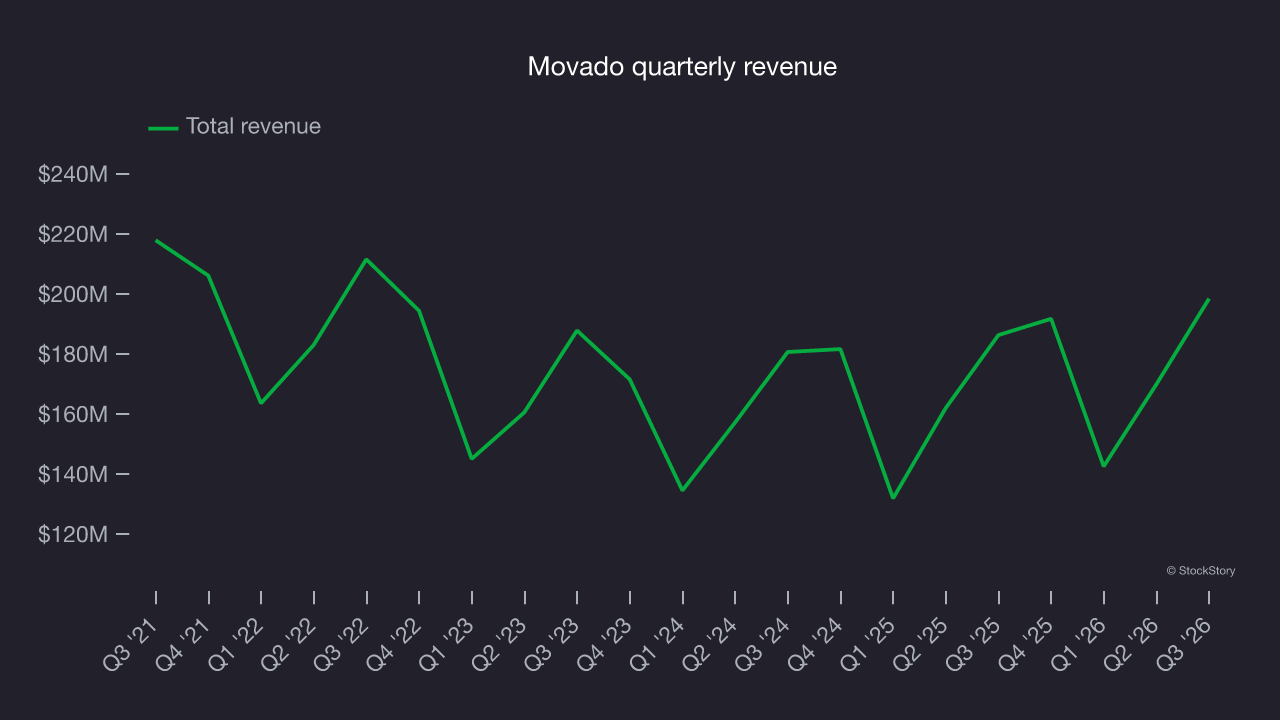
Long-term growth matters most, but within consumer discretionary, a stretched historical view may miss a company riding a successful new product or trend. Movado’s annualized revenue growth of 4.5% over the last two years is above its five-year trend. The pickup is off a weak base, and demand in this sector can still turn. 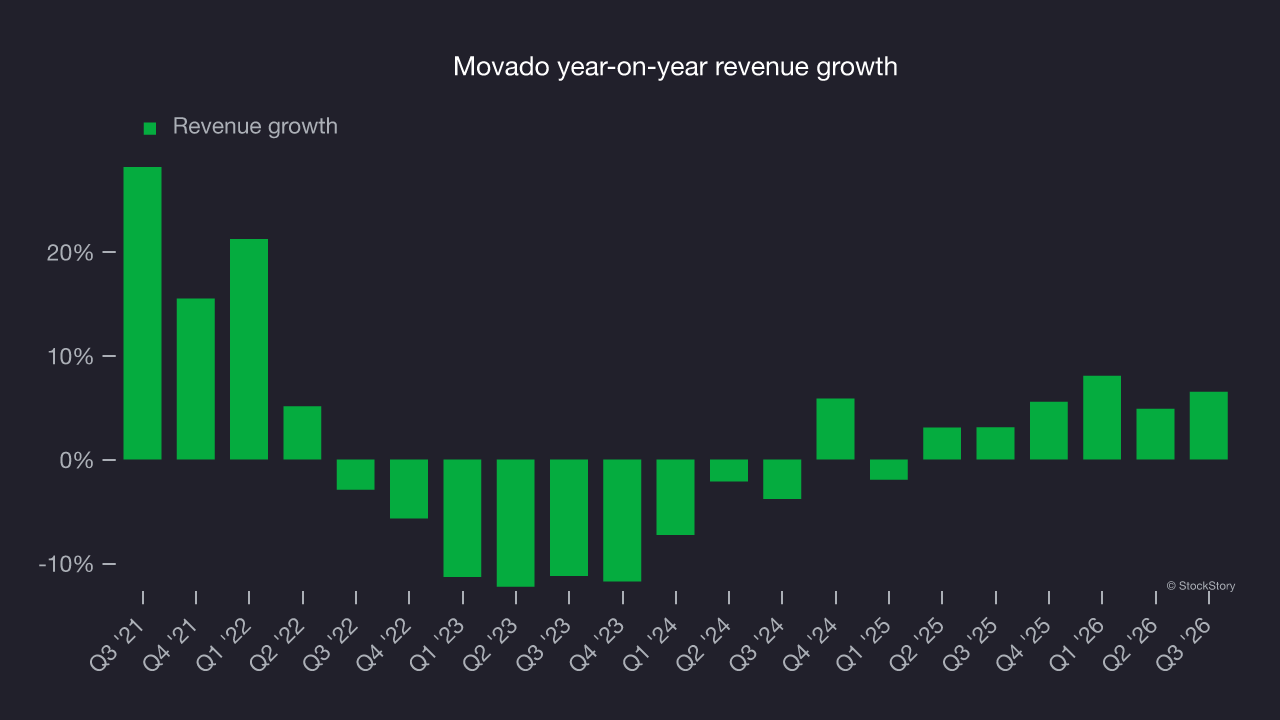
This quarter, Movado reported year-on-year revenue growth of 6.5%, and its $198.3 million in revenue exceeded Wall Street’s consensus estimates by 1.5%.
Looking ahead, sell-side analysts expect revenue to grow 4.5% over the next 12 months, according to S&P, similar to its two-year rate. This projection is underwhelming and indicates its newer products and services will not lead to better top-line performance yet.
Operating margin
Operating margin is an important measure of profitability as it shows the portion of revenue left after accounting for all core expenses, everything from the cost of goods sold to advertising and wages. It’s also useful for comparing profitability across companies with different levels of debt and tax rates because it excludes interest and taxes.
Movado’s operating margin has been trending up over the last 12 months and averaged 6.2% over the last two years. This is a limited stretch of time, and revenue, and therefore profit margins, can change quickly in the consumer discretionary sector.
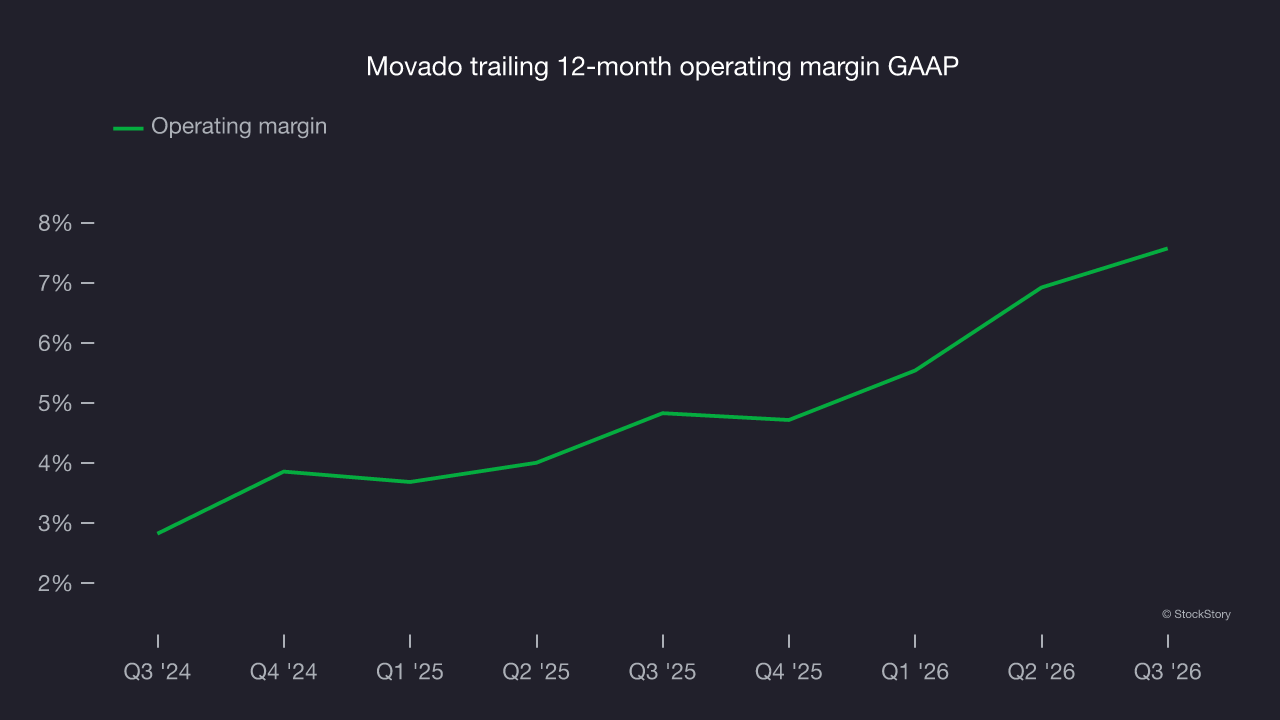
This quarter, Movado generated an operating profit margin of 8.6%, up 2.3 percentage points year on year.
Earnings per share
Long-term changes in earnings per share, or EPS, matter for the same reason as long-term revenue growth. Compared to revenue, however, EPS highlights whether a company’s growth is profitable.
Movado’s full-year EPS dropped 53.4%, or 15.3% annually, over the last three years. Companies with falling revenue and EPS warrant caution, as diminishing earnings could imply changing secular trends and preferences. Consumer discretionary companies are particularly exposed to this, and if conditions turn unexpectedly, Movado’s low margin of safety could leave its stock price susceptible to large declines.
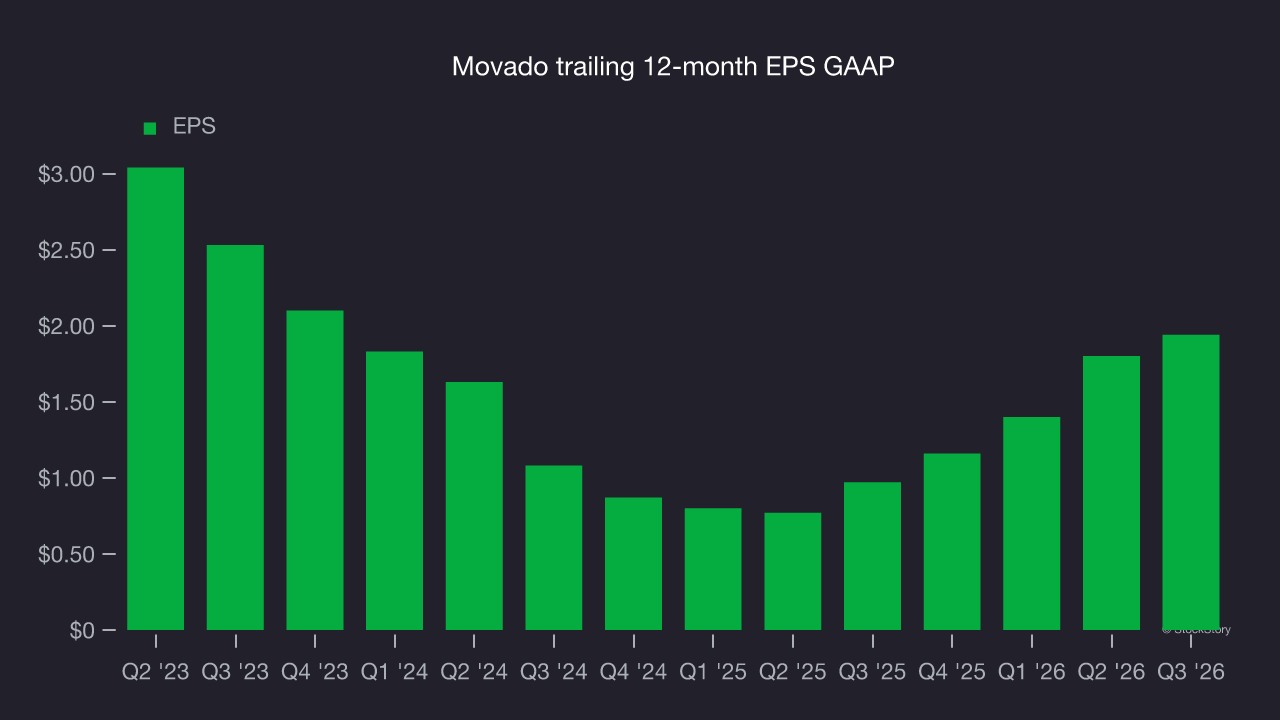
In Q3, Movado reported EPS of $0.56, up from $0.42 in the same quarter last year. This result beat analysts’ consensus estimates by 1.4%. Over the next 12 months, Wall Street expects Movado’s full-year EPS to grow 11.6% from $1.94 to $2.17, according to S&P.
Key takeaways from Movado’s Q3 results
Movado’s Q3 results had some clear positives, including revenue that topped analysts’ consensus estimates. Shares remained flat at $30.23 immediately after the release.
For investors considering Movado, the latest quarter is only one part of the longer-term business quality picture. Quality, combined with valuation, can help determine whether the stock is a buy. We cover that in our full research report, which you can read here (it’s free).