


EN
Interpretation of IPOs | From breaking through market segments to expanding the industry footprint, what kind of growth test has Gurelli faced?
For a long time, high-end domestic manufacturing companies have relied heavily on overseas suppliers for related core systems. As the semiconductor industry continues to expand and localization substitution continues to deepen, local industrial software companies are ushering in a critical window to enter the core production chain and seek greater market share.
Recently, Shanghai Goreley Software (hereinafter referred to as “Gorrelli”) updated the Hong Kong Stock Exchange data collection after the hearing, and the Hong Kong stock IPO process went one step further. According to the Frost & Sullivan report, in terms of 2025 revenue, Gorrelli ranked third in the Pan-Semiconductor Intelligent Manufacturing Software Solution (IMSS) market in China, with a market share of about 12%.
From the accumulation of technology in the past 20 years, to entering high-end manufacturing scenarios such as the 12-inch semiconductor front-end factory, to promoting the integration of AI and intelligent manufacturing systems, Gurelli's business development path has gradually become clear. Facing the market demand brought about by the digital upgrading of the pan-semiconductor industry, can the company use its existing product system, project experience and customer base to further expand market coverage and transform technology accumulation into commercial results of continuous growth?
Deeply cultivate the pan-semiconductor circuit and build core competitiveness in the CIM business
The Zhitong Finance App learned that the semiconductor factory's production process is complicated, the number of equipment is huge, and different production processes require a high degree of collaboration. How to issue production instructions, how to monitor equipment status, how to collect production data, and how to schedule materials all require support from corresponding software systems. The CIM system is an important infrastructure connecting factory production management and equipment automation.
Gorelli's core business revolves around this demand. The company provides IMSS solutions through five major platforms, of which the production and operation platform and the integrated automation platform form the core part of the CIM system. The former is mainly responsible for production execution, planning and operation management functions, while the latter is responsible for equipment connection, equipment communication, and automated control. Together, the two support the operation of the factory's production system.
On this basis, the intelligent control digital platform undertakes centralized monitoring and intelligent operation functions. The intelligent big data engine platform focuses on data analysis and quality decision-making, while the digital equipment platform supports equipment control, data exchange, and process simulation. The five major platforms can be purchased separately or deployed in combination according to customer needs, enabling the company to move from a single production link and then expand to more manufacturing scenarios.
Judging from the revenue structure, CIM is still the core of Gorrelli's business. From 2023 to 2025, production and operation platforms and integrated automation platforms contributed 82.7%, 78.5%, and 71.6% of total revenue, respectively. This ratio is declining year by year, mainly reflecting the gradual expansion of the company's other platform business and expansion of revenue sources, but CIM is still the main support for its product system and commercialization capabilities.
In terms of industry coverage, Gorelli's solutions have been used in pan-semiconductor fields such as semiconductors, display panels, PCBs, and photovoltaics. Different manufacturing industries have differences in equipment types, production processes, and process requirements. Software suppliers must not only have product development capabilities, but also understand customer production processes and complete system configuration, integration and delivery according to specific scenarios. Therefore, industry experience and project implementation ability are important thresholds for industrial software companies to participate in competition.
From 8 inches to 12 inches, from single system delivery to fully automated factory projects, Gorelli's project experience gradually extends to more complex manufacturing scenarios. In particular, the 12-inch front-end factory has high requirements for software system stability, equipment compatibility, and project delivery level. Relevant project experience helps the company accumulate industry cases, and also supports its subsequent expansion to similar customers.
Looking at the industry space, the pan-semiconductor intelligent manufacturing software market is still expanding. According to the Frost & Sullivan report, China's pan-semiconductor IMSS market will grow from about 1.3 billion yuan in 2021 to about 2.5 billion yuan in 2025, and is expected to reach about 7.2 billion yuan in 2030. The compound annual growth rate from 2026 to 2030 is expected to be 25%. This growth rate is higher than the expected growth rate of China's overall IMSS market during the same period.
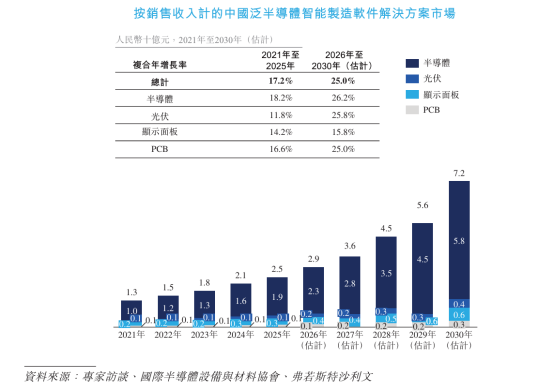
In 2025, Gorelli ranked third in China's pan-semiconductor IMSS market, with a market share of about 12%; if the overall IMSS market in China is calculated, the company ranked 16th, with a market share of about 0.5%. The two sets of data show that the company has a certain competitive advantage in the vertical field of pan-semiconductors, but judging from the broader industrial intelligent manufacturing software market, there is still room for further expansion of the business scale.
Revenue scale increases, profitability improvement and project delivery efficiency remain key
According to the Zhitong Finance App, from 2023 to 2025, the company achieved revenue of about 165 million yuan, 249 million yuan and 300 million yuan respectively. In 2024, the year-on-year increase was 50.4%, and the year-on-year increase was 20.7% in 2025. Among them, IMSS revenue in 2025 is about 298 million yuan, accounting for 99.3% of total revenue. The company's revenue is highly concentrated on the main business of intelligent manufacturing software solutions.
The company said that revenue growth in 2025 is mainly due to an increase in the number of CIM software solution projects and an increase in the number and average scale of intelligent big data engine platform projects. The increase in new customers and the expansion of the scope of projects are also driving the growth of related business revenue.
In terms of customer structure, Gurelli's number of customers and projects continued to increase. The five major customers accounted for revenue from 54.2% in 2023 to 23.1% in 2025, and customer concentration improved. For project-based industrial software companies, changes in the customer structure are significant: on the one hand, the customer sources are more diverse, which is conducive to dispersing the impact of fluctuations in the operation of a single customer; on the other hand, the increase in the number of customers also means that the company needs to invest more resources in project management, technical support and follow-up services.
In terms of revenue composition, software revenue in 2025 was about 240 million yuan, accounting for 79.7% of total revenue; hardware revenue was about 60.82 million yuan, accounting for 20.3%. The share of software revenue has increased compared to 2024, reflecting a further shift in the company's business structure towards software solutions. However, software projects usually require supporting implementation, equipment and technical services. Revenue recognition is closely related to project delivery schedule, and the company's actual profitability still depends on project cost control and delivery efficiency.
Gross margin is an important indicator for observing this change. From 2023 to 2025, Gurelli's overall gross margin was 3.4%, 13.2%, and 14.2%, respectively, improving for two consecutive years. In 2025, the company achieved gross profit of about 42.64 million yuan, a further increase from about 32.8 million yuan in 2024. The company explained that the increase in gross profit was mainly related to an increase in the scale of revenue.
However, from the cost side, the increase in the scale of project delivery has also led to an increase in personnel and external service costs. In 2025, the company's sales cost was about 258 million yuan, an increase of 19.2% over the previous year; of these, employee welfare expenses increased from about 80.6 million yuan in 2024 to about 129 million yuan in 2025, and service fees increased from about 27.9 million yuan to about 47.3 million yuan. In other words, revenue growth requires more project executives and external technical service support. How to improve project delivery efficiency and control labor and service procurement costs will directly affect the subsequent gross margin performance.
In terms of cash flow, according to the prospectus, Gurelli's cash turnover period was shortened from 556 days in 2023 to 359 days in 2024, and further shortened to 243 days in 2025. Working capital in the form of inventory and contract costs also declined from about $130.5 million in 2023 to around $2.9 million in 2025. The company said the relevant improvements are related to measures such as strengthening project delivery management, promoting customer acceptance, and shortening the payment cycle.
This means that the company has made some progress in project delivery and working capital management, but the cash turnover period is still long, and the pace of project acceptance and repayment is still worth watching. For industrial software companies that require continuous investment in personnel and technical resources, whether a virtuous cycle can be formed between revenue growth, profit improvement, and cash recovery is related to the sustainability of business expansion.
Looking at the longer cycle, Gurelli's industry has some room for growth. Semiconductor manufacturing line construction, localization and replacement of manufacturing systems, and the integration of AI and industrial scenarios may all bring new project opportunities for intelligent manufacturing software suppliers.
At present, the company has achieved a certain market position in the pan-semiconductor IMSS market segment, and has also accumulated experience in projects such as the 12-inch front-end factory. Whether it can further enhance standardized product capabilities, expand customer coverage, and transform project experience into higher delivery efficiency in the future will be an important factor in expanding its market share.
From ranking third in the market segment to seeking a larger share of the industrial software market, Gorelli has taken the first step. Next, the company's ability to transform technology accumulation, project experience, and industry demand into large-scale business growth will determine its long-term competitiveness in the domestic pan-semiconductor intelligent manufacturing software circuit.