


EN
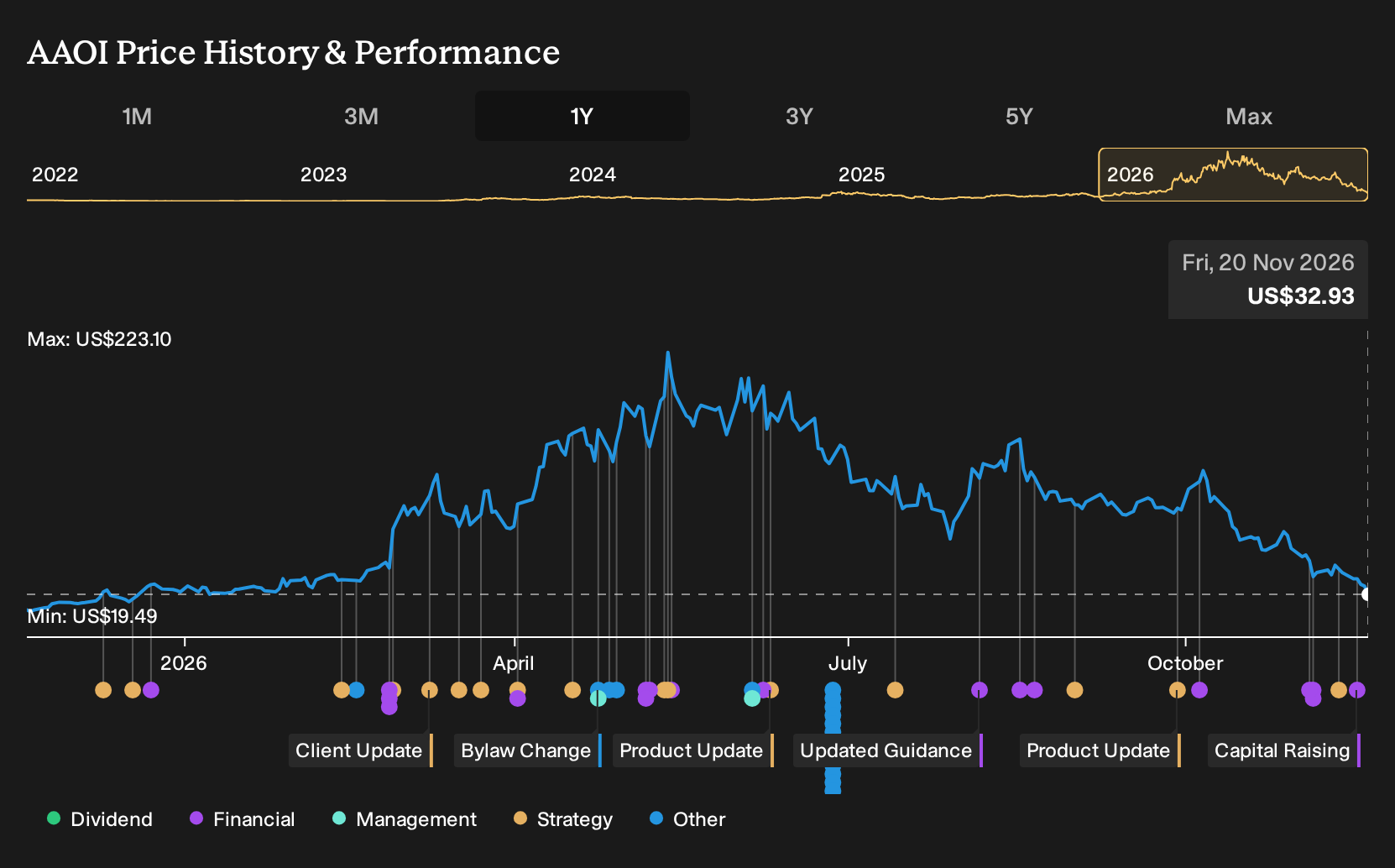
Why Applied Optoelectronics (AAOI) Is Up 17.5% And What's Next After Volume Orders
- Applied Optoelectronics has filed a US$550 million at-the-market follow-on equity offering after recently completing a US$102.25 million purchase of three Houston manufacturing, warehouse and office buildings totaling about 736,216 rentable square feet.
- The shift from leasing to owning major U.S. facilities, combined with new equity funding capacity, points to Applied Optoelectronics committing heavily to in-house production just as it begins shipping volume orders of advanced AI-focused optical transceivers.
- We will now look at how Applied Optoelectronics' new equity program and facility ownership could reshape its execution-focused investment narrative.
Scan beyond Applied Optoelectronics and compare this kind of AI infrastructure move with a curated list of 52 AI infrastructure stocks to see who else is gearing up for similar demand.
Applied Optoelectronics Investment Narrative Recap
To back Applied Optoelectronics as a shareholder, you need to believe the analyst consensus Narrative on Simply Wall St that heavy investment in AI optical transceivers and in-house laser capacity can be turned into sustained, profitable volume. The near term hinge is execution, getting qualified product out of these facilities at scale while customers still want more 400G, 800G and 1.6T modules than the firm can supply.
The fresh US$550 million at-the-market program sits directly on top of that story. It may ease funding pressure from capex that already runs in the hundreds of millions per quarter, yet it also extends the recent pattern of share issuance. The biggest risk right now remains that delays, cost overruns or slower customer ramps make that extra equity feel expensive.
The facility purchase in Houston matters most alongside the new equity filing. Applied Optoelectronics moved from leasing to owning roughly 736,216 rentable square feet of U.S. manufacturing, warehouse and office space, which ties directly to the expansion plan behind higher 800G and 1.6T output and the multiyear 1.6T transceiver agreement the analyst consensus Narrative on Simply Wall St focuses on.
Owning those buildings could give Applied Optoelectronics more control over timelines than a lease tied to a third-party developer, which matters when Sugar Land construction delays and power access already feature as execution risks. For you, the practical question is whether this combination of on-balance-sheet real estate and incremental equity capacity changes the likelihood that AI transceiver volume, CATV demand and in-house lasers reach the levels analysts are modeling without compressing future earnings per share too sharply through dilution.
Applied Optoelectronics' current analyst narrative points to revenues of US$6.0b and earnings of US$1.4b by 2029, built on an assumed 100.3% yearly revenue growth rate and an earnings swing of roughly US$1.43b from a loss of US$32.8m today to that 2029 consensus profit level.
Uncover why Applied Optoelectronics' fair value indicates a 231% potential upside to its current price that may not remain available for long.
Exploring Other Perspectives
One contrasting angle around Applied Optoelectronics is factory utilization risk. The most cautious analysts were already building in roughly US$6.1b of 2029 revenue and US$1.5b of earnings before this equity raise and Houston purchase, yet still landed on a US$45.0 target. That reflects worry that aggressive expansion and funding could disappoint, and suggests that readers compare several viewpoints and decide which story feels more realistic to them.
Explore 8 other Applied Optoelectronics fair value estimates, including one that suggests as much as 92% downside from the current price.
Reach Your Own Conclusion
Don't just follow the ticker. Dig into the data and build a conviction that's truly your own.
- A great starting point for your Applied Optoelectronics research is our analysis highlighting 1 key reward and 3 important warning signs that could impact your investment decision.
- See our latest analysis for Applied Optoelectronics. The report includes a comprehensive fundamental analysis summarized in a single visual, the Snowflake, making it easy to evaluate Applied Optoelectronics' overall financial health at a glance.
Looking for more investment ideas beyond Applied Optoelectronics?
If the Applied Optoelectronics story has sharpened your focus on where risk and reward might line up next, use that same mindset across the wider market with the Simply Wall St Screener.
- For investors who want potential upside without ignoring quality, consider a curated set of 19 high quality undiscovered gems that pair strong fundamentals with less crowded coverage.
- If capital preservation comes first for you, tilt your search toward a 31 resilient stocks with low risk scores that highlights companies with more resilient profiles.
- When financial strength is non negotiable, focus your research around a list of solid balance sheet and fundamentals (24 results) to see which businesses combine sturdy balance sheets with solid operating foundations.
Have feedback on this article? Concerned about the content? Get in touch with us directly. Alternatively, email editorial-team@simplywallst.com