


EN
Hewlett Packard Enterprise exceeds Q3 CY2026 expectations but stock drops
Enterprise technology company Hewlett Packard Enterprise (NYSE:HPE) reported calendar Q3 2026 [fiscal Q4 2026] results beating Wall Street’s revenue expectations, with revenue rising 50.3% year on year to $14.55 billion. In addition, next quarter’s revenue guidance ($14.3 billion at the midpoint) was surprisingly strong, coming in 10.5% above analysts’ consensus estimates. Its non-GAAP profit of $1.43 per share was 11% above analysts’ consensus estimates.
For more on Hewlett Packard Enterprise, read our full research report for free.
Hewlett Packard Enterprise Q3 CY2026 highlights:
- Revenue $14.55 billion vs analysts’ consensus estimate of $14.45 billion, according to S&P (50.3% year-on-year growth, 0.6% beat)
- Adjusted EPS $1.43 vs analysts’ consensus estimate of $1.29, according to S&P (11% beat)
- Revenue guidance $14.3 billion at the midpoint for Q4 CY2026, above analysts’ consensus estimates of $12.95 billion
- Adjusted EPS guidance $5.20 at the midpoint for fiscal 2027, beating analysts’ consensus estimates by 9.1%
- Operating margin 13.4%, up from -0.1% in the same quarter last year
- Free cash flow margin 13.2%, down from 20.1% in the same quarter last year
- Market capitalization $54.31 billion
“Fiscal 2026 was a defining year for HPE as we built a new networking industry leader and expanded our role in the AI infrastructure market,” said Antonio Neri, president and CEO of HPE. “We are now a fundamentally different company, with greater earnings power, a stronger competitive position, and a portfolio built to capitalize on the next phase of AI. Our record performance reflects the portfolio we have built to drive durable, profitable growth for our shareholders.”
Revenue growth
A company’s long-term revenue performance is one signal of its overall quality. Any business can report a good quarter or two, but the best consistently grow over the long term. Over the last five years, Hewlett Packard Enterprise grew its revenue at a favorable 11% compounded annual growth rate. Its growth beat the average business services company and shows its offerings resonate with customers.
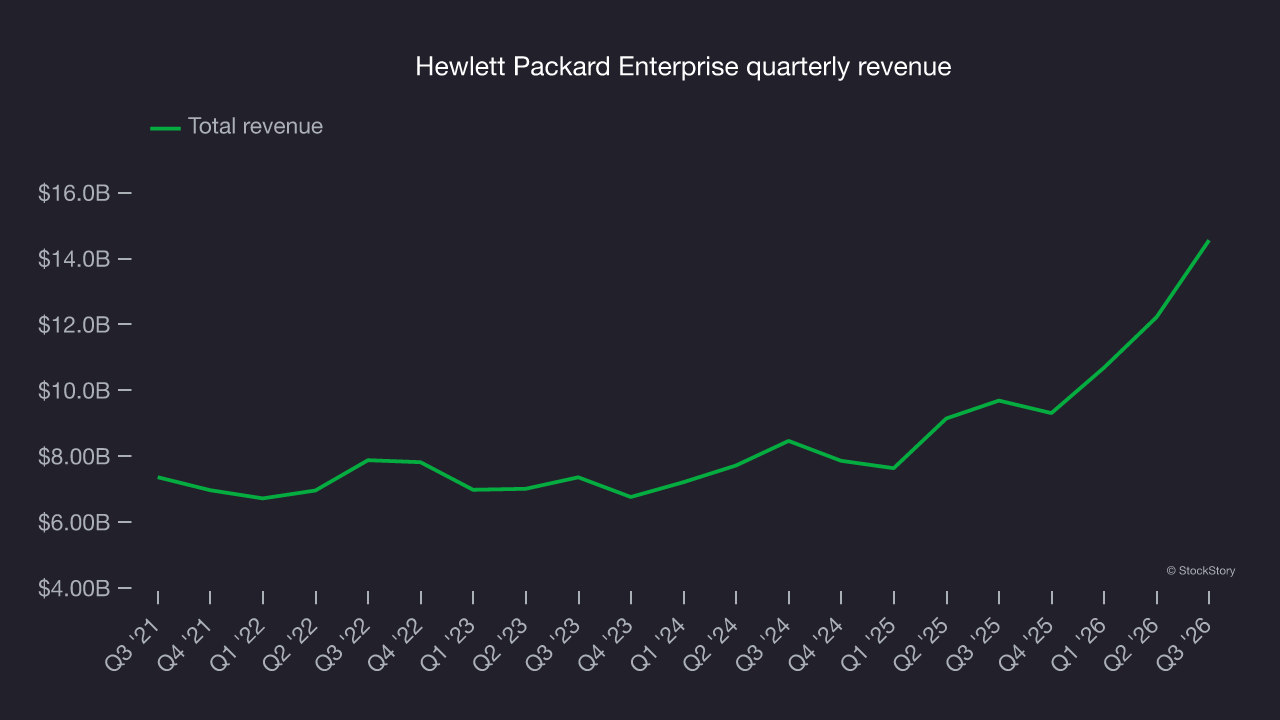
Long-term growth is the most important, but within business services, a half-decade historical view may miss new innovations or demand cycles. Hewlett Packard Enterprise’s annualized revenue growth of 24.6% over the last two years is above its five-year trend, suggesting its demand was strong and recently accelerated. 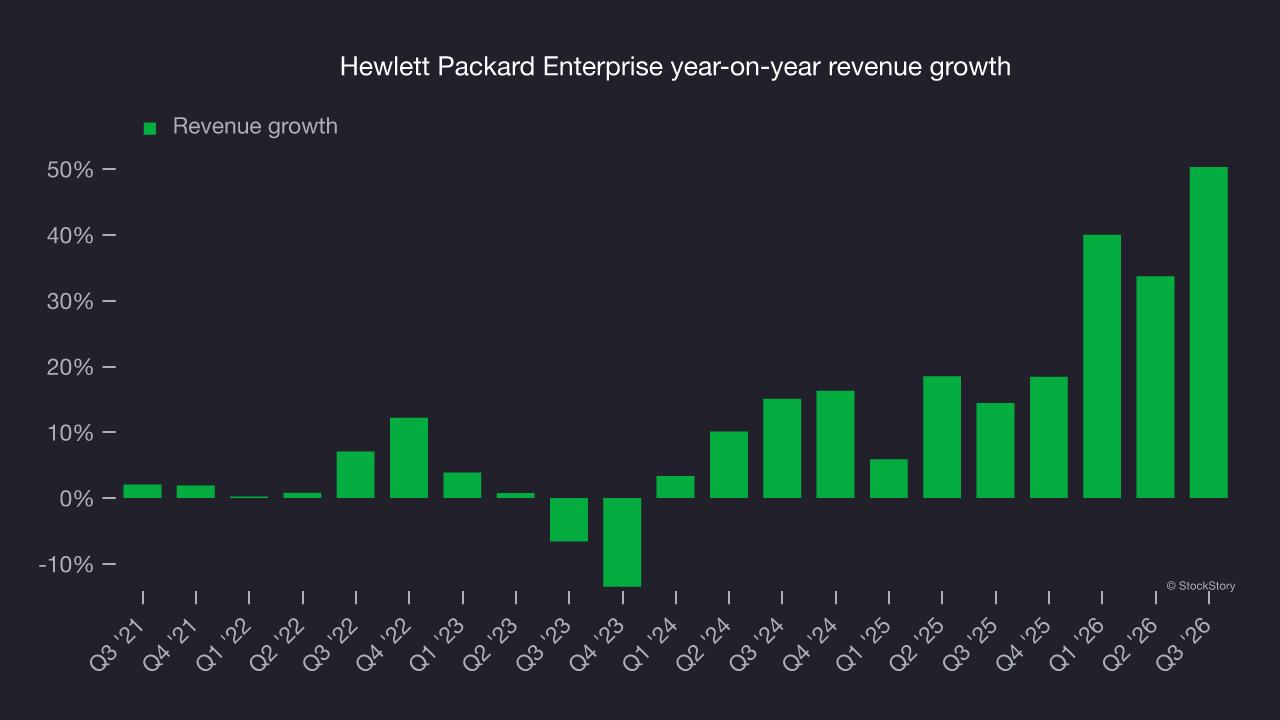
This quarter, Hewlett Packard Enterprise reported year-on-year revenue growth of 50.3%, and its $14.55 billion in revenue beat Wall Street’s consensus estimates by 0.6%. Management is guiding for a 53.7% year-on-year increase in revenue next quarter.
Looking further ahead, sell-side analysts expect revenue to grow 17.7% over the next 12 months, according to S&P, a deceleration versus the last two years. Still, the projected growth is strong given its scale and implies the market sees success for its products and services.
Adjusted operating margin
Adjusted operating margin is a key measure of profitability. Think of it as net income (the bottom line) excluding the impact of non-recurring expenses, taxes and interest on debt – items less connected to business fundamentals.
Hewlett Packard Enterprise has done a decent job managing its cost base over the last five years. The company has produced an average adjusted operating margin of 11.5%, higher than the broader business services sector.
Analyzing the trend in its profitability, Hewlett Packard Enterprise’s adjusted operating margin rose by 3.7 percentage points over the last five years, as its revenue growth gave it operating leverage.
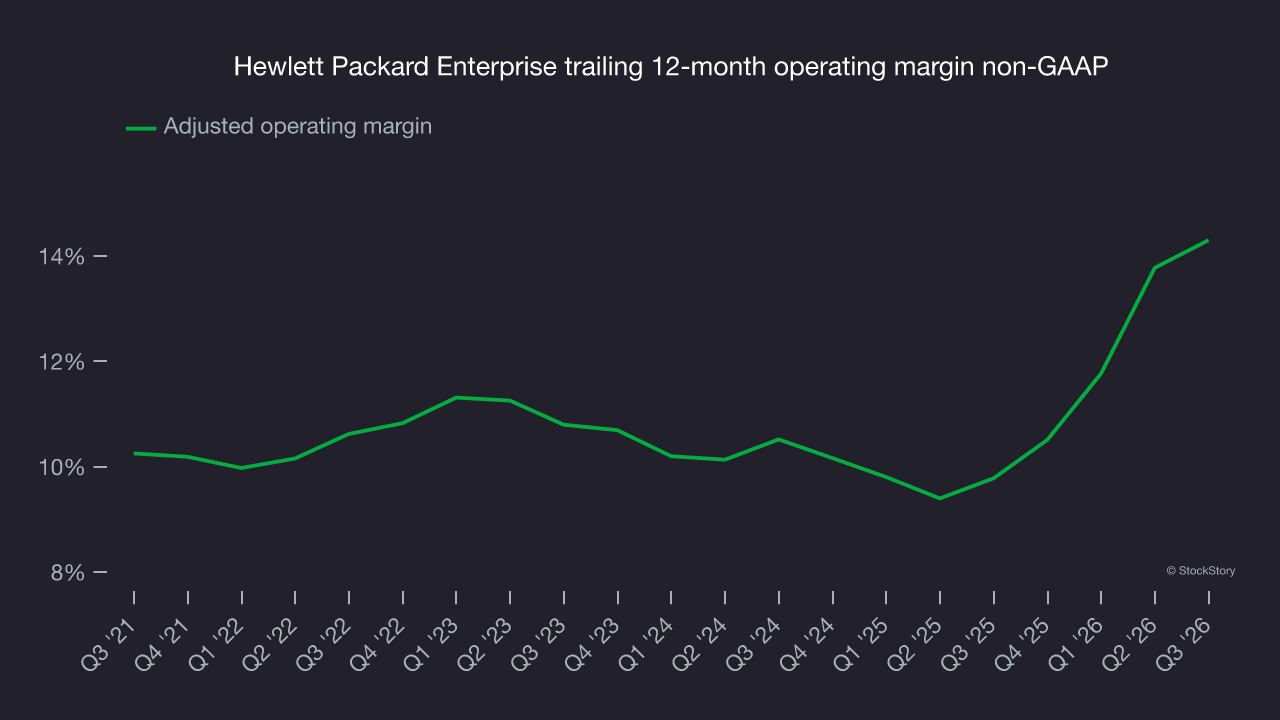
This quarter, Hewlett Packard Enterprise generated an adjusted operating profit margin of 14.4%, up 2.2 percentage points year on year. This increase was a positive development and shows improved efficiency.
Earnings per share
Revenue trends explain a company’s historical growth, but the long-term change in earnings per share, or EPS, points to the profitability of that growth. For example, a company could inflate its revenue through excessive spending on advertising and promotions.
Hewlett Packard Enterprise’s EPS grew at a 15.1% compounded annual growth rate over the last five years, higher than its 11% annualized revenue growth. This indicates the company became more profitable on a per-share basis as it expanded.
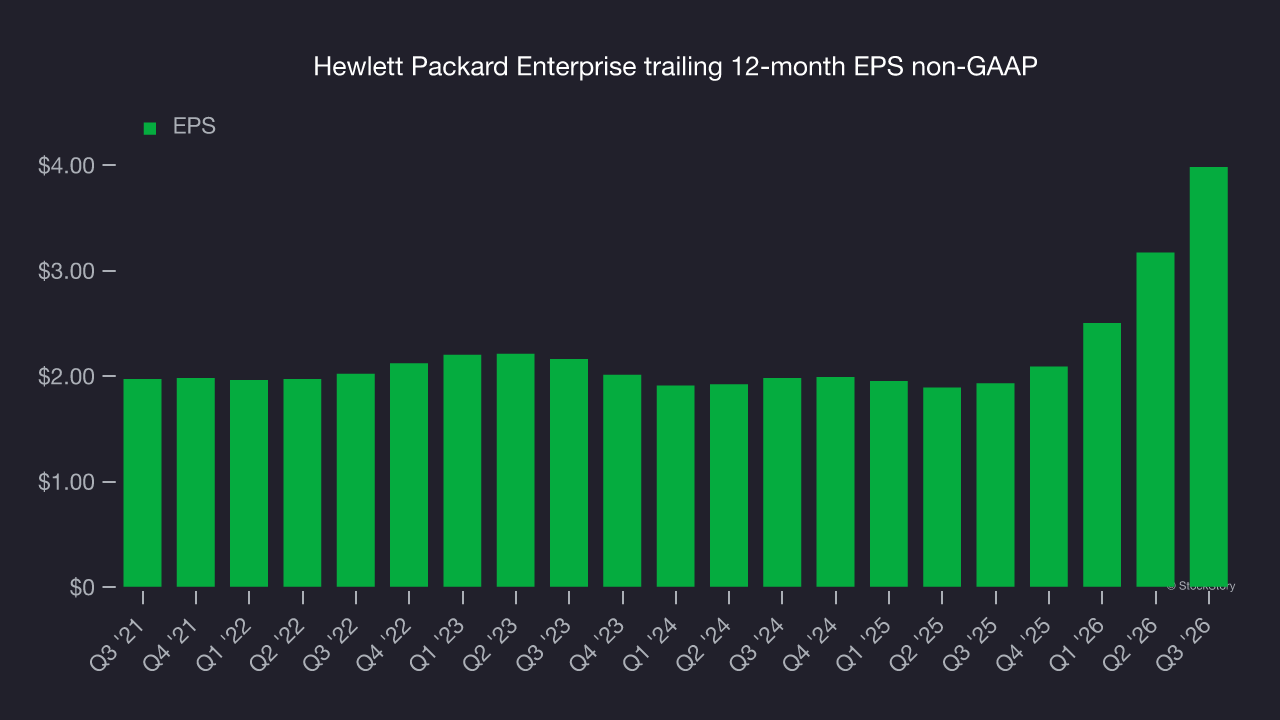
A closer look at Hewlett Packard Enterprise’s earnings helps explain its performance. As noted earlier, Hewlett Packard Enterprise’s adjusted operating margin expanded by 3.7 percentage points over the last five years. This was the most relevant factor (aside from the revenue impact) behind its higher earnings; interest expenses and taxes can also affect EPS but don’t tell us as much about a company’s fundamentals.
As with revenue, examining EPS over a more recent period can provide insight into an emerging theme or development for the business.
For Hewlett Packard Enterprise, its two-year annual EPS growth of 41.8% was higher than its five-year trend. That acceleration is a positive sign, especially given the already high growth base.
In Q3, Hewlett Packard Enterprise reported adjusted EPS of $1.43, up from $0.62 in the same quarter last year. EPS comfortably topped analysts’ consensus estimates, a positive result for shareholders. Over the next 12 months, Wall Street expects Hewlett Packard Enterprise’s full-year EPS to grow 18.8% from $3.98 to $4.73, according to S&P.
Key takeaways from Hewlett Packard Enterprise’s Q3 results
Hewlett Packard Enterprise’s outlook stood out among the quarter’s key positives: Next-quarter EPS guidance came in well ahead of analysts’ consensus estimates, and revenue guidance for the same period topped Wall Street’s consensus. Still, investors were likely hoping for more. Shares tumbled 7.1% to $45.44 immediately after the results.
Is Hewlett Packard Enterprise an attractive investment at the current price? The latest quarter matters, but not nearly as much as longer-term fundamentals and valuation when deciding whether to buy the stock. Read the full research report here (it’s free).