


EN
Pfizer (PFE) Signs New CAR T Deal, Is The Stock Undervalued?
Pfizer (PFE) just signed an exclusive licensing deal with Starna Therapeutics that grants it global rights, outside Greater China, to three early in vivo CAR-T programs for autoimmune diseases.
Pfizer’s latest in vivo CAR-T agreement comes after a choppy stretch for the shares, with the price down 5.1% over the past week and 8.8% over the past month, yet still up 8.8% year to date at about $27.40.
That short term weakness contrasts with a 1-year total shareholder return of 15.9%, helped by dividends, even though the 5-year total shareholder return is still down 31.5%. This suggests that recent momentum has improved from a low base.
Recent announcements around berobenatide funding, higher 2026 revenue guidance and new oncology and autoimmunity partnerships give investors additional data points to weigh against ongoing legal disputes and the long running impact of earlier patent expiries. These factors may help in assessing whether the latest pullback reflects rising perceived risk or a pause after a rebound.
Scan beyond Pfizer and consider other healthcare groups that are repositioning through partnerships and licensing deals using our hand picked 35 healthcare AI stocks.
Pfizer now trades at a discount to both analyst targets and some intrinsic value estimates after this pullback. Does that gap reflect an opportunity, or is it a fair price for the legal and patent overhangs?
Most Popular Narrative: 8% Undervalued
Pfizer’s analyst consensus Narrative on Simply Wall St puts fair value at about $29.72 per share compared with the last close of $27.40. This frames the current pullback as a discount that hinges on execution in obesity, oncology and cost savings.
“Execution on large scale productivity and manufacturing programs, now expected to deliver about US$9.7b in net savings through 2029 after already removing US$7.2b from the cost base, provides a longer runway for operating margin support and underpins earnings capacity while Pfizer increases R&D spending on oncology and obesity.”
See why 573 investors see Pfizer as 8% undervalued.
Result: Fair Value of $29.72 (UNDERVALUED)
Still, the Pfizer narrative can be knocked off course if pipeline setbacks limit expected oncology or obesity contributions, or if drug pricing pressure squeezes margins more than analysts model.
Find out about the key risks to this Pfizer narrative.
Another View: What Pfizer’s P/E Is Saying
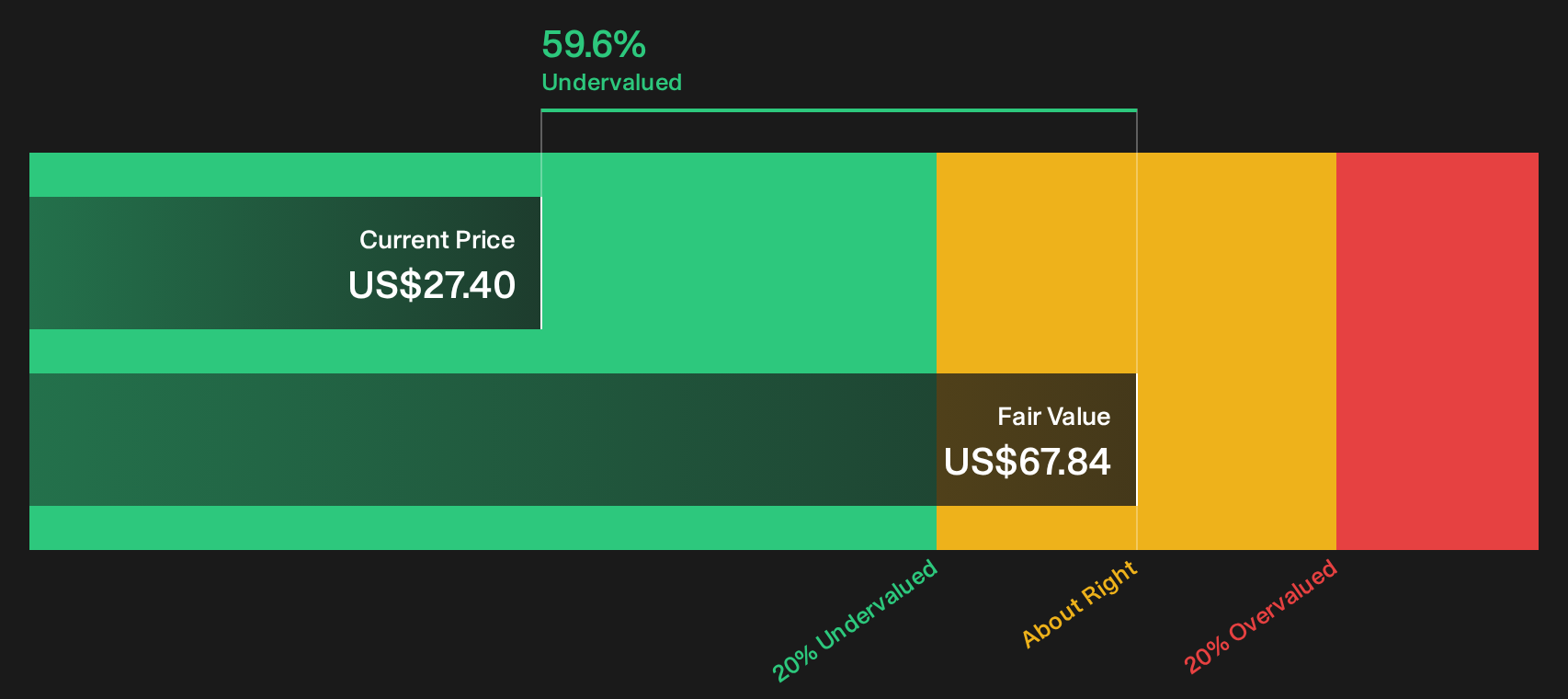
The SWS DCF model sees Pfizer as trading about 59.6% below an estimated future cash flow value of $67.84 per share, which points to an undervalued setup against the analyst fair value of $29.72. The gap is wide. Does that reflect hidden upside or just very optimistic cash flow assumptions?
Look into how the SWS DCF model arrives at its fair value.
Next Steps
If this mix of optimism and concern feels familiar, that is the point. The market rarely prices only one side of the story. Move quickly and pressure test the bullish and cautious arguments against your own expectations by weighing the 2 key rewards and 4 important warning signs.
Looking for more ideas beyond Pfizer?
Do not stop your research with Pfizer. The best portfolios usually blend several clear themes, and the screener can surface possibilities you may not have considered.
- Target resilient payouts by reviewing a curated set of income ideas through the 11 dividend fortresses.
- Hunt for potential value gaps by scanning companies that combine quality fundamentals with attractive pricing using the 40 high quality undervalued stocks.
- Prioritise financial strength by focusing on businesses with cleaner balance sheets and solid core metrics via the list of solid balance sheet and fundamentals (24 results).
Have feedback on this article? Concerned about the content? Get in touch with us directly. Alternatively, email editorial-team@simplywallst.com