


EN
Q3 earnings highlights: Nubank vs the rest of the personal loan stocks

The end of an earnings season can be a great time to discover new stocks and assess how companies are handling the current business environment. Let’s take a look at how Nubank NYSE:NU and the rest of the personal loan stocks fared in Q3.
Personal loan providers offer unsecured credit for various consumer needs. The sector benefits from digital application processes, increasing consumer comfort with online financial services, and opportunities in underserved credit segments. Headwinds include credit risk management in unsecured lending, regulatory oversight of lending practices, and intense competition affecting margins from both traditional and fintech lenders.
The 9 personal loan stocks we track reported a solid Q3. As a group, revenues beat analysts’ consensus estimates by 5.6% while next quarter’s revenue guidance was 1.1% above.
Amidst this news, share prices of the companies have had a rough stretch. On average, they are down 9.7% since the latest earnings results.
Nubank NYSE:NU
With well over one hundred million customers across Brazil, Mexico, and Colombia through its viral member-get-member referral program, Nubank (NYSE:NU) is a digital banking platform that offers financial services including spending, saving, investing, borrowing, and protection products to millions of customers across Latin America.
Nubank reported revenues of $6.26 billion, up 45% year on year. This print exceeded analysts’ expectations by 27.6%. Overall, it was a very strong quarter for the company with a beat of analysts’ EPS estimates.
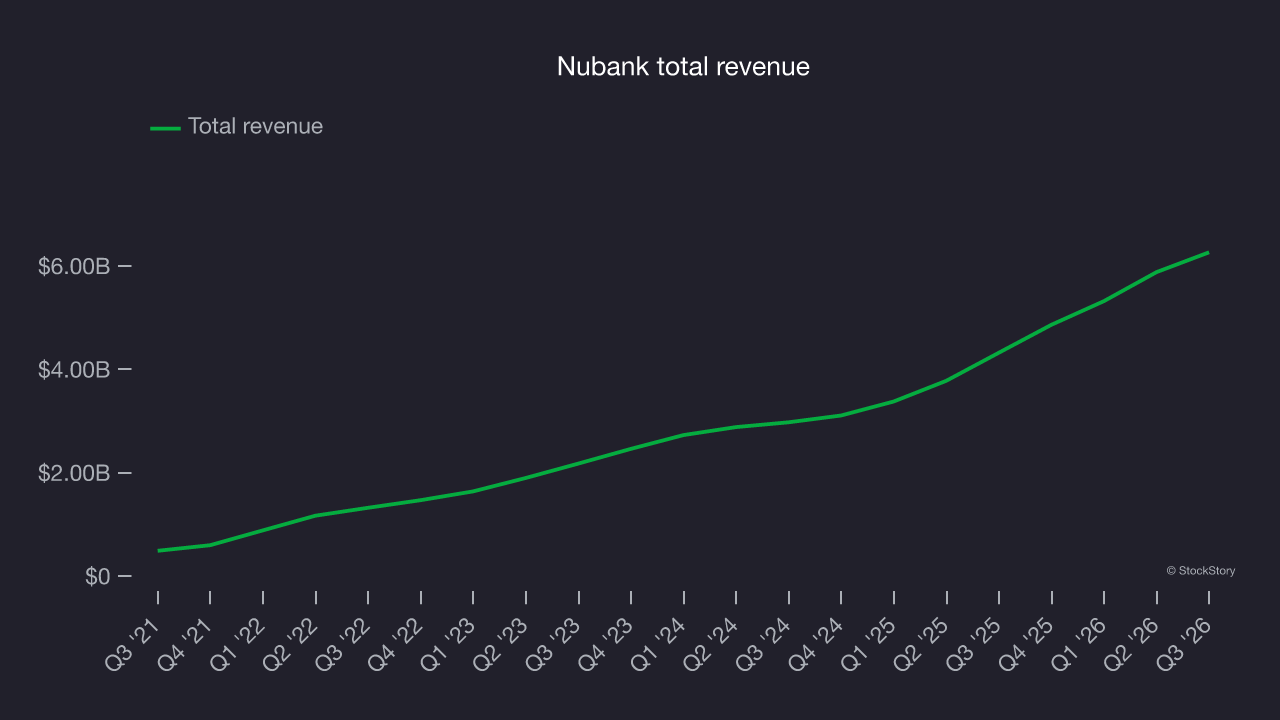
Nubank achieved the biggest analyst estimate beat among its peers. Investor expectations, however, were likely higher than Wall Street’s published projections, leaving some wishing for even better results (analysts’ consensus estimates are those published by big banks and advisory firms, not the investors who make buy and sell decisions). The stock is down 3.2% since reporting and currently trades at $11.45.
Read why we think that Nubank is one of the best personal loan stocks, our full report is free.
Best Q3: SoFi (NASDAQ:SOFI)
Starting as a student loan refinancing company founded by Stanford business school students in 2011, SoFi Technologies (NASDAQ:SOFI) operates a digital financial platform offering lending, banking, investing, and other financial services to help members borrow, save, spend, invest, and protect their money.
SoFi reported revenues of $1.37 billion, up 44.4% year on year, outperforming analysts’ expectations by 8.5%. The business had an impressive quarter with full-year revenue guidance exceeding analysts’ expectations and a solid beat of analysts’ transaction volumes estimates.
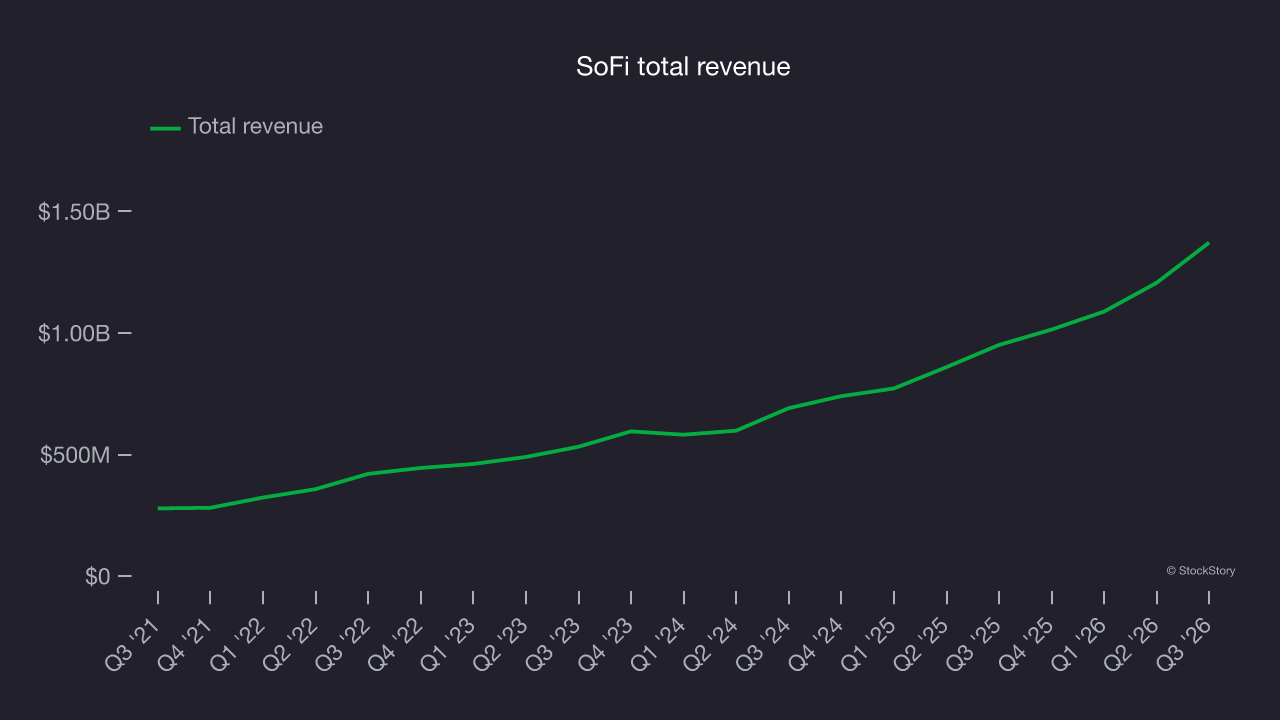
Although it had a fine quarter compared to its peers, the market seems unhappy with the results as the stock is down 11.8% since reporting. It currently trades at $12.76.
Is now the time to buy SoFi? Access our full analysis of the earnings results here, it’s free.
Weakest Q3: OneMain (NYSE:OMF)
Dating back to 1912 and formerly known as Springleaf, OneMain Holdings (NYSE:OMF) provides personal loans, auto financing, and credit cards to nonprime consumers who have limited access to traditional banking services.
OneMain reported revenues of $1.35 billion, up 6.9% year on year, exceeding analysts’ expectations by 1.1%. Still, it was a softer quarter as it posted a significant miss of analysts’ EBITDA estimates and a significant miss of analysts’ EPS estimates.
As expected, the stock is down 5.4% since the results and currently trades at $56.13.
Read our full analysis of OneMain’s results here.
Enova (NYSE:ENVA)
Pioneering online lending since 2004 with a massive database of over 65 terabytes of customer behavior data, Enova International (NYSE:ENVA) provides online financial services including installment loans and lines of credit to non-prime consumers and small businesses in the United States and Brazil.
Enova reported revenues of $1.01 billion, up 25.7% year on year. This result topped analysts’ expectations by 0.7%. Overall, it was a solid quarter as it also logged a solid beat of analysts’ EBITDA estimates and a beat of analysts’ EPS estimates.
The stock is down 5.9% since reporting and currently trades at $166.28.
Read our full, actionable report on Enova here, it’s free.
FirstCash (NASDAQ:FCFS)
Offering a financial lifeline to the unbanked and credit-constrained since 1988, FirstCash (NASDAQ:FCFS) operates pawn stores across the U.S. and Latin America while also providing retail point-of-sale payment solutions for credit-constrained consumers.
FirstCash reported revenues of $1.10 billion, up 17.7% year on year. This number surpassed analysts’ expectations by 2.4%. Zooming out, it was a mixed quarter as it also produced a beat of analysts’ EPS estimates but a miss of analysts’ EBITDA estimates.
The stock is down 22.6% since reporting and currently trades at $167.74.
Read our full, actionable report on FirstCash here, it’s free.
Market update
Over the past year, investors have been forced to repeatedly answer the same question: What is the market’s biggest risk? The answer has changed several times, and each shift has reshaped market leadership.
Late in 2025 and early 2026, artificial intelligence became the market’s primary uncertainty. Investors questioned whether AI would erode software pricing power and weaken competitive moats as AI made it easier to replicate once-differentiated products.
By the spring, technology took a back seat to geopolitics. The U.S. conflict with Iran briefly became the market’s dominant narrative, raising concerns about oil prices, inflation, and global growth. But as energy markets remained orderly and fears of a prolonged supply disruption faded, investors quickly turned their focus back to fundamentals.
Want to invest in winners with rock-solid fundamentals? Check out our Hidden Gem Stocks and add them to your watchlist. These companies are poised for growth regardless of the political or macroeconomic climate.