


EN
Investment banking & brokerage stocks Q3 highlights: PJT

Looking back on investment banking & brokerage stocks’ Q3 earnings, we examine this quarter’s best and worst performers, including PJT NYSE:PJT and its peers.
Investment banks and brokerages facilitate capital raises, mergers and acquisitions, and securities trading. The sector benefits from corporate activity during economic expansion, increased retail trading participation, and advisory opportunities in emerging sectors. Headwinds include economic cycle vulnerability affecting deal flow, compressed trading commissions due to electronic platforms, and regulatory capital requirements constraining certain higher-risk activities.
The 15 investment banking & brokerage stocks we track reported a solid Q3. As a group, revenues beat analysts’ consensus estimates by 5.3% while next quarter’s revenue guidance was in line.
Amidst this news, share prices of the companies have had a rough stretch. On average, they are down 7.2% since the latest earnings results.
PJT NYSE:PJT
Spun off from Blackstone in 2015 and founded by former Morgan Stanley executive Paul J. Taubman, PJT Partners (NYSE:PJT) is an advisory-focused investment bank that provides strategic advice, restructuring services, and fundraising solutions to corporations, boards, and investment firms.
PJT reported revenues of $385.1 million, down 13.9% year on year. This print fell short of analysts’ expectations by 1.3%, but it was still a solid quarter for the company with a solid beat of analysts’ EBITDA estimates and a beat of analysts’ EPS estimates.
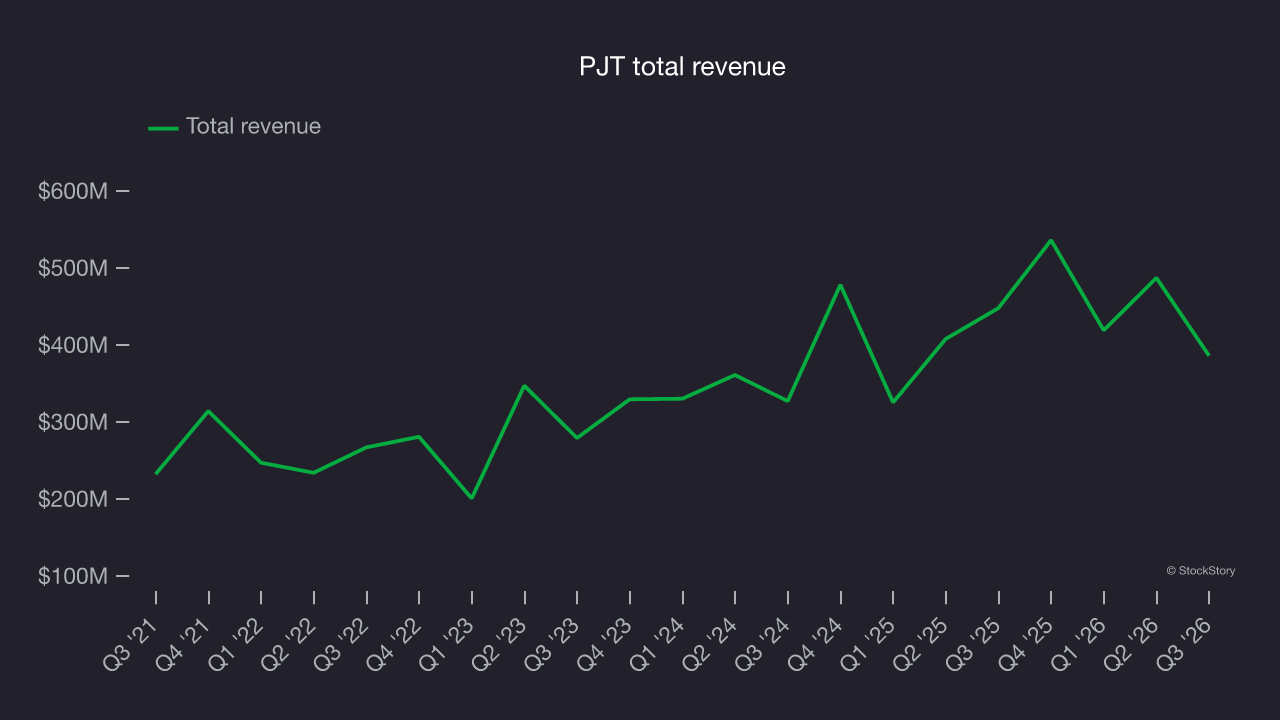
PJT delivered the slowest revenue growth in the group. Investor expectations, however, were likely higher than Wall Street’s published projections, leaving some wishing for even better results (analysts’ consensus estimates are those published by big banks and advisory firms, not the investors who make buy and sell decisions). The stock is down 8.4% since reporting and currently trades at $140.75.
We think PJT is a good business, but is it a buy today? Read our full report here, it’s free.
Best Q3: Evercore (NYSE:EVR)
Founded in 1995 as a boutique advisory firm focused on independence and client trust, Evercore (NYSE:EVR) is an independent investment banking firm that provides strategic advisory, capital markets, and wealth management services to corporations, financial sponsors, and high-net-worth individuals.
Evercore reported revenues of $1.18 billion, up 12.5% year on year, outperforming analysts’ expectations by 32.1%. The business had an exceptional quarter with a beat of analysts’ EPS estimates and a solid beat of analysts’ Investment Banking segment estimates.
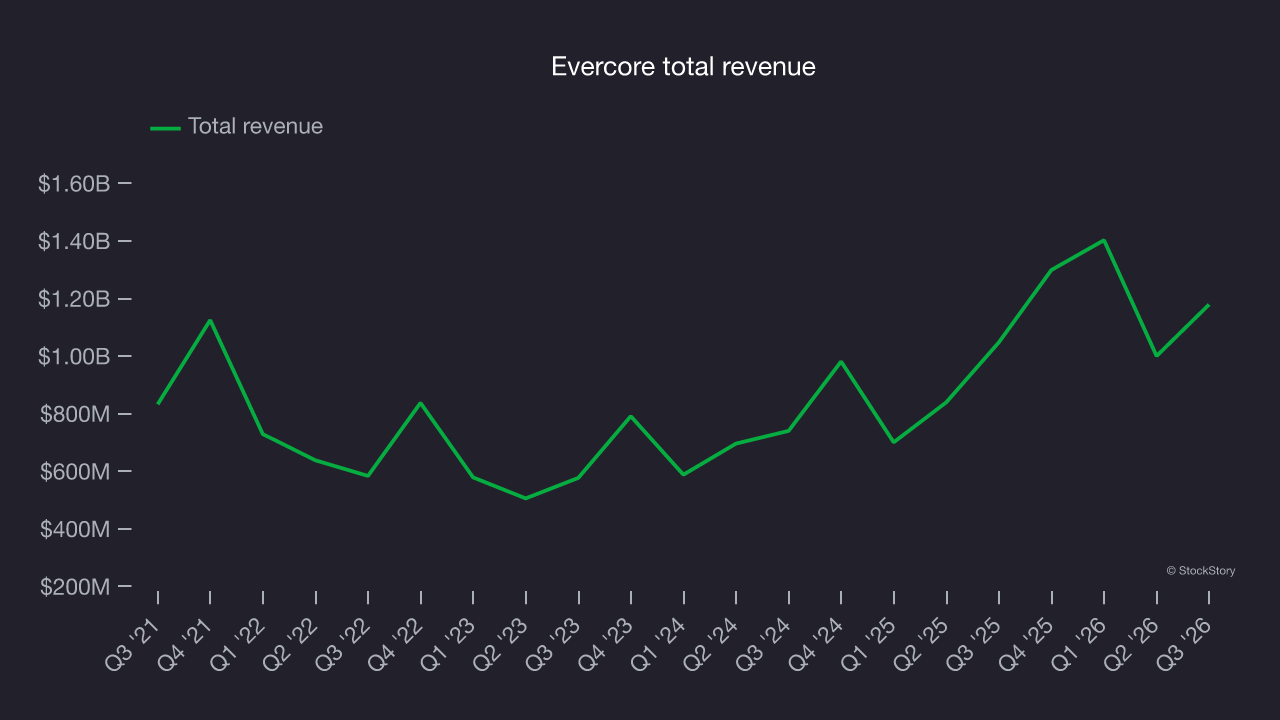
The market seems content with the results as the stock is up 4.2% since reporting. It currently trades at $270.75.
Is now the time to buy Evercore? Access our full analysis of the earnings results here, it’s free.
Weakest Q3: Lazard (NYSE:LAZ)
Tracing its roots back to 1848 when it began as a dry goods merchant in New Orleans, Lazard (NYSE:LAZ) is a global financial advisory and asset management firm that provides strategic advice to corporations, governments, institutions, and wealthy individuals.
Lazard reported revenues of $804.6 million, up 11% year on year, falling short of analysts’ expectations by 5.6%. It was an underwhelming quarter as it posted a significant miss of analysts’ EPS estimates and a slight miss of analysts’ AUM estimates.
Lazard delivered the weakest performance against analyst estimates among its peers. As expected, the stock is down 4.7% since the results and currently trades at $35.61.
Read our full analysis of Lazard’s results here.
Goldman Sachs (NYSE:GS)
Founded in 1869 as a small commercial paper business in New York City, Goldman Sachs (NYSE:GS) is a global financial institution that provides investment banking, securities, asset management, and consumer banking services to corporations, governments, and individuals.
Goldman Sachs reported revenues of $18.68 billion, up 23% year on year. This result surpassed analysts’ expectations by 11.5%. It was a favorable quarter as it also recorded a beat of analysts’ EPS estimates and a solid beat of analysts’ Banking & Markets segment estimates.
The stock is down 10.8% since reporting and currently trades at $797.49.
Read our full, actionable report on Goldman Sachs here, it’s free.
Charles Schwab (NYSE:SCHW)
Founded in 1971 as a disruptive force challenging Wall Street's high fees and limited access, Charles Schwab (NYSE:SCHW) is a wealth management and brokerage firm that provides investment services, banking, and financial advice to individual investors and independent advisors.
Charles Schwab reported revenues of $7.17 billion, up 16.9% year on year. This print met analysts’ expectations. Taking a step back, it was a mixed quarter as it also logged a beat of analysts’ EPS estimates but EBITDA in line with analysts’ estimates.
The stock is down 6% since reporting and currently trades at $90.97.
Read our full, actionable report on Charles Schwab here, it’s free.
Market update
Over the past year, investors have been forced to repeatedly answer the same question: What is the market’s biggest risk? The answer has changed several times, and each shift has reshaped market leadership.
Late in 2025 and early 2026, artificial intelligence became the market’s primary uncertainty. Investors questioned whether AI would erode software pricing power and weaken competitive moats as AI made it easier to replicate once-differentiated products.
By the spring, technology took a back seat to geopolitics. The U.S. conflict with Iran briefly became the market’s dominant narrative, raising concerns about oil prices, inflation, and global growth. But as energy markets remained orderly and fears of a prolonged supply disruption faded, investors quickly turned their focus back to fundamentals.
Want to invest in winners with rock-solid fundamentals? Check out our 9 Best Market-Beating Stocks and add them to your watchlist. These companies are poised for growth regardless of the political or macroeconomic climate.