


EN
Double financial report+historic merger and acquisition: demand for AI security explodes, CrowdStrike's acquisition of zScaler catalyzes the “wave of platform-based integration” in the cybersecurity industry
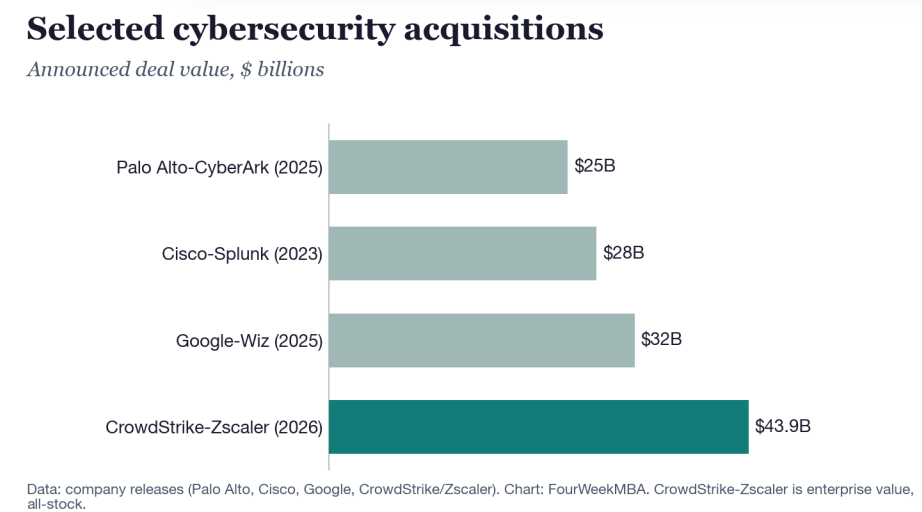
The Zhitong Finance App learned that before the market on Monday, CrowdStrike (CRWD.US) and Zscaler (ZS.US) handed over financial reports in advance at the same time and announced a final agreement: CrowdStrike will acquire zScaler in full stock, valuing the latter at about US$43.9 billion. Each share of Zscaler shareholders can be exchanged for 1.135 shares of CrowdStrike common stock. Based on the closing price on November 20, the exchange rate implied $260.41 per share, with a premium of about 34%. This is one of the largest deals in cybersecurity history, surpassing Alphabet's $32 billion acquisition of Wiz, which was announced in March 2025 and completed in March 2026.
But for this “almost no one doubts the direction” of this deal, the market gave a set of reverse pricing. The buyout rumor first came out after the market on November 20, EST. Insiders confirmed that the two sides were still in negotiations, with Zscaler up about 17% after the market and CrowdStrike falling about 8%; after the official announcement on November 23, pre-market readings continued to diverge — as of press release, Zscaler had risen 16% and CrowdStrike had fallen 8.5%. In the same transaction, the seller was given a premium on the “platform ticket”, but the buyer was immediately factored into the risk of equity dilution and consolidation.
The disagreement is not about “whether integration is the direction”, but who will complete the integration at what price and how much risk. At a time when the overall valuation of technology stocks is shrinking, CrowdStrike chose to use stocks that are still at least 30 times the market sales rate as currency to preempt the “network-side control surface in the AI era” — this is not only a strategic judgment, but also a use of its own valuation premium.
Why now: AI pushes the security boundary from the terminal to the full link
Demand-side data first pinned the background — IDC's “Global AI Security Spending Forecast, 2025-2029” predicts that in 2027, global AI security spending will reach 58.3 billion US dollars, a compound annual growth rate of 37.8%, which is the fastest growing segment in the security sector; total global security spending during the same period was 361.9 billion US dollars, an increase of 12.4% over the previous year. In other words, AI security spending is growing three times faster than the overall security market. IDC's estimates include AI-enabled security tools and services.
The real mechanic change is in the attack surface. Intelligence divides a business task into multiple calls across systems, and security decisions are distributed across terminals, networks, identity, and data. Deutsche Bank analyst Brad Zelnick (Brad Zelnick) and researcher Nasr Islam (Nasr Islam) gave an example in the November 23 report: Employees authorized agents to query cloud data warehouses to generate internal reports. The query itself can be compliant, but if the same agent sends customer details to an external model, it may exceed the authorization.
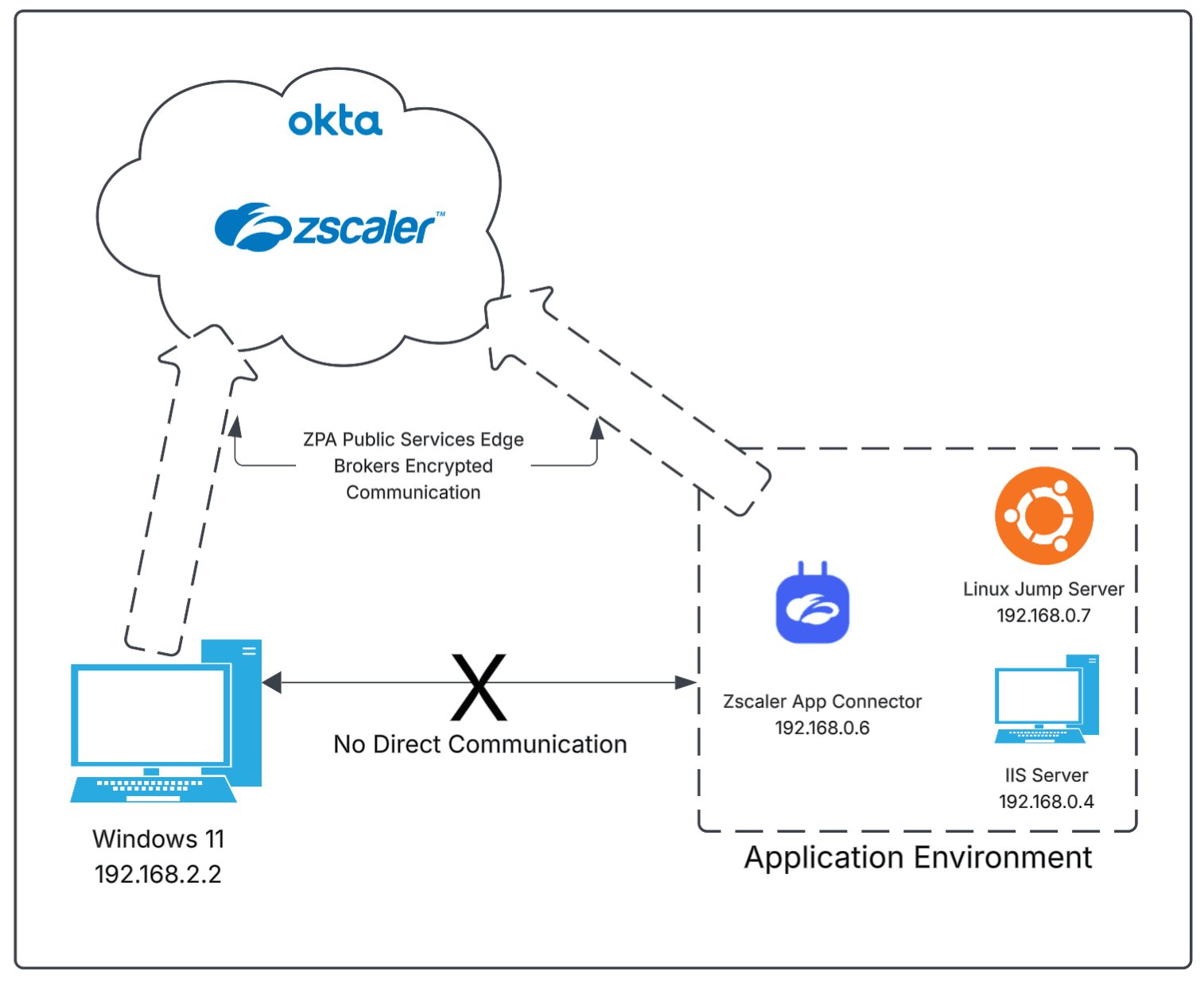
CrowdStrike's Falcon is good at observing processes, identities, and workload behavior from terminals and servers, while Zscaler's Zero Trust Exchange controls connections and data flows between users, branches, cloud environments, and applications through secure access to the service edge (SASE); it can only see part of the attack path by relying on terminal telemetry or network policies alone.
George Kurtz, founder and CEO of Crowdstrike, said, “With the acquisition of Zscaler announced today, we will make up for the network and enter the largest accessible market in the security field as a large-scale leader,” adding that “Falcon is a secure operating system for the proxy AI era”; Jay Chaudhry, founder and CEO of zscaler, said that AI “is driving the most significant security transformation of our generation”. The Zero Trust architecture is critical in cloud and mobile migration Importantly, “negotiation is not possible in the age of proxy AI”, and “security in place is an accelerator for AI.”
Looking at the pace of the industry, this deal is not an exception, but a favorable example of the latest wave of mergers and acquisitions in the industry. Alphabet acquires Wiz for $32 billion in full cash (announced in March 2025, delivered on March 11, 2026), Palo Alto Networks acquired CyberArk for approximately $25 billion in cash plus shares (announced in July 2025, with a premium of about 26%, delivery on February 11, 2026), ServiceNow for $7.75 billion (announced in December 2025), and Fortinet acquired an AI security company in August 2026 VirtueAI.
According to SecurityWeek tracking, there were 426 cybersecurity mergers and acquisitions in 2025, with 74 disclosures totaling US$92.5 billion and 11 exceeding US$1 billion, with a year-on-year increase of about 82%; according to Momentum Cyber statistics, about 90% of transactions in the first half of 2026 were completed by strategic buyers (historical typical value of about 60%), and AI security-related mergers and acquisitions rose from 10 in 2025 to 29 in the first half of 2026.
Based on this, TD Cowen analyst Shaul Eyal judged that cybersecurity integration “may be entering a more substantial stage” and maintaining CrowdStrike's purchase rating and target price of $280. The mergers and acquisitions of the previous two years were a “supplement category” — supplementing cloud security, supplementing identity, and supplementing data; this round of supplementation was the AI security control plane, that is, whether it is possible to implement a unified strategy for every tool call, every use of a certificate, and every data flow of the intelligent body.
What to buy: Closed loop of data on the network side, not product line superposition
The core asset of the acquisition was not zScaler's SASE product line itself, but rather network-side behavioral and data flow records — it filled Falcon's structural gaps in the dimensions of “where the request was sent and whether the current identity was granted access”. According to framework data provided by users, Falcon generates trillions of events every day from terminals and cloud workloads, and Zero Trust Exchange processes more than 750 billion transactions per day, covers more than 200 service nodes, and protects about 50% of the Fortune 500. Once the two end data are linked, the model can be trained on the “complete attack path of the attacker”, which cannot be achieved with terminal data alone. Deutsche Bank also found in the Black Hat 2026 industry survey that peers still regard CrowdStrike's limited native network capabilities as an obvious gap.
The cross-selling numbers are clear: CrowdStrike says around 8,000 ZScaler customers have yet to use its platform, and the two parties already have more than 2,000 joint customers. The deeper mechanism is the Falcon Flex contract system — after making a purchase commitment, the customer can flexibly add or remove two products within the same contract, and the platform switching cost is structurally raised. As for the accessible market, the two sets of standards need to be viewed separately: CrowdStrike set the expanded TAM at more than US$185 billion (based on the 2029 calendar year); Deutsche Bank believes that it “nearly doubled” after adding zero trust user access, branch office security, and expanding cloud zero trust and data security as a base. The base year is different from the definition and cannot be directly compared.
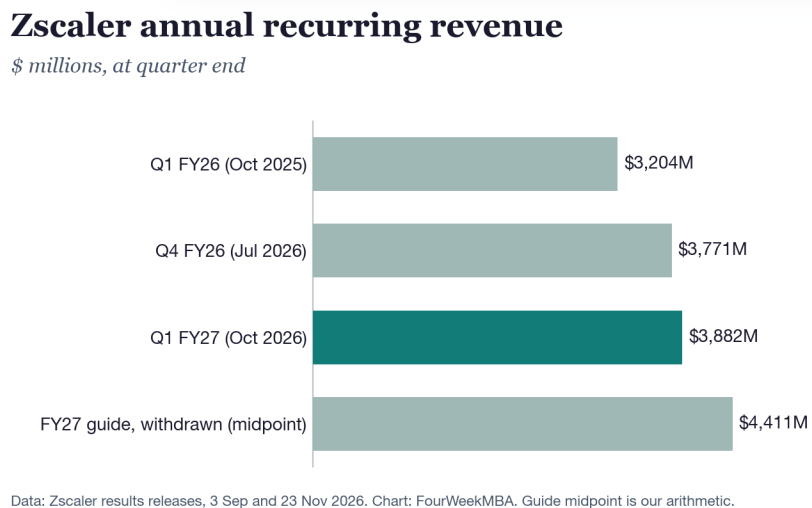
However, zscaler's AI security assets are still very small. At the end of FY2026, its Security for AI business was about 70 million US dollars, less than 2% of the total ARR (about 3.77 billion US dollars), although the growth rate was more than ten times. A significant portion of the $43.9 billion is pricing “entry eligibility for network control points in the AI security era” rather than zScaler's current AI security revenue — this is both a source of strategic rationality and a source of valuation risk.
“Same speed, different price” in financial reports: high-multiple stocks are the acquisition of currency
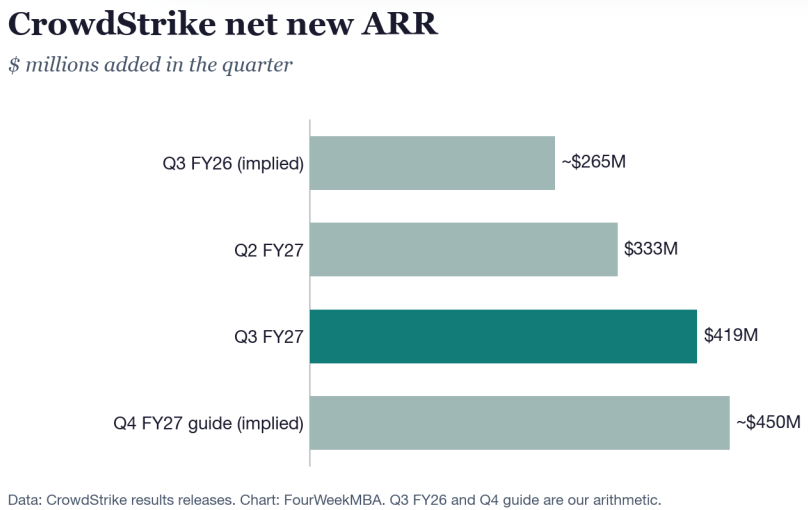
CrowdStrike's latest quarter (FY2027 Q3, ending October 31, 2026) set a record for almost all: revenue of US$1,583.4 billion, up 28% year on year ($1,234.2 billion in the same period last year), subscription revenue of 1,502.9 billion yuan, an increase of 29%; ARR of 6.26 billion US dollars at the end of the period, an increase of 27%, for the fifth consecutive quarter; a net increase of US$419.2 million in a single quarter, a sharp increase of 58%, the highest in the company's history. Non-GAAP net profit of $354.9 million ($245.4 million in the same period of the previous year), non-GAAP diluted EPS of $0.34 (0.24 in the same period of the previous year); GAAP diluted EPS of $0.02, reversing losses year over year. Operating cash flow of $665.2 million and free cash flow of $474.4 million both hit record highs, with GAAP/non-GAAP subscription gross margins of 79%/82%, respectively.
52%/36%/26% of subscribed customers used 6 or more/7 and more/ 8 or more modules; Falcon Guardian for enterprise AI smart security surpassed $100 million in ARR for the first year after the end of the quarter. The company simultaneously raised FY27's full-year revenue to $6,084.1 billion, non-GAAP EPS to $1.28 billion, and raised the FY27 net ARR growth guide by 1,060 basis points to a median value of 45% — but the above guidelines only cover existing business and do not include Zscaler. CFO Burt Podbere said in a written statement that the deal is expected to significantly increase free cash flow per share after settlement and “does not include any synergy.”
Zscaler's FY2027 Q1 (also ending October 31, 2026) was not weak: revenue of US$949.3 million, up 20% (US$788.1 million in the same period last year), higher than Koyfin's consolidated forecast of US$938 million; an ARR of US$3882 million at the end of the period, an increase of 21%; a net increase of US$111 million, after excluding the $98 million contribution from the acquisition of Red Canary in the same period last year.
Non-GAAP operating profit of US$230.2 million, operating margin of 24.3% (US$171.9 million/ 21.8% in the same period last year), and non-GAAP diluted EPS of US$1.23 (0.96 in the same period last year), higher than market expectations of US$1.16 million; operating cash flow of $541 million and free cash flow of US$416.5 million all set records, with remaining performance obligations of $7.287 billion, an increase of 23%. However, due to the acquisition, Zscaler cancelled the original conference call and withdrew previously issued financial guidelines.
The ARR growth rates of the two companies in the latest quarter were 27% and 21%, respectively, and revenue growth rates were 28% and 20%, respectively. The difference was not large, but there was a huge gap in valuation. According to framework data estimates, Zscaler is about 8.4 times ARR and CrowdStrike is about 40.2 times, a difference of about 4.8 times; one verifiable cross section is that as of December 31, 2025, CrowdStrike was about 30.0 times the revenue for the past 12 months, Rapid7 was only 1.9 times, WiZ was about 32 times ARR, and CyberArk was about 18.6 times ARR.
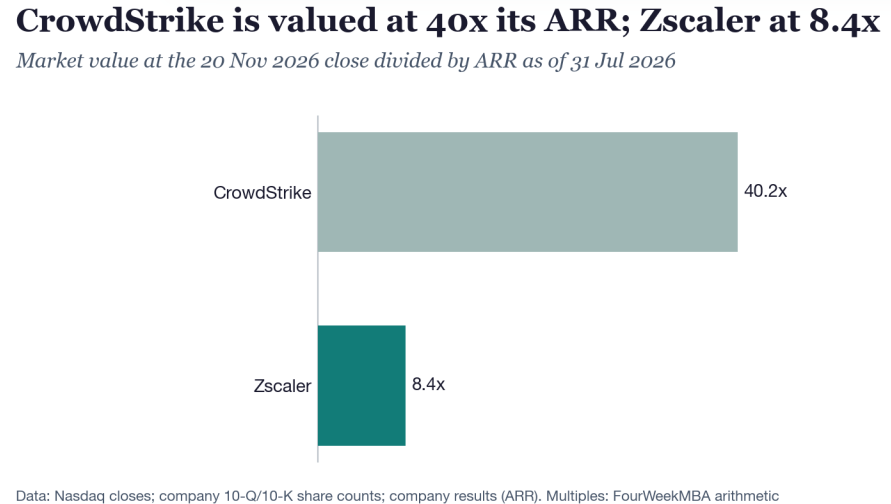
Capital is concentrated on platforms and AI native stacks, and the long-term revenue multiples of cloud security and SASE leaders are significantly higher than traditional legacy stacks. This is the key motive for the transaction: Zscaler is unable to obtain a valuation premium that matches the quality of growth in an independent state, and CrowdStrike's high-multiple stocks just provide room for valuation arbitrage; using high-multiple stocks as a counterprice makes it easier to create “thickening” in accounting, but buyers must continue to prove that the growth premium can be absorbed and diluted.
The full stock transaction is expected to issue approximately 17.7% of new shares. After the transaction is completed, CrowdStrike's original shareholders will hold about 84.1% of the consolidated company and 15.9% of Zscaler's shareholders. According to the simple sum of the ARR of the two companies in the last quarter of about 10.14 billion US dollars, “ARR over 10 billion dollars after the merger” is the sum of exam preparation; it is not the company's financial disclosure standard. GAAP profits were likely to be basically flat at the beginning of the merger. The so-called increase came more from accounting standards than from operational improvements.
Regulatory risk: The correct industry logic does not mean that the transaction can be completed
The judgment given by Deutsche Bank's Zelnick team was the most calm: the merger between the two parties had a clear industrial logic, but “the possibility of reaching a final regulatory approval transaction is less than 50%”; the bank still maintains the “buy” ratings for the two stocks, with target prices of 300 US dollars and 215 US dollars respectively, which is about 30.8% and 10.4% higher than the regular closing price on November 20, respectively. The probability of a successful transaction implied in market pricing is about 50%, which is roughly in line with Deutsche Bank's judgment. The two companies overlap in multiple categories of endpoint security, SASE, and zero trust network access, and US and European antitrust reviews are almost inevitable; the deal is not expected to be completed until the second half of CrowdStrike FY2028, and this schedule itself already implies expectations for a long review cycle.
Why is the seller willing to discuss it? Deutsche Bank's valuation deduction provides a clue: Zscaler's market value was about 32 billion US dollars at the time, and reached 55 billion dollars less than a month ago; using Palo Alto's acquisition of CyberArk about 17 times the corporate value/revenue for the next 12 months as a precedent and adjusted according to growth differences, the implied equity value is about 55 billion US dollars. If the cybersecurity ETF (BUG) increases of about 27% since the transaction was announced, the scenario value is close to 70 billion US dollars. These are deductions made before the terms of the offer were made public; they are not in the same caliber as the actual consideration of 43.9 billion US dollars. The attitude of Jay Chaudhry, the founder and largest shareholder, is also critical — he holds about 34% of Zscaler's shares with related parties, has signed a voting agreement, and will continue to lead Zscaler and join the CrowdStrike board of directors after delivery; both boards of directors have unanimously approved it.
The depth of technology integration requires far more than the average interface between products. To establish the acquisition logic, “one platform, one data layer, one contract” must be achieved: Zero Trust Exchange and Falcon terminal telemetry are integrated in the data layer, the cutting-edge security model is retrained on the merged data set, and the Falcon Flex contract system accommodates all of Zscaler's product logic. As a result, consolidation risk became CrowdStrike investors' second biggest concern other than dilution. However, Zscaler's own execution problems will not disappear due to the acquisition narrative — the market reaction was negative after the release of its results for the first quarter of the 2026 calendar year, two senior sales leaders left, new customer growth was uncertain, and execution in the European market slowed; the acquisition provided a “strategic exit” narrative, but if integrated and distracted management's attention, the leverage of 8,000 cross-selling customers may first encounter organizational friction before being realized.
Platform-based end: who is being squeezed, and who wins and loses
The pressure first fell on Palo Alto Networks (PANW.US). TD Cowen's Eyal believes that after the merger, the entity will become a more difficult competitor in multiple categories; Deutsche Bank also determined that there are only a few manufacturers that can cover major AI attack-related markets after the merger, and Palo Alto and Microsoft (MSFT.US) “to a certain extent” are the only comparable players.
Palo Alto himself isn't unprepared. Its FY2027 Q1 (as of October 31) revenue announced on November 18 was about US$3.445 billion, up 39% year on year, higher than LSEG's aggregate forecast of US$3.31 billion; next-generation security ARR increased 66% to US$9.73 billion, and remaining performance obligations increased 35% to US$21 billion; the intelligent traffic on the SASE platform was about 9 times that of the same period last year, and ARR was close to US$170 million after Prisma AIRS was officially put into business for five quarters.
At the same time, the company announced the acquisition of the AI model platform Applied Compute for 4.5 billion US dollars, extending its capabilities from “checking AI traffic” to post-training and reasoning. Financial reports for the same period confirm the demand side quite solidly: AI calls are being converted into paid contracts.
A deeper industry signal is that platformization is changing from a growth strategy to a living condition. The valuation differentiation of the security sector has clearly priced this layer of logic — cloud security and SASE leaders' transactions are 14-22 times the forward revenue, and the legacy stack of traditional cybersecurity is only 5-8 times; even if Zscaler maintains growth of around 20%, independent valuation is lower than its strategic value as part of the platform. Deutsche Bank, on the other hand, emphasized that feedback from its channel research is still strong. The company's guidelines implied that net addition of ARR increased by more than 20% for three consecutive years, so this is more like “actively supplementing network capabilities” rather than seeking external growth after core business stalls.
AI security requirements are indeed speeding up industry integration, and CrowdStrike is indeed paying a price that matches “AI security control plane entry eligibility.” However, the full stock consideration of 43.9 billion US dollars, the probability of passing regulations of less than 50%, the equity dilution of about 17.7%, and the deep integration requirements of the two platforms at the data layer and contract layer together form a set of hypotheses that can only be verified after the fact. If the deal is completed, the cybersecurity industry will further converge from “multi-point optimization” to two to three platform operating systems; if blocked by regulation or integration falls short of expectations, Zscaler's independent valuation will continue to bear the pressure of “declining growth rate and mismatch in multiples”, and CrowdStrike will need to fill Falcon's visibility gap on the network side in other ways.