


EN
AMAT Stock Alert: David Tepper Just Poured $115 Million on This Tumbling AI Chip Stock
When a billionaire hedge fund manager makes a major move, investors naturally pay attention. But sometimes, the most interesting part isn't what they buy. It's what they are willing to sell to make room for it.
That's exactly what makes Applied Materials (AMAT) worth watching right now. David Tepper's Appaloosa Management just opened a new $115 million position in the semiconductor equipment maker, even as the stock struggles through a painful sell-off.
Interestingly, Tepper also exited his entire positions in AMD (AMD), Broadcom (AVGO), and Qualcomm (QCOM) during the same quarter. That raises an important question: Is he simply rotating his semiconductor exposure, or does he see something Wall Street is missing?
So, it makes complete sense that Tepper would bet at a time when Applied Materials has had its best quarter ever and when demand for AI has been surging.
Why Applied Materials Stock Has Been Under Pressure
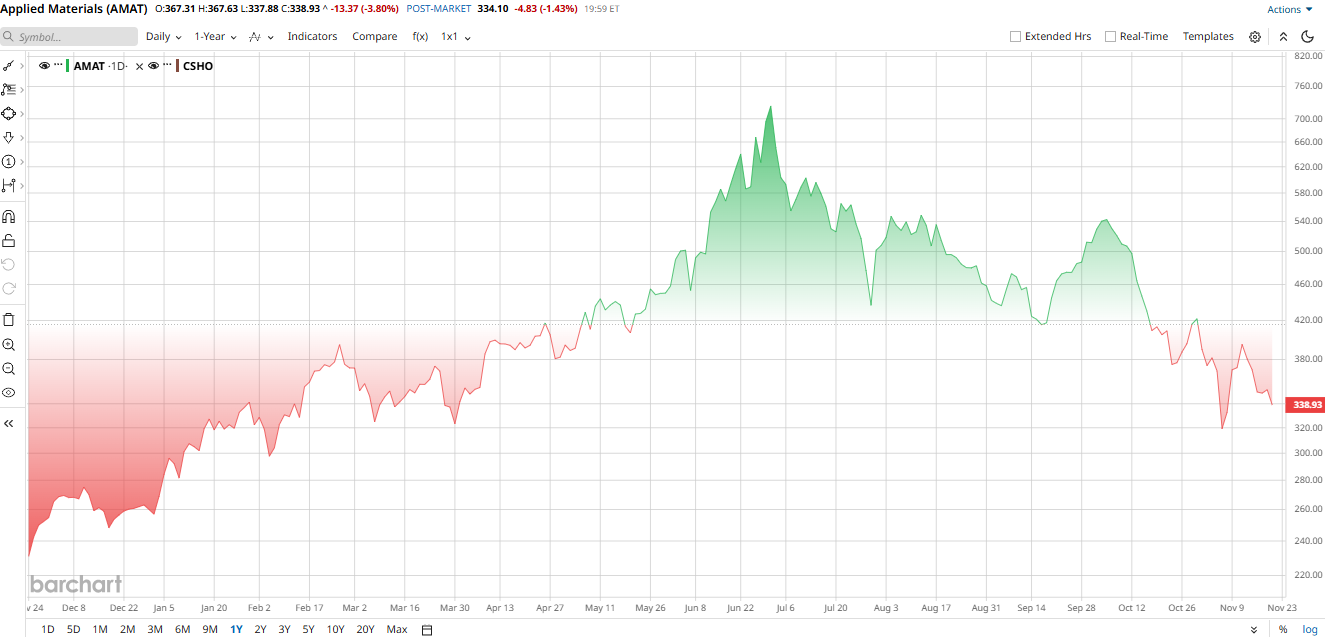
Applied Materials has delivered impressive returns this year, but the recent weakness has changed the picture.
Shares are up approximately 32% year to date (YTD); however, the stock has fallen nearly 29% over the last three months and roughly 18% in the past month.
A downturn has hit the wider semiconductor industry as traditional and anticipated big spending on AI has been rethought. The Fed's September rate increase was another worry, and it raised questions about borrowing costs and high-growth technology company valuations.
Applied Materials was hit by the sell-off despite strong underlying business momentum. That made AMAT’s valuation somehow expensive. Its Price-to-Sales ratio is 8.53, well above the sector median of 3.28, and Price-to-Book is also elevated at 11.25 versus the sector’s 3.29. However, the company trades at a forward P/E of 19.44, cheaper than the sector’s 27.10. This suggests that while the stock is costly in several metrics, its earnings relative to price are more attractive.
What David Tepper's $115 Million Bet Really Means
Tepper's latest 13F filing, submitted on Nov. 16, revealed that Appaloosa purchased 225,000 shares of Applied Materials during the third quarter. The position was worth approximately $115 million at quarter-end prices, representing about 1.5% of its disclosed equity portfolio. But the bigger story is what Tepper did elsewhere.
In the same quarter, he exited completely from his roles in AMD, Broadcom, and Qualcomm. He wasn't ready to do away with all semiconductor exposure but instead turned to the equipment manufacturer that provides the technology required to produce some of today's advanced chips.
That distinction matters. AMD and Broadcom will design the chips, while Applied Materials will provide the machinery and manufacturing techniques to produce advanced semiconductors. No matter which chip designer emerges victorious, Applied stands to benefit as chipmakers increase capacity to satisfy the demand for AI.
This is the classic “picks and shovels” approach to investing, but Tepper is gradually gaining exposure to the broader AI infrastructure ecosystem rather than betting on just one chipmaker.
He isn't alone in his interest in the firm. Of the 460 large funds that disclosed holdings in the third quarter, 27 increased their Applied Materials holdings, while 27 cut their stakes. There continues to be a split in institutional sentiment, but it's Tepper's move that stands out.
Record Earnings Show AI Demand Is Still Growing
Applied Materials reported fiscal fourth-quarter results on Nov. 12, delivering record revenue of $10.41 billion, up 53% year over year. Adjusted earnings per share jumped 92% to $4.16, while net income increased 43% to $2.718 billion.
For the full fiscal year 2026, revenue reached $34.45 billion, representing 21% growth. The company also generated $6.2 billion in free cash flow, while gross margin expanded for the 14th consecutive quarter.
More importantly, management sees demand continuing to strengthen. CEO Gary Dickerson said leading indicators continue pointing upward, highlighting AI-driven wafer demand and leading-edge logic and DRAM factories operating at full utilization.
Advanced packaging is another important growth opportunity. This technology allows memory and processors to work together more efficiently, improving performance for demanding AI applications. Management expects the business to grow approximately 90% this calendar year, with strong growth continuing into 2027.
For the current quarter, management expects revenue of $11.1 billion and adjusted EPS of $4.35. That would represent year-over-year growth of approximately 58% and 83%, respectively.
Wall Street Sees Significant Upside for AMAT Stock
Wall Street remains overwhelmingly optimistic despite the recent sell-off.
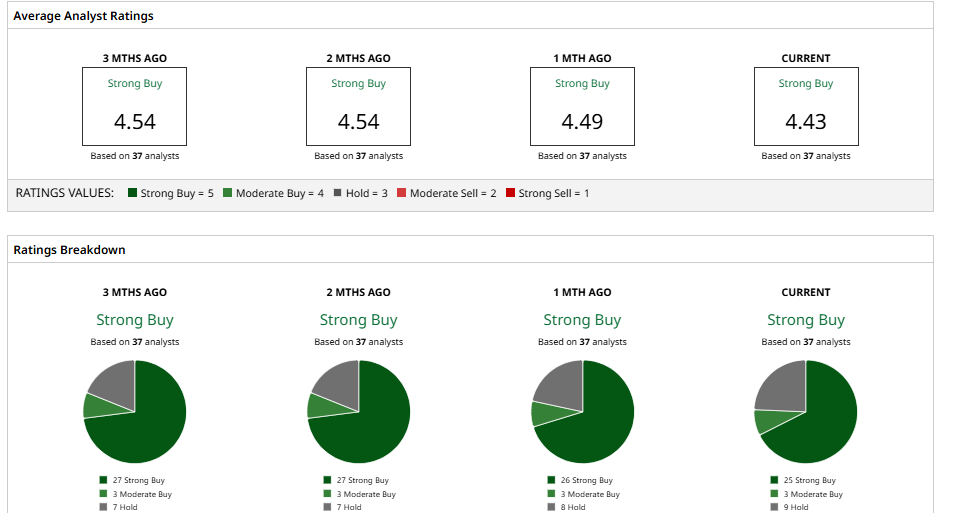
According to Barchart, Applied Materials carries a “Strong Buy ”consensus among 37 analysts, including 25 “Strong Buy” ratings, three “Moderate Buys,” and eight ”Holds.”
The average price target stands at $634.9, suggesting approximately 66% upside from its recent price. The highest target reaches $900.
Beyond the ratings, analysts are focusing on Applied's ability to capture a growing share of semiconductor equipment spending. UBS analyst Timothy Arcuri maintained a Buy rating with a $695 price target, highlighting the company's potential to outgrow the broader wafer fabrication equipment market.
Conversely, Bernstein cut its target from $700 to $600, which shows a more conservative valuation multiple rather than abandoning its growth expectations.
Similarly, Morgan Stanley has lowered its price target from $538 to $507. Although solid underlying fundamentals exist, its location leaves the short-term valuation and market scenario an issue.
So it looks like the disagreement over the valuation of AI demand is about whether it is boosting company valuations, rather than the growth itself.
On the date of publication, Nauman Khan did not directly have a position in any of the securities mentioned in this article. All information and data in this article is solely for informational purposes. For more information please view the Barchart Disclosure Policy here.