


EN
What Are Wall Street Analysts' Target Price for COMPANY NAME Stock?
Qnity Electronics, Inc. (Q) is a pure-play advanced electronics company that develops high-performance materials and integration solutions for semiconductor manufacturing, advanced computing, and connectivity. Based in Wilmington, Delaware, the company’s products support AI chips, printed circuit boards, electronic devices, and high-speed data transmission across technology industries. It has a market capitalization of approximately $21.6 billion.
Shares of this leading semiconductor materials manufacturer have considerably outperformed the broader market over the past year. Q has gained 38.1% over this period, while the broader S&P 500 Index ($SPX) has posted a 5.7% gain. On a year-to-date basis, Q has also continued to outperform, climbing 26.7%, compared with the index’s marginal gain over the same period.
Narrowing the comparison, Q has matched the performance of the iShares Semiconductor ETF (SOXX), with both gaining 38.1% over the past year. However, Q has outperformed the ETF year-to-date, compared with SOXX’s 22.9% gain.
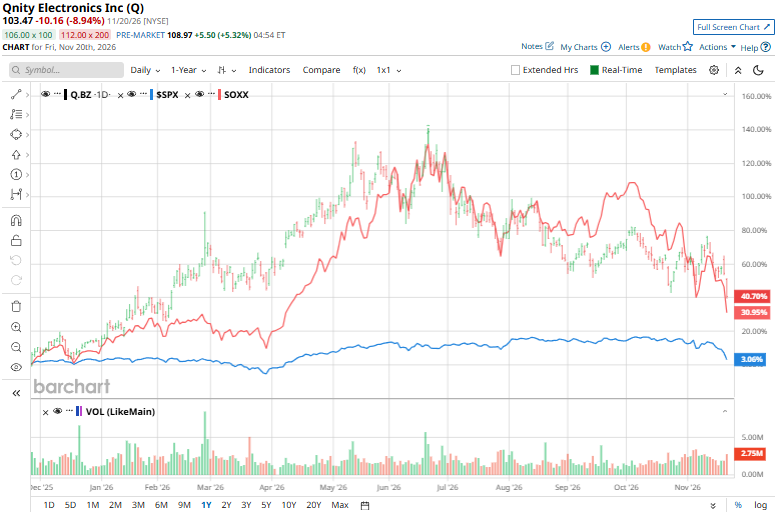
On Nov. 4, 2026, Qnity Electronics reported Q3 2026 net sales of $1.56 billion, up 21.9% year over year. Adjusted Operating EBITDA increased 35.9% to $503 million, while adjusted EPS climbed 55.3% to $1.46. However, net income declined 12.1% to $196 million. Both business segments contributed to revenue growth, with Semiconductor Technologies sales increasing 15% to $797 million and Interconnect Solutions sales rising 30.2% to $759 million. Adjusted gross margin was 47.8%. Following the results, Q shares declined only marginally.
For full-year 2026, Qnity raised its guidance, forecasting net sales of $5.77 billion to $5.83 billion, Adjusted Operating EBITDA of $1.785 billion to $1.805 billion, and adjusted EPS of $4.95 to $5.05. The company also expects adjusted free cash flow of $800 million to $900 million. Management attributed the improved outlook to strong third-quarter performance and continued business momentum.
Earlier, on Oct. 21, 2026, Qnity introduced ultra-thin flexible circuit materials based on Kapton polyimide films and Pyralux flexible laminates for next-generation consumer electronics, including smartphones, AI glasses, and AR/VR devices. These innovations enhance design flexibility, signal integrity, mechanical durability, and reliability, positioning the company to capitalize on growing demand for miniaturized, high-performance components driven by edge AI and connected devices.
For the current fiscal year ending in December 2026, analysts expect Q’s diluted EPS to increase 49.3% to $5. Notably, Q has surpassed consensus EPS estimates in each of the past four quarters, demonstrating a consistent track record of earnings outperformance.
Among the 11 analysts covering Q stock, the consensus rating is “Strong Buy,” based on 10 “Strong Buy” and one “Moderate Buy” recommendation.
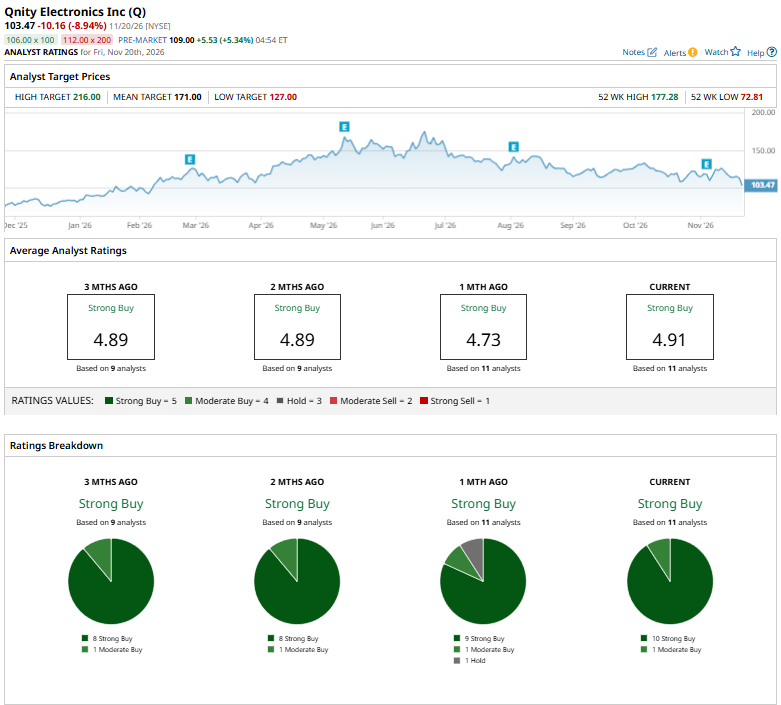
Q’s analyst outlook is more bullish than it was a month ago, when the stock had nine “Strong Buy” ratings.
On Nov. 6, 2026, Barclays analyst Aleksey Yefremov maintained a “Buy” rating on Qnity Electronics and raised the price target from $211 to $216.
The mean price target of $171 implies a 65.3% upside from Q’s current share price, while the Street-high target of $216 suggests potential upside of 108.8%.
On the date of publication, Abhishek Bhuyan did not directly have a position in any of the securities mentioned in this article. All information and data in this article is solely for informational purposes. For more information please view the Barchart Disclosure Policy here.