


EN
Nvidia Just Lost Nearly Half Its Value. A 62-Year-Old With $1 Million in an S&P 500 Index Fund Owns About $50,000 of It Without Buying a Share
Consider a 62-year-old with $1 million in a 401(k) who has never bought a single share of Nvidia (NASDAQ: NVDA). That saver owns Nvidia anyway: about $50,000 of it if the money sits in an S&P 500 index fund, and roughly $14,000 if it sits in a 2030 target-date fund.
Nvidia closed Friday at $125.53, 47.5% below its Oct. 6 record close of $239.24. The stock lost nearly half its value in six weeks, and if you hold either kind of fund in your own 401(k), a slice of that loss is yours. The fund figures here come from 24/7 Wall St.’s new research report, "Nvidia Without Jensen," which traced Nvidia through the holdings that fund companies publish and file.
Nvidia’s fall reads as a warning to check how much of your 401(k) rides on a handful of giant stocks, because seven companies make up 32.5% of the S&P 500 fund; the limit of that reading is that the same fund fell 11.5% while one of its biggest stocks lost nearly half its value.
What an S&P 500 index fund holdsNvidia was 5.7% of the SPDR S&P 500 ETF on Nov. 19, the day before Friday’s 14% drop, according to State Street Global Advisors’ daily holdings. Only Apple, at 8.2%, and Microsoft, at 6%, were bigger. An S&P 500 index fund on a 401(k) menu tracks the same index, so its weights are close to these.
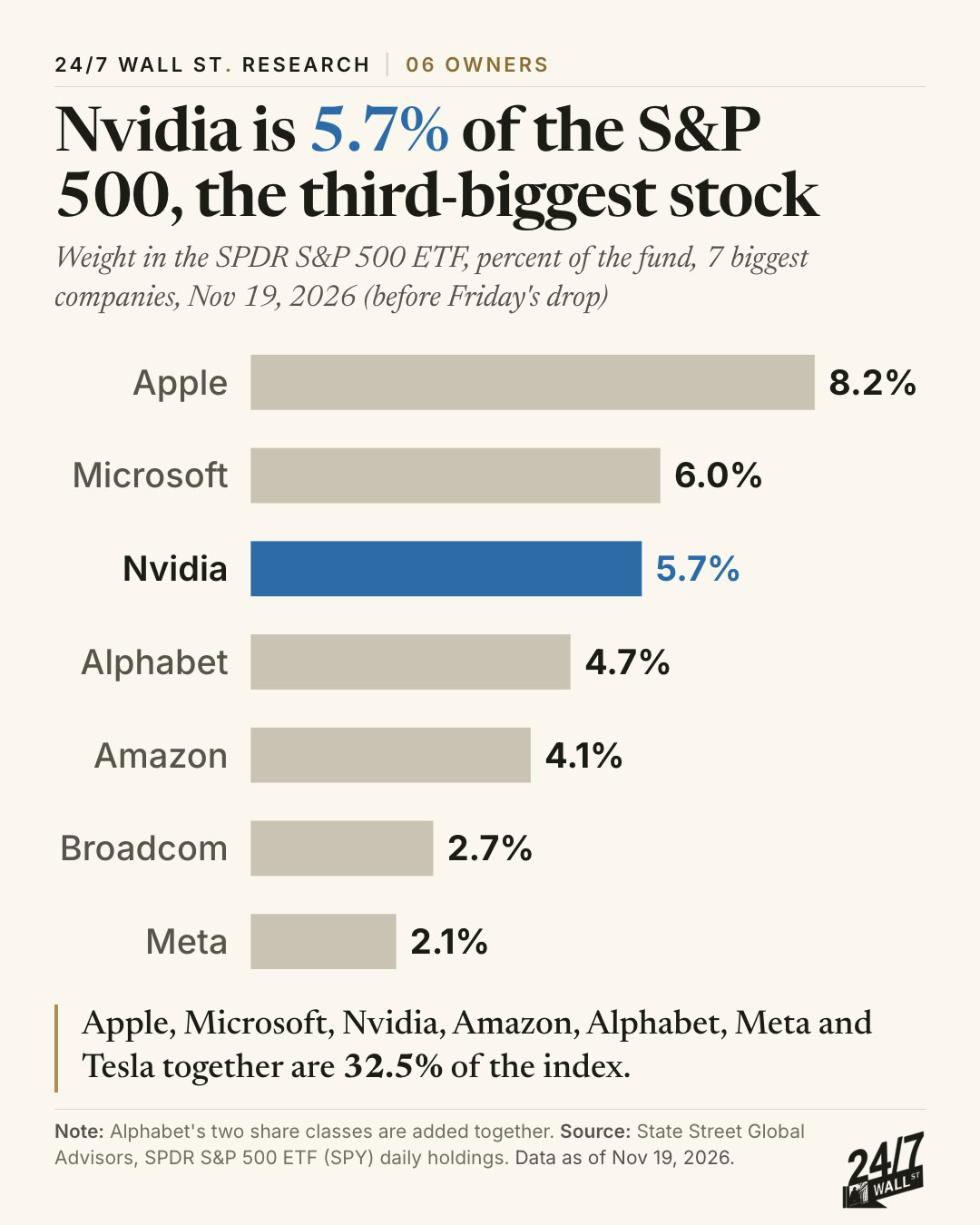
Friday’s drop cut that weight. Adjusting the Nov. 19 holdings for Friday’s closing prices, Nvidia ended the week at about 5.1% of the fund. On the saver’s balance, that is about $50,000. The larger number sits beside it. Apple, Microsoft, Nvidia, Amazon, Alphabet, Meta and Tesla together were 32.5% of the fund on Nov. 19, according to the same holdings. That was $325,000 of the account in seven companies, inside a fund that holds about 500.
The past six weeks show what that concentration does. The SPDR fund closed Friday 11.5% below its Oct. 6 close. Working back from the Nov. 19 weight and the two price changes, Nvidia was about 8.6% of the fund on Oct. 6, and its fall accounts for about 4.1 of the fund’s 11.5 points. That is 36% of the whole decline, from one stock.
In dollars, $1 million in the fund at the Oct. 6 close was worth $885,405 at Friday’s close. About $41,000 of the roughly $115,000 lost came from Nvidia. Friday’s drop closed out what I reported was Nvidia’s worst week since 2008.
What a target-date fund holdsA target-date fund owns stock funds and bond funds, and it shifts toward bonds as its year gets closer. That shift decides how much Nvidia you own.
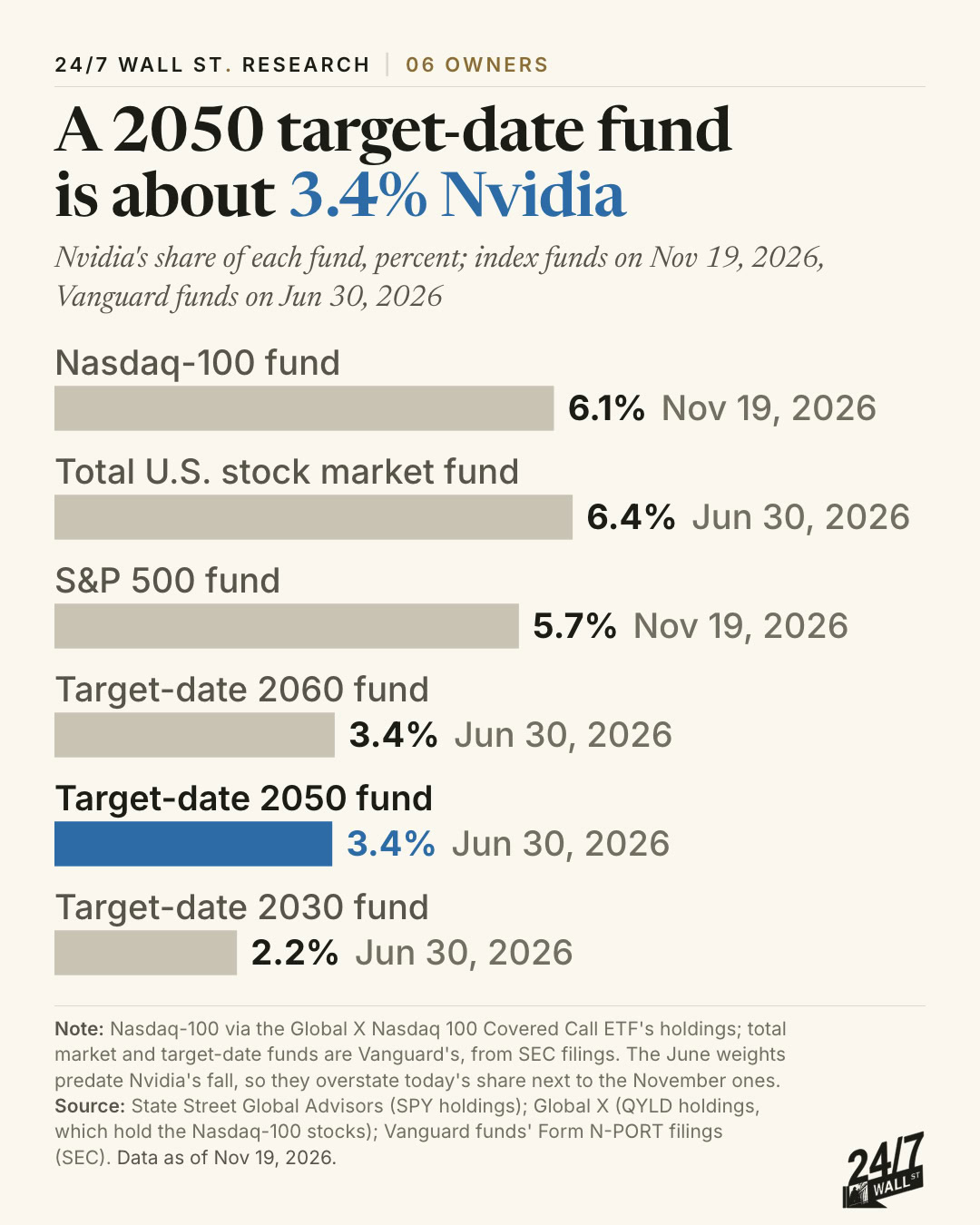
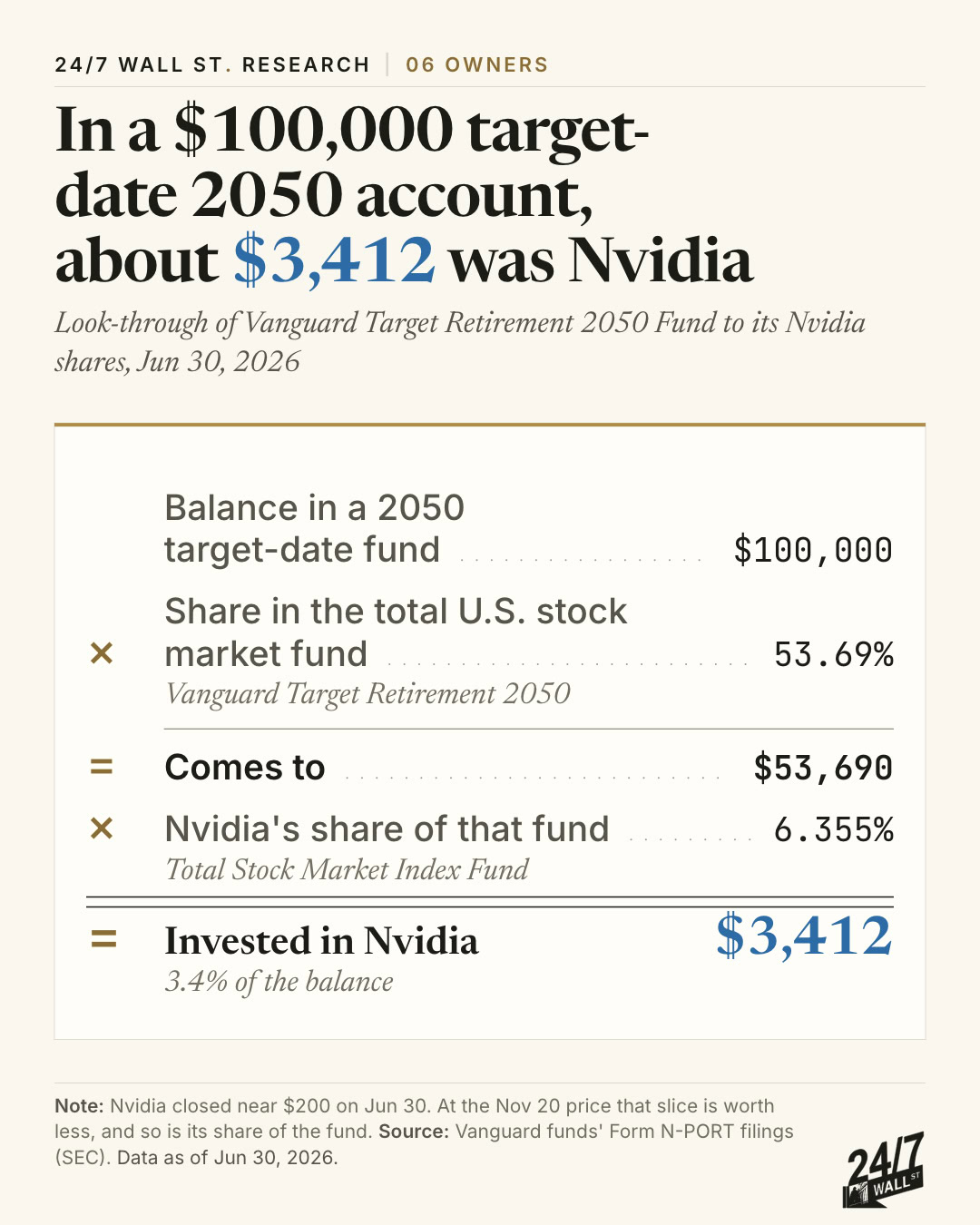
Vanguard’s filings with the SEC for June 30 show its Target Retirement 2050 Fund kept about 54% of its money in Vanguard’s total U.S. stock market fund, and Nvidia was about 6.4% of that fund. Multiply the two, and a $100,000 balance in the 2050 fund held about $3,412 of Nvidia, or 3.4%.
The 2030 fund, the one built for a 62-year-old who plans to stop work at about 66, held about 2.2% in Nvidia. By our calculation from the same filings, it kept roughly 35% of its money in that stock fund and more in bonds. On the saver’s balance, that was $22,000 of Nvidia.
Nvidia closed at $200.09 on June 30. At Friday’s price the same shares are worth about $13,800, the roughly $14,000 in the first paragraph. At the Oct. 6 record they were worth about $26,300. The fall from the record cost this saver about $12,500, a little over 1% of the account. The June filings are the latest on file, so this is an estimate that assumes the fund still holds the same shares. Other companies’ target-date funds will differ a little.
The check to run before you move the moneyThe saver in this example has a decision coming. Many people roll a 401(k) into an IRA when they retire and pick new funds. Moving the whole balance from the 2030 target-date fund to an S&P 500 index fund would lift the Nvidia stake from roughly $14,000 to about $50,000, more than three times as much. It would also put nearly a third of the money in seven companies.
You can run the same check on your own account in a few minutes. Find each fund’s top 10 holdings on its fact sheet or your plan’s website. Multiply your balance in each fund by Nvidia’s weight and add the results. An S&P 500 fund and a Nasdaq-100 fund held together stack up, since Nvidia was 6.1% of the Nasdaq-100 on Nov. 19, according to Global X’s holdings of those stocks. Then do the same for the seven largest companies, and add any single stocks you hold outside the plan.
To skip the math, we’re putting Nvidia’s share of the most common target-date and S&P 500 index funds in The Daily Profit, our free weekday email. Get it here and check your own funds in a minute.
My read of these numbers is that Nvidia’s fall is a reason to count what you own. For the saver in the 2030 fund, a stock that lost nearly half its value cost a little over 1% of the account, and selling a broad fund after a drop would lock that loss in. For a saver who is all in the S&P 500, more than a third of the loss traces to one stock. Both now have a number, and the time to decide whether it is too high is before the rollover.