


EN
3 US Market Infrastructure Stocks Facing An AI Pricing Test
Markets are whipsawing as Anthropic’s trillion dollar IPO, an S&P 500 that just dropped more than 8% in a week, and upcoming PCE inflation data collide with fresh earnings clues from tech and retailers. Volatility like this often reshuffles winners and laggards in US exchange and market infrastructure operators. This article breaks down three such stocks that appear particularly exposed to these cross currents right now.
The three operators covered below are just a sample, and the full screen on Simply Wall St surfaced 9 more US exchange and market infrastructure companies with equally compelling narratives that are not discussed here. To see the broader peer group and analyze where you want to focus capital first, head straight to the US Exchange and Market Infrastructure Operators screener.
FactSet Research Systems (FDS)
FactSet Research Systems plugs into this theme as the data and AI backbone behind trading, risk and portfolio workflows, and SelectiveCapital, a Simply Wall St Community investor, argues the market is missing how deeply that toolkit now functions as market infrastructure.
"Cobalt is attacking the Private Equity market (20 trillion USD TAM). The integration with CUSIP is the “secret weapon”, FactSet can create unique standardized identifiers for private assets, unifying clients’ portfolios in a way that Bloomberg or start-ups cannot easily replicate."
What happens if one quiet shift in how institutions handle complex portfolios starts to show up in pricing power and long-run stickiness?
FactSet Research Systems runs global data and AI tools that support trading, research and risk management, with most revenue coming from the Americas at about US$1.6b, followed by EMEA on roughly US$605 million and Asia Pacific on about US$253 million. The group is valued near US$11.0b in market cap.
If that pricing power story is starting to form in your head, the full narrative for FactSet Research Systems walks through how FactSet Research Systems could turn workflow stickiness into accelerating monetization optionality.

S&P Global (SPGI)
S&P Global plugs into the US Exchange and Market Infrastructure Operators theme through its indices, ratings and data that many trading strategies rely on, and SakuraCoffee, an investor in the Simply Wall St Community, frames why that position now intersects directly with the AI debate.
"At the same time, there is a structural concern weighing on sentiment: the potential impact of AI on S&P Global’s data and analytics franchises. The traditional value proposition faces pressure from the increasing accessibility of information through APIs, automated tools, and large language models."
What happens to S&P Global’s pricing power and contract durability if a single unseen pressure changes how clients value differentiated data?
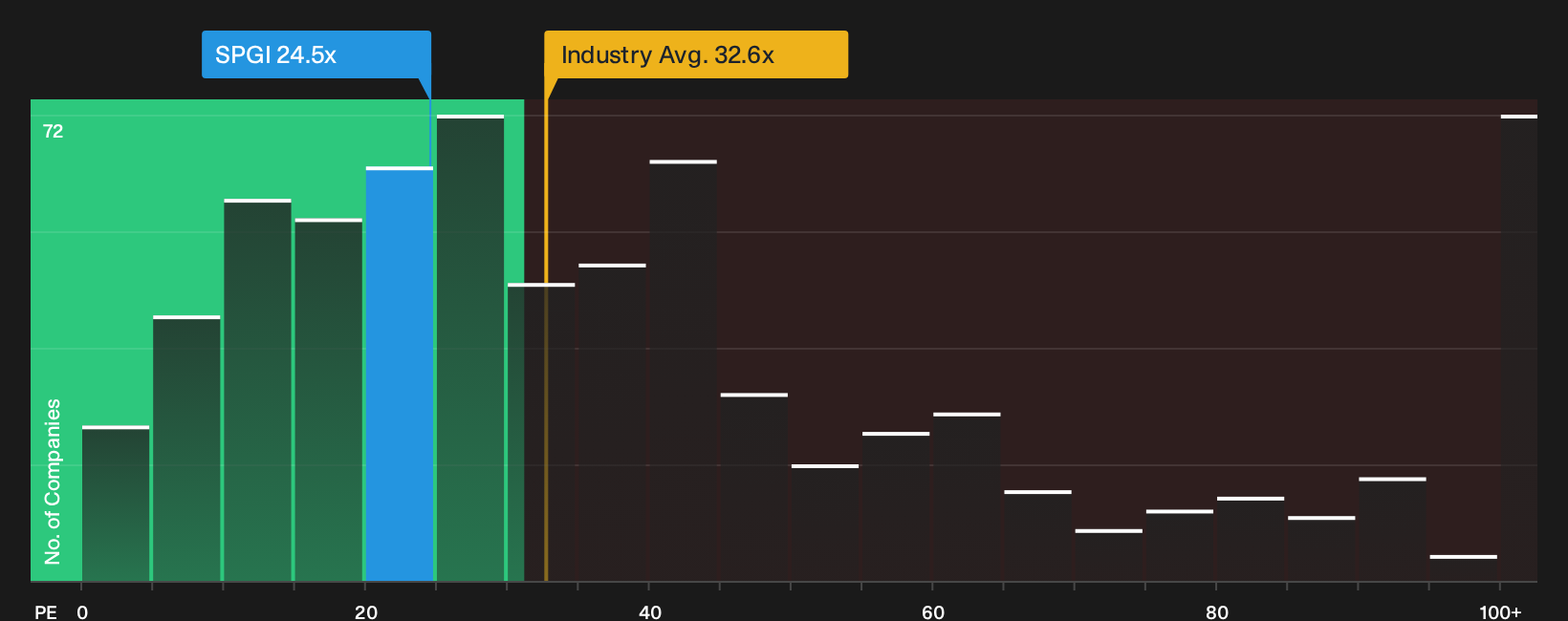
S&P Global underpins capital markets with benchmarks, ratings and information rather than running an exchange floor directly, generating about US$5.2b from Market Intelligence, US$5.1b from Ratings, US$2.4b from Energy and US$2.1b from Indices, and the group’s equity value sits near US$127.4b in market cap.
If that pressure on differentiated data is what you are watching, the full narrative for S&P Global shows how S&P Global’s contracts could decouple sentiment from fundamentals.
Moody's (MCO)
Moody’s connects to the US Exchange and Market Infrastructure Operators theme through its role in rating debt markets and supplying risk tools that capital markets rely on every day, and according to prajeeshprathap, an investor in the Simply Wall St Community, that positioning comes with a very specific kind of toll-booth power.
"The core Ratings business, Moody’s Investors Service (MIS), functions almost like a toll booth on the global debt market. When interest rates rise aggressively, bond issuance slows and ratings revenue can temporarily fall sharply, exactly what happened in 2022 when the Federal Reserve tightened policy."
The real test for Moody’s could come if one quiet change in how issuers tap capital markets shifts the balance between resilience and pricing power.
Moody’s is an integrated risk assessment group that supports global capital markets through credit ratings and analytics, tying it indirectly into the market infrastructure theme. The MIS division produces about US$4.6b in revenue, while Moody’s Analytics contributes roughly US$3.7b, and the firm’s equity value is near US$80.5b in market cap.
If that balance is what you care about, the full narrative for Moody's unpacks how Moody's toll-booth role, AI tools and issuance cycles could reshape its resilience story.
Seeking Alternatives Before The Crowd?
Fresh ideas often move fastest when volatility spikes. Some stocks build quiet breakout momentum while others decline. Scan these under-the-radar lists before the edge fades.
- Identify cash-generating compounders early by scanning the curated 40 high quality undervalued stocks while it still sits under the radar for now.
- Follow the rise of real-world automation as factories, warehouses and grids upgrade, and track potential beneficiaries through the focused 91 robotics and automation stocks before momentum attracts more attention.
- Explore insurers, grid players and hardware suppliers positioned around the AI buildout by using the tightly filtered 52 AI infrastructure stocks while pricing still reflects yesterday’s assumptions.
Have feedback on this article? Concerned about the content? Get in touch with us directly. Alternatively, email editorial-team@simplywallst.com