


EN
Philip Morris Stock And 2 Defensive Dividend Names Worth Watching Now
Markets are caught between hot inflation data, war driven energy costs, and a booming AI story, even as the Nasdaq experiences a sharp pullback. That combination leaves investors uncertain about where to find resilience while rate expectations and consumer confidence continue to shift. This article focuses on three large cap dividend payers from a value focused screener that appear closely linked to these forces and explains how each stock could either help or hurt a portfolio now.
The stocks covered below are only a small sample from this value focused, defensive dividend idea. The full screen surfaced 42 more large cap companies with similarly interesting stories that are not unpacked here.
To identify and analyze your own higher conviction angles on this theme, go straight to the U.S. Large-Cap Value and Defensive Dividend Stocks screener.
Philip Morris International (PM)
Overview: Philip Morris International is a global tobacco group that sells cigarettes and smoke free nicotine products like IQOS and ZYN, plus related accessories.
Market Cap: US$286.9b
Philip Morris International fits this large cap defensive dividend theme because investors often look to its tobacco cash flows and smoke free transition for income and stability. This is exactly what the analyst consensus Narrative on Simply Wall St focuses on in the quote below.
"The accelerating global adoption of smoke free alternatives, driven by increasing health awareness and regulatory moves away from combustibles, is still supporting strong growth in IQOS, ZYN, and VEEV. Smoke free products are now delivering double digit revenue and gross profit expansion at around a 70% gross margin, which can continue to support higher net revenue and operating margin mix over time."
What really matters now is how one pressure on this mix shapes the gap between resilient dividends and future earnings power.
To see how that dividend and earnings mix could evolve through different smoke free adoption paths, read the full narrative for Philip Morris International for the full roadmap and hidden swing factors.

PepsiCo (PEP)
Overview: PepsiCo is a mega-cap consumer staples group that sells branded snacks and beverages worldwide, making it a classic defensive dividend payer.
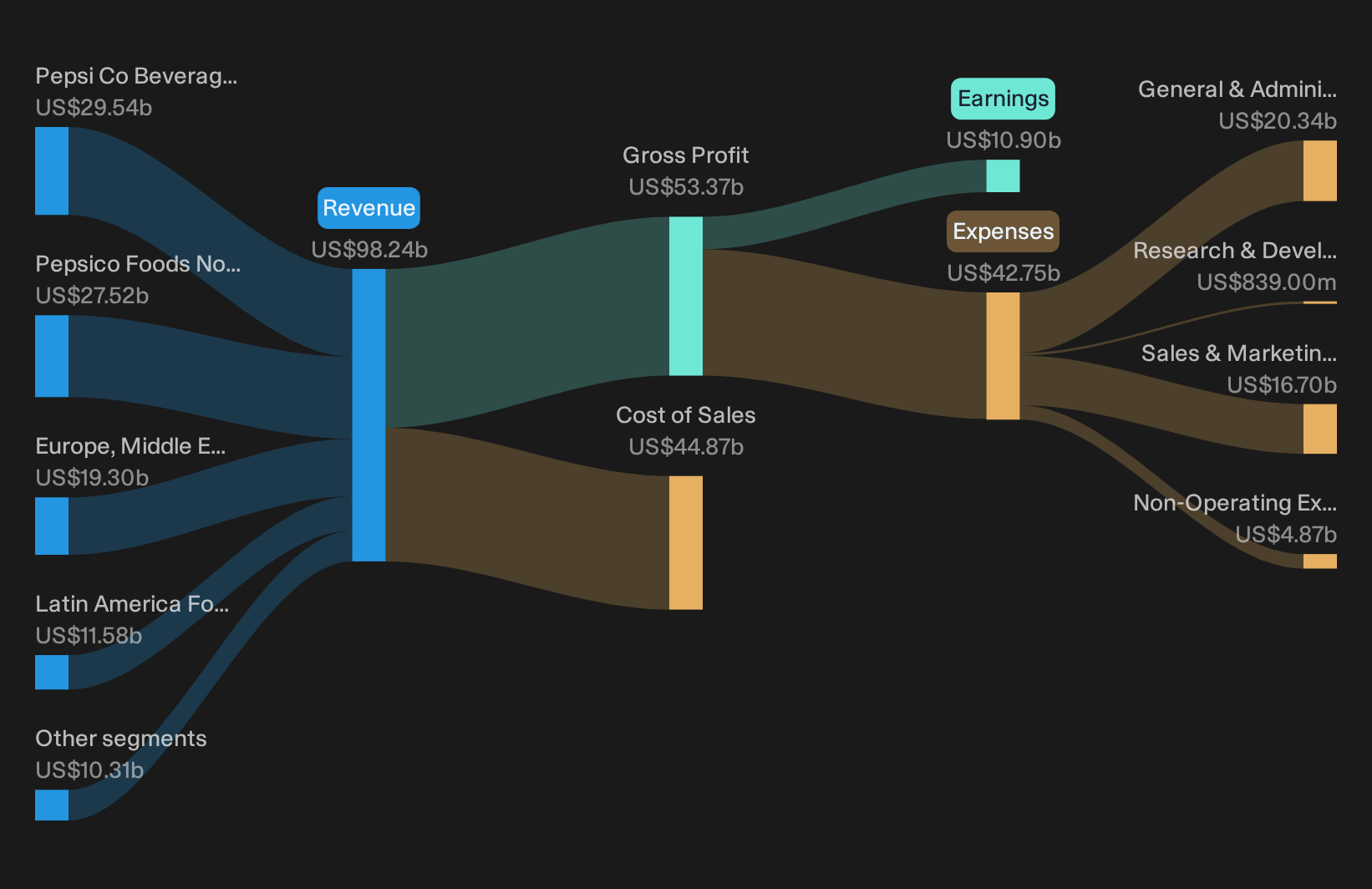
Operations: PepsiCo generates most of its revenue from North American beverages and foods, with US$29.5b from beverages and US$27.5b from foods, plus international divisions.
Market Cap: US$193.7b
PepsiCo fits this large cap value and defensive dividend screen because, according to ANTONI0, an investor in the Simply Wall St Community, it blends durable snack and drink demand with an income profile investors often turn to when inflation and rates stay elevated.
"An activist, Elliott Management, has taken a roughly $4bn stake and forced cost cuts."
The extent to which those cuts reshape PepsiCo’s margins and dividend headroom now largely depends on how one unresolved cost pressure plays out.
That unresolved cost pressure is exactly where the story gets interesting, and the full narrative for PepsiCo shows how those cuts, pricing, and brand power could still accelerate PepsiCo’s edge.
Hershey (HSY)
Overview: Hershey manufactures and sells branded chocolate, confectionery, salty snacks, and pantry items across major retail channels in the United States and internationally.
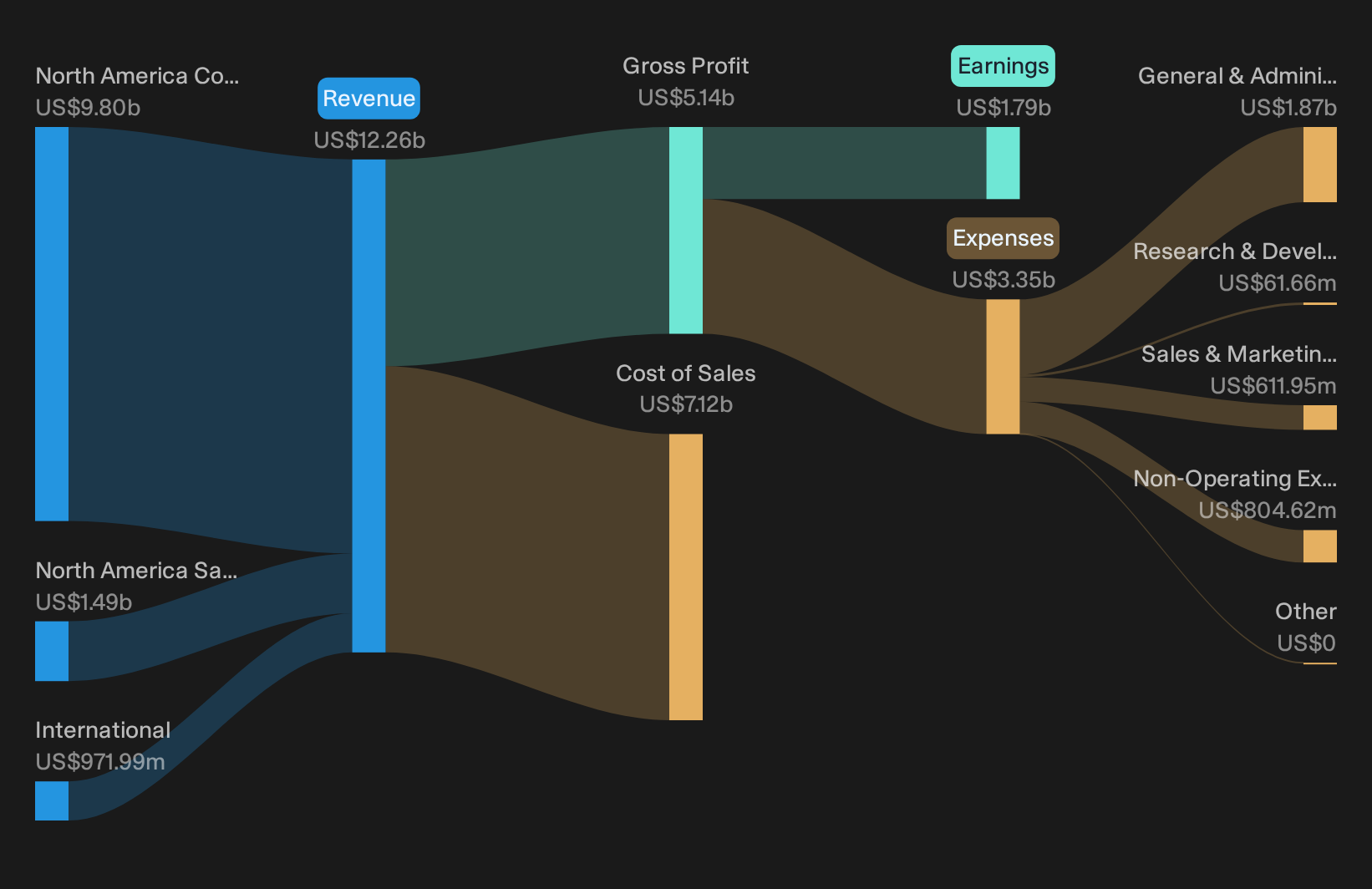
Operations: Hershey generates about US$9.8b from North America Confectionery, US$1.5b from North America Salty Snacks, and roughly US$1.0b from International markets.
Market Cap: US$35.3b
For a screener built around large, dividend paying consumer staples, Hershey slots in as the classic everyday treat producer. Esteban, an investor in the Simply Wall St Community who wrote the Narrative, argues that the company can still lean on brand strength and pricing even when inflation, rates, and energy costs unsettle other sectors.
"The forward thesis rests on three assumptions: that cocoa is structurally elevated but normalizing, allowing operating margin to recover toward a ~24% ceiling over the decade; that the One Hershey strategy extends the moat into salty, functional, and international adjacencies to sustain mid-single-digit (~3.5%) revenue growth."
What really matters now is how one pressure on that pricing and cocoa cost balance ultimately feeds through to future earnings and dividends.
As that cocoa and pricing tension plays out, the full narrative for Hershey breaks down how Hershey’s margin recovery plans and dividend ambitions could quietly accelerate from here.
Seeking Alternatives Beyond Dividend Staples?
Fresh ideas move first. By the time every headline catches up, the best prices can be gone. Scan these under the radar lists while it matters and get in early.
- Target steadier income potential while rates stay unpredictable by reviewing a curated 8 dividend fortresses that focuses on payouts investors often watch closely.
- Hunt for mispriced quality as sentiment swings by checking a refined 40 high quality undervalued stocks built around cash flow strength and cleaner balance sheets.
- Track where AI profits and real businesses intersect by scanning a filtered 44 profitable AI stocks that aren't just burning cash that screens for revenue, earnings, and capital discipline together.
Have feedback on this article? Concerned about the content? Get in touch with us directly. Alternatively, email editorial-team@simplywallst.com