


EN
Qualcomm Stock Faces Apple Loss As AI Data Center Push Takes Center Stage
- Qualcomm has completed multiple fixed income offerings totaling several billion dollars and expanded its underwriter group, while also presenting its chip and connectivity roadmap at industry conferences in Miami and Munich during November 2026.
- The business is absorbing weaker handset demand and the loss of Apple modem orders, and it is redirecting cash and talent toward AI and data center programs, including custom silicon for large cloud providers.
- We will now look at how Qualcomm's refocus on AI data center chips over Apple handset revenue could reshape its investment narrative.
Scan how other chip and AI infrastructure players are positioning for the same data center wave by reviewing our curated list of 53 AI infrastructure stocks.
QUALCOMM Investment Narrative Recap
To own QUALCOMM today, you need to believe its AI, data center, automotive and IoT ambitions can gradually rebalance the business away from a softer handset market and the loss of Apple modem revenue. The analyst consensus Narrative on Simply Wall St leans heavily on that mix shift. In the near term, the key catalyst is execution on early AI data center programs while the company absorbs weaker phone demand and higher memory costs.
The main risk right now is that AI and custom silicon spending runs ahead of confirmed orders, especially if smartphone volumes stay under pressure and free cash flow remains constrained. November’s bond deals and packed conference schedule appear to be more about preparing for that long investment cycle than signaling a material change to the immediate operating outlook.
The fixed income offerings in early November, including the US$1b 5.350% notes due 2031 and several US$750m tranches, matter most for funding those AI and data center build outs. QUALCOMM now has multi year capital locked in at known coupons, which can support heavier R&D and capacity commitments tied to its US$5b fiscal 2027 and US$15b fiscal 2029 AI data center revenue targets.
For you as a shareholder, that new debt stack raises the execution bar on projects such as the AWS custom silicon and optical connectivity agreement, which the analyst consensus Narrative on Simply Wall St views as a core driver of future non handset QCT revenue. If those design wins ramp more slowly than planned, higher interest costs and elevated operating expenses could weigh more heavily on earnings and keep valuation sensitive to any setback in AI centric programs.
QUALCOMM's narrative projects US$62.7b revenue and US$12.3b earnings by 2029, which implies forecast revenue growth of 13.3% per year and an earnings decline of US$1.3b from current earnings of US$13.6b.
Uncover how QUALCOMM's fair value indicates a 24% potential upside to its current price, before the market starts to close that gap.
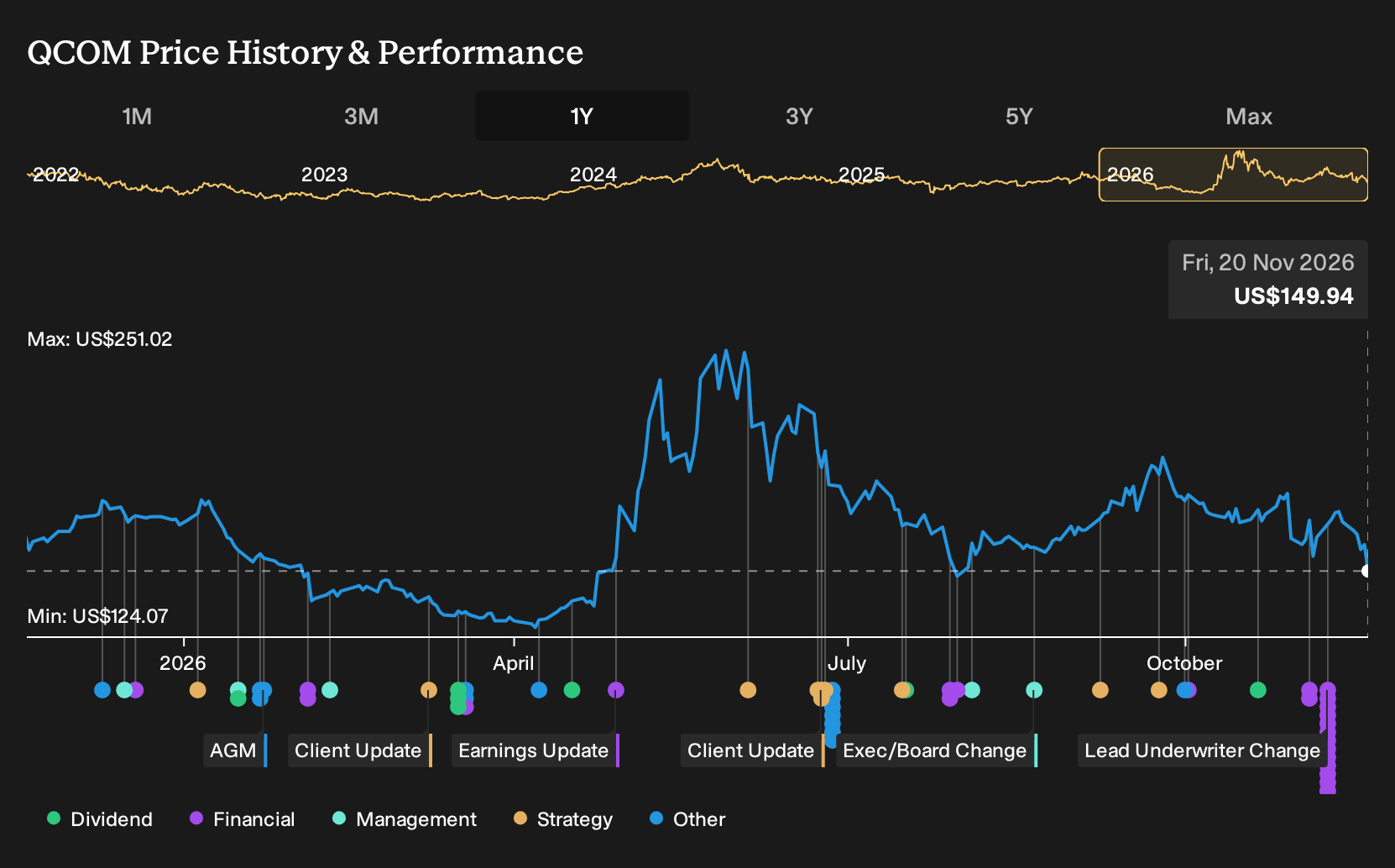
Exploring Other Perspectives
One bearish angle on Qualcomm focuses on the risk that new AI data center custom chips come through on thinner margins, not just whether the US$5b and US$15b revenue goals are reached. The most cautious analysts were projecting about US$58.1b of sales and US$11.8b of earnings by 2029, yet still saw a sharply lower fair value. Those forecasts, along with the fresh bond deals and conference updates in Miami and Munich, did not exist in the same picture when those views were set, so you may want to compare both narratives and decide which assumptions feel closer to how you think Qualcomm’s story could evolve from here.
Explore 3 other QUALCOMM fair value estimates, including one that suggests it could be worth just $170.53.
Decide For Yourself
Disagree with existing narratives? Extraordinary investment outcomes typically do not come from following the herd, so consider trusting your own analysis.
- A great starting point for your QUALCOMM research is our analysis highlighting 4 key rewards and 1 important warning sign that could impact your investment decision.
- See our latest analysis for QUALCOMM. The report includes a comprehensive fundamental analysis summarized in a single visual, the Snowflake, making it easy to evaluate QUALCOMM's overall financial health at a glance.
Looking for more QUALCOMM sized investment ideas?
If Qualcomm has sharpened your interest in AI, cash flow resilience, or income potential, it can make sense to widen your research beyond a single ticker and see how other businesses line up on quality and risk using the Simply Wall St Screener.
- For investors who want income without ignoring balance sheet strength, consider income plays featured in our 8 dividend fortresses that aim to combine yield with durability.
- If capital preservation sits high on your priority list, reduce guesswork by focusing on companies that score well on risk, starting with this 32 resilient stocks with low risk scores.
- To hunt for lesser known opportunities backed by solid fundamentals, scan through the 18 high quality undiscovered gems and see which businesses deserve a place on your watchlist.
Have feedback on this article? Concerned about the content? Get in touch with us directly. Alternatively, email editorial-team@simplywallst.com