


EN
Palo Alto Is Cashing In on AI, But PANW Stock Is Already Too Expensive
Accelerating artificial intelligence (AI) adoption is reshaping the cybersecurity sector, creating new opportunities for companies offering comprehensive, integrated security solutions. Palo Alto Networks (PANW) is emerging as a key beneficiary of this trend, supported by growing demand for advanced cybersecurity capabilities and its expanding platform-based business model.
As companies adopt more AI models, autonomous agents, and AI-powered applications, the risk of cyberattacks is also increasing. As a result, businesses are likely to increase their cybersecurity spending to address these emerging threats.
At the same time, the cybersecurity industry is witnessing a structural shift toward platform consolidation. Rather than relying on multiple vendors for fragmented security requirements, organizations are increasingly seeking integrated solutions that offer centralized visibility, simplified management, and comprehensive protection. This trend creates a competitive advantage for established providers such as Palo Alto Networks, who can address a wider range of enterprise security requirements through a unified ecosystem.
Palo Alto Networks is capitalizing on this shift through its platformization strategy, which brings a wide range of cybersecurity products and services under one integrated offering. This approach allows the company to deepen relationships with existing customers, encourage greater adoption of its solutions, and capture a larger share of their overall cybersecurity budgets. It also supports customer retention and creates opportunities for sustainable long-term growth.
These favorable industry trends, along with the company's solid financial performance and recently raised guidance, have boosted PANW stock. Shares have surged 88% year-to-date (YTD), reflecting optimism around Palo Alto Networks' growth prospects and ability to capitalize on rising demand for AI-related cybersecurity solutions.
However, while the company appears well-positioned to benefit from rising cybersecurity spending and enterprise demand for integrated platforms, the strong rally has also made PANW stock more expensive. Let's take a closer look.
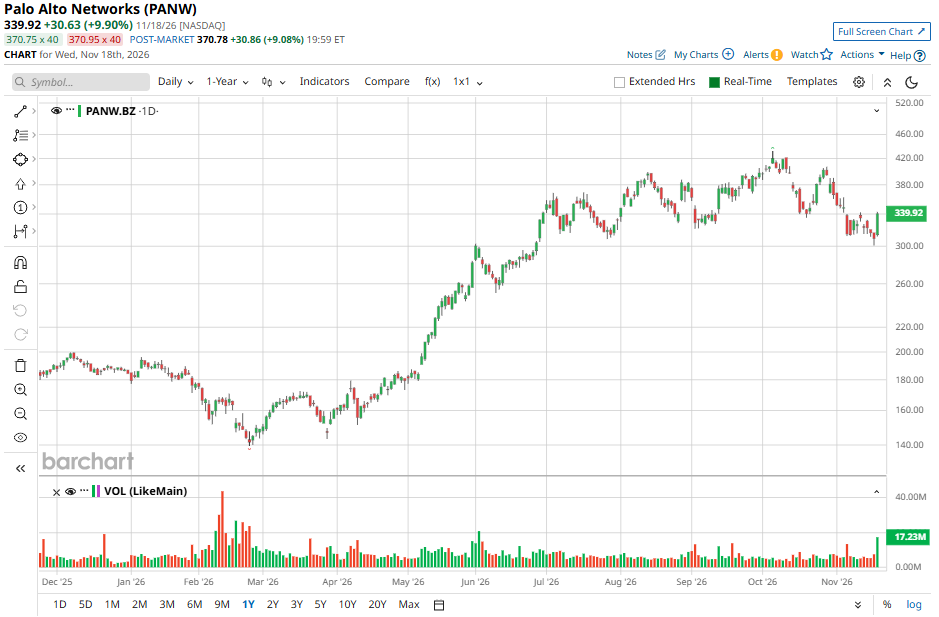
Palo Alto’s Q1 Fiscal 2027 Performance
Palo Alto Networks started fiscal 2027 on strong footing, with growth accelerating across its businesses. In the first quarter of fiscal 2027, revenue increased 39% year-over-year (YOY), while remaining performance obligations (RPO) grew 35%, with both metrics improving from the previous quarter. This reflects strong enterprise demand for integrated cybersecurity solutions as organizations increasingly consolidate security vendors and simplify their IT infrastructure.
Growth was broad-based across Palo Alto's major business segments. Network and AI security revenue increased 20%, supported by demand for Secure Access Service Edge (SASE) as well as software and hardware firewalls.
Firewall bookings remained strong, with trailing 12-month bookings rising 28% YOY. Software firewall annual recurring revenue (ARR) also accelerated for the third consecutive quarter, growing 34%. Prisma AIRS was a key contributor, emerging as the company's fastest-growing product and reaching nearly $170 million in ARR. Cortex — Palo Alto Networks' security operations and observability platform — also delivered strong results, with revenue growing 53% YOY. In identity security, revenue grew 23% YOY.
Customer adoption of integrated security solutions is another positive indicator. “Platformized customers now represent two-thirds of our next-generation security ARR and continue to expand at a robust rate, with net retention above 120%,” said CEO Nikesh Arora on the Q1 earnings call.
Palo Alto also announced the acquisition of Applied Compute alongside the results. The deal is expected to strengthen its position in the growing AI and cybersecurity market.
Palo Alto Raises Fiscal 2027 Guidance
Following the strong quarterly performance and solid demand, management raised its full-year outlook. Next-generation security ARR is now expected to grow 26% to 27% YOY, up from the previous forecast of 22% to 23%.
Palo Alto Networks also increased its full-year revenue forecast to $14.52 billion to $14.57 billion, implying growth of 26% to 27%. That is up from its earlier estimate of $14.1 billion to $14.2 billion, which indicated growth of 23% to 24%. Finally, management increased its adjusted EPS forecast to a range of $4.26 to $4.30 from $4.16 to $4.19.
PANW Stock Is Already Too Expensive
Palo Alto Networks’ Q1 performance reflects robust demand for integrated cybersecurity solutions, driven by AI adoption and escalating enterprise security needs. Strong segment momentum, customer growth, and improved guidance support its long-term prospects.
Nevertheless, valuation remains a key concern. With a forward price-to-earnings (P/E) ratio of 133.5 times, PANW stock is already expensive relative to its earnings growth. Analysts project earnings growth of 15% in fiscal 2027 and 20% in fiscal 2028. Palo Alto Networks also trades at a premium multiple compared to its industry peers.
AI Tailwinds Support Growth, But Valuation Limits Upside
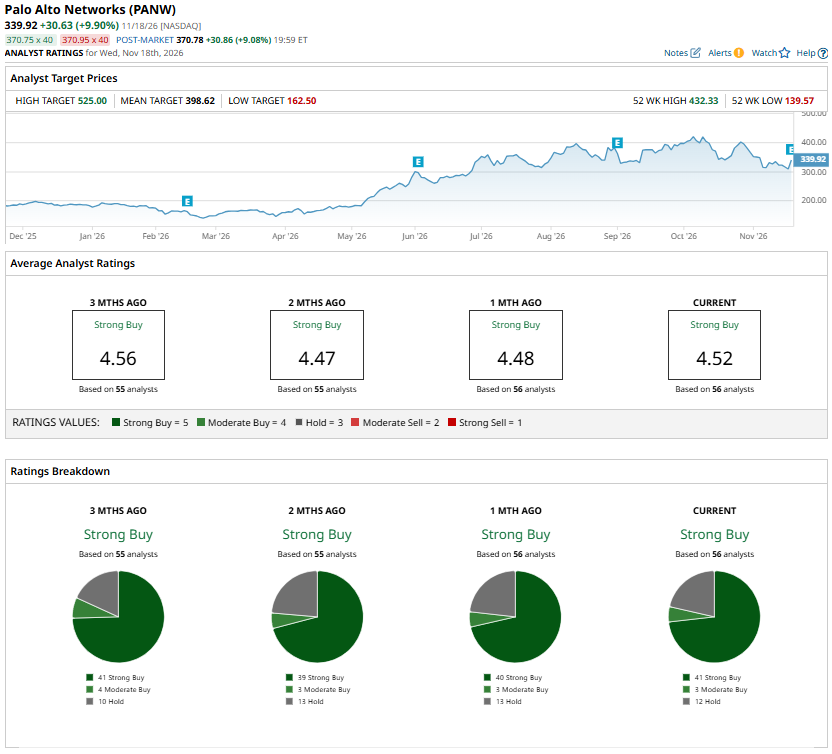
Palo Alto Networks is well-positioned to capitalize on rising AI-driven cybersecurity spending and growing demand for integrated security platforms. Overall, analysts are bullish and maintain a consensus “Strong Buy” rating on PANW stock.
However, with Palo Alto Networks stock trading at a forward P/E ratio of 133.5 times, its valuation already reflects considerable optimism. Given the relatively moderate earnings growth projected for fiscal 2027 and fiscal 2028, the stock's premium valuation could limit further upside.
On the date of publication, Amit Singh did not directly have a position in any of the securities mentioned in this article. All information and data in this article is solely for informational purposes. For more information please view the Barchart Disclosure Policy here.