


EN
Is Serve Robotics Stock’s 669% Options Payout a Bull Trap? You Might Be Shocked By the Answer.
You don’t have to convince anyone that Serve Robotics (SERV) is a subpar investment. On a year-to-date basis, SERV stock is down a shocking 78%. There’s also no apparent indication that the ticker is due for a broader recovery. As damning evidence, just consider the trailing-month loss of roughly 26%.
Fundamentally, even the boldest of contrarians would have difficulty justifying a position in Serve Robotics stock. While the autonomous sidewalk delivery robotics specialist recently posted strong third-quarter revenue growth and raised guidance, SERV continues to be dogged by substantial net losses. Additionally, a noticeable reduction in delivery volumes from major partners has contributed to the challenging environment.
At the same time, we should distinguish between two categories. As a long-term investment, SERV stock obviously lacks credibility — I don’t think too many market participants would take issue with that charge. But as a short-term swing trade (especially using the leverage of capped-risk options strategies), debit buyers may have a case, provided that the price (and potential payout) is right.
Just look at what happened between Nov. 5 and Nov. 9. In short order, Serve Robotics stock popped more than 46%. True, the ticker subsequently collapsed but the point was proven. Under certain circumstances, it's possible for a junk asset to mean revert abruptly.
What’s more, we know through historical data that when sentiment is overloaded to the bearish side, contrarian bulls have been known to seize the moment and temporarily bid up shares. To be fair, that doesn’t guarantee that the same outcome will materialize this time around for SERV stock.
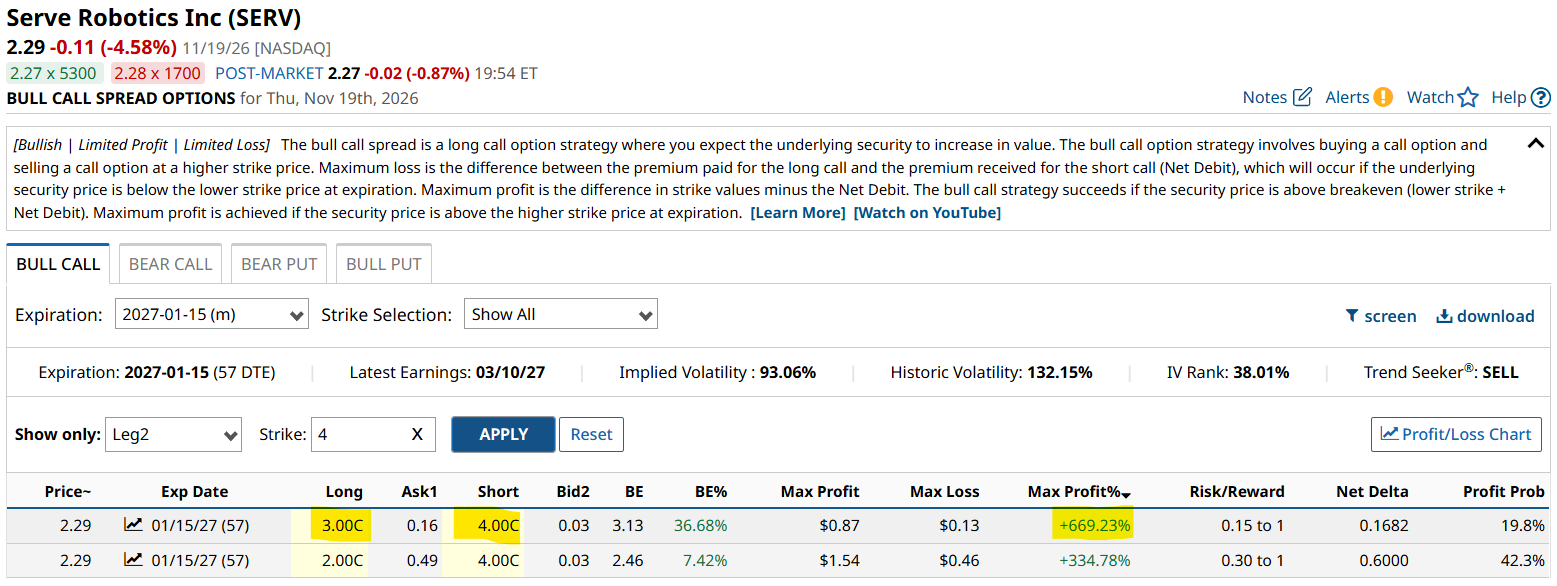
Nevertheless, if it did, the ultra-aggressive 3/4 bull call spread expiring Jan. 15 could surprisingly be in play.
An Immediate Analysis of SERV Stock Looks Deeply Unfavorable
We really have to be honest here. Outside of any context, the assumption that Serve Robotics stock might trigger the $4 second-leg strike price comes off as irrational, perhaps absurd. At the time-of-writing price of $2.29, SERV would need to rise by an astounding 74.67% by expiration (about eight weeks away) for the trade to be fully profitable.
That’s such an improbable event so what’s the spread’s saving grace? There are two factors at play. First, the spread is dirt cheap. Second, the potential payout is massive. As long as the probability of success is adequate, exposure can be justified in terms of expected value (EV).
Unfortunately, the probability is very much lacking. Let’s assume that SERV stock will trade within a framework defined by a lognormal distribution of outcomes, with the 30-day implied volatility of approximately 94.3% representing the benchmark of a risk-neutral environment. Colloquially, we can label this environment as “laboratory conditions.”
Under this model, the odds of SERV stock terminating at $4 on Jan. 15 sit at 9.37%. That’s just not going to make the trade capital efficient for the debit buyer. As you would expect (given that there are no free lunches on Wall Street), this speculative bull spread favors the credit seller.
How do I know? The key stats give us the intelligence we need:
- A net debit (upfront cost) of $13.
- A maximum payout (American-style odds) of 669.23%.
- A win probability of 9.37%.
Plug these numbers into the EV formula and you get a value of $3.63 below zero or a return on capital (ROC) of -27.92%. Mathematically, as mentioned earlier, this favors the credit seller.
However, the wrinkle to this narrative is that, while the wager and the payout are determined by the market (and thus out of our control), the win probability is undetermined. The laboratory conditions represent an industry standard; they’re not necessarily absolute truth.
That’s where an alternative model may sharpen our insights.
Using Inductive Inference to Place a Wild Bet on Serve Robotics Stock
Although the technical chart tells a terrible tale about SERV stock, this assessment is more of a vibe check than a quantitative analysis. A better approach may be to filter for an identifiable signal and use past analogs of said symbol to estimate a forward trajectory.
In other words, we can use inductive inference (basically a fancy way of saying pattern recognition) to speculate on Serve Robotics stock. For example, one identifiable signal is that, in the last two months, SERV printed 10 weekly candlesticks — and seven of these sessions were negative, where Friday’s close was lower than Monday’s open.
Subsequently, we can confidently say that SERV is presently in a bearish state, evidenced by the seven-to-three ratio of negative sessions to positive. However, the data reveals that the ticker has demonstrated a tendency of transitioning from extreme pessimism to optimism over the next several weeks.
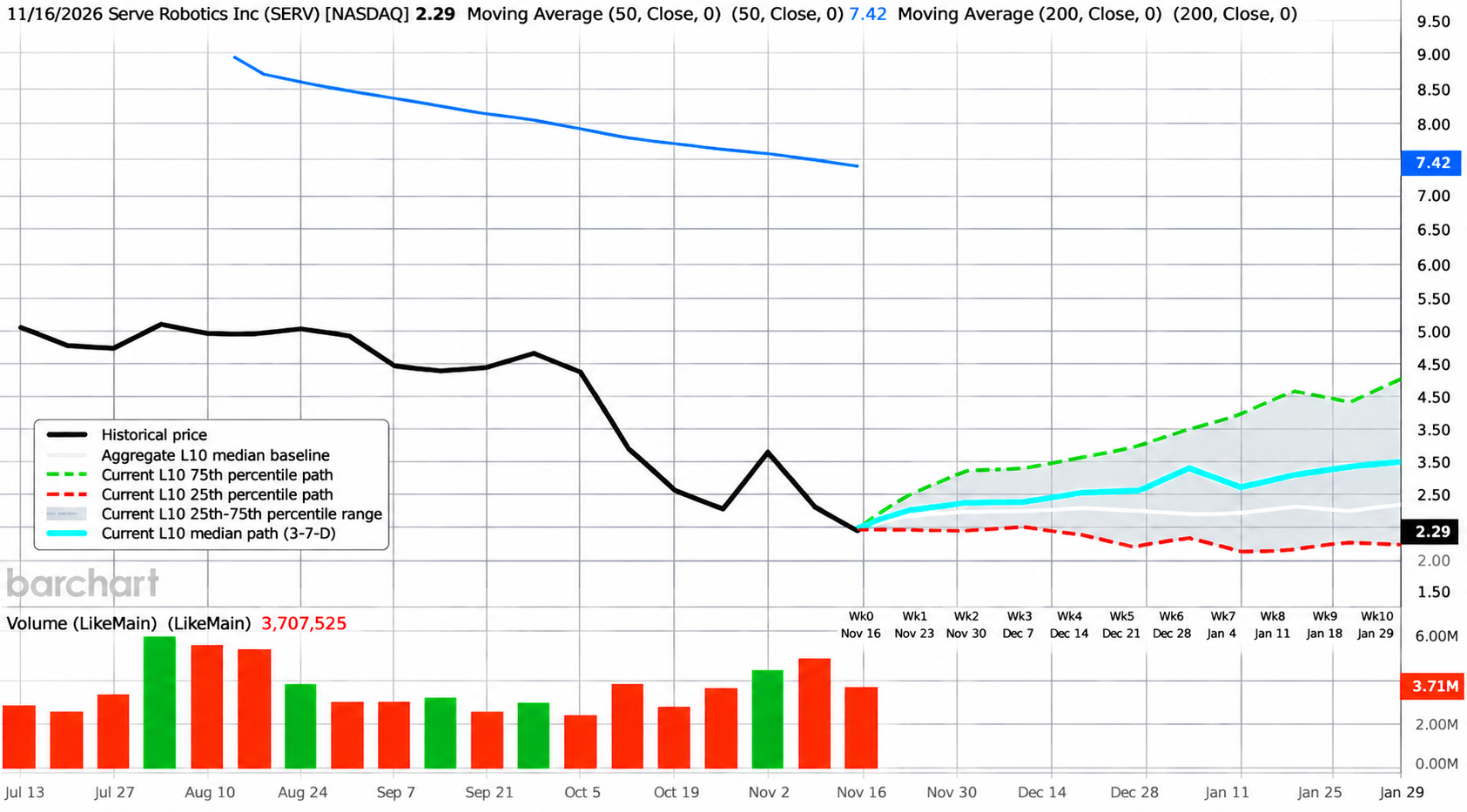
If we were to apply the average observed response to the 7-to-3 ratio to the current price, we would calculate an estimated win probability ranging between 11.1% and 25.9% that Serve Robotics stock will trigger the $4 strike on expiration.
Admittedly, at a probability of 11.1%, SERV stock would generate an EV of $1.90 below zero (although that would also be a more palatable ROC of -14.62%). But at roughly the midpoint at 18.5%, EV would jump to $5.50 or an ROC of 42.31%. And at the highest probabilistic end, EV would simply skyrocket to $12.90, a stunning ROC of 99.23%.
What Does This All Mean?
So, then, the ultimate question: what does a 99% ROC imply for the 3/4 bull spread? I’ll tell you straight up that it does not mean you have a high chance of getting the trade right. Statistically, if you buy the Serve Robotics stock spread now, you will likely be on the losing end.
What it does mean, though, is that (from a practical perspective), you are incentivized to speculate on this and multiple trades with similar risk-reward profiles; that is, a cheap cost, a massive payout and an adequate win probability.
The EV formula explains why this methodology is capital efficient. While your losses will be frequent, of the few times that you do win, the massive payout makes up for the earlier losses and then some. Of course, this methodology assumes that you’re practicing sober risk management so that your portfolio doesn’t go to zero during extended losing streaks.
That’s where the adequate probability comes into play. As long as there’s a rational basis for believing that the win rate stays above a certain threshold, you can statistically win the game because even a junk equity occasionally delivers the goods.
On the date of publication, Josh Enomoto did not directly have a position in any of the securities mentioned in this article. All information and data in this article is solely for informational purposes. For more information please view the Barchart Disclosure Policy here.