


EN
Are the hopes of the bulls who bounced back with their Anthropic debut in vain? Before technology stocks plummeted on Thursday, the global stock base attracted huge amounts of gold for nine consecutive weeks
The Zhitong Finance App learned that before the sharp sell-off of technology stocks in the US stock market on Thursday and the sharp fall in semiconductors in the Asian market on Friday, the global equity fund had already had net intake of US$59.23 billion in the week ending November 18. This also meant that for nine consecutive weeks, the US stock fund had attracted 45.71 billion US dollars, contributing about 77.2%. During the same period, Michael Burry, who has the title of “Big Short on Wall Street”, indicated that he would abandon his subscription to Anthropic; he took advantage of the rebound to double his NASDAQ 100 put option positions and bought back some Vaneck semiconductor ETF put options he had previously reduced, then revealed on the 19th that his holdings of undervalued Chinese technology assets — JD, Tencent, and BYD — increased at low prices.
As of the closing of US stocks on November 19, EST, Anthropic (ANT.US), one of the world's leading AI applications, opened at $111.50 on the NASDAQ stock market and closed at $97.17, up 17.07% from the $83 issue price. Investors who bought and held until the close lost 12.85%.
Strong third-quarter profits and falling oil prices supported some investors to establish short- or medium-term long positions. The technology sector, which subsequently experienced a sharp sell-off, was one of the most obvious directions in which subscriptions heated up in the previous week — as of Wednesday, the net weekly inflow of US technology funds hit a new high since June 16.
On the same day, the three major US stock indices fell collectively, and the technology sector, where AI computing power and semiconductors dominate market capitalization, fell the hardest. US stocks closed on Thursday, with the Dow falling 1,101.11 points, or 2.19%. The S&P 500 fell 2.02%, closing lower for the sixth consecutive trading day, and the Nasdaq Composite Index fell 2.25%. The Philadelphia Semiconductor Index fell 2.41% to 9,419.72 points, retreating 35.63% from its historical closing high on June 22, and is already mired in a deep technical bear market. Memory chip giant Micron Technology fell for six consecutive trading days, closing at $690.44, up 43.11% from its all-time high closing price retracement on June 25.
Facing this wave of AI trading sell-off, Michael Berry, who has the title of “big short,” abandoned his subscription to Anthropic, and while increasing bearish on US technology stocks, bucked the trend and increased his holdings of undervalued Chinese technology assets such as JD, Tencent, and BYD.
Dan Niles, the founder and portfolio manager of Niles Investment Management Company, a senior Wall Street fund manager who has been deeply involved in technology stock research for 15 years, said that Anthropic has served companies that are willing to pay since the beginning of the business, which is more beneficial than seeking AI subscription services from ordinary C-end consumers who are used to free services, and emphasized that Anthropic is more likely than OpenAI to eventually win in this round of global AI intelligence competitions; although Niles is optimistic about its corporate customer base, he also questions short-term stock prices at a time when models reduce prices and promise high computing power — that is It is questionable whether the stock price can maintain the issue price of $83 during the 30-day green shoe period.
$59.23 billion poured into the stock base just before the massive sell-off, and Anthropic's much-anticipated debut failed to hold back tech stocks
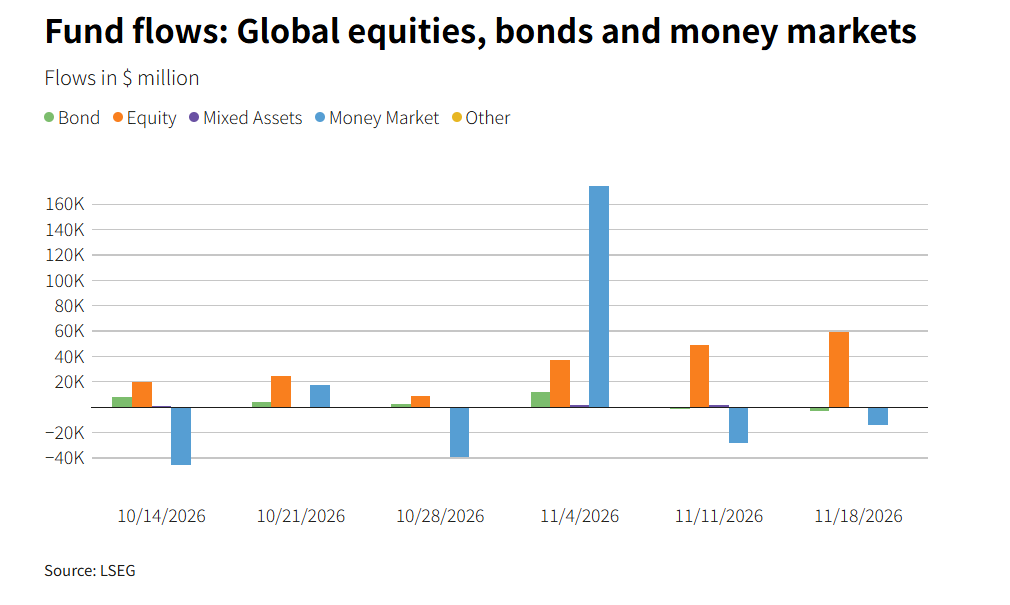
Over the past three weeks, global equity funds have continued to attract money. What has changed the most is where the new capital is invested. In the week ending November 4, global equity funds had a net inflow of US$38.63 billion, while money market funds absorbed US$172.71 billion on a record scale, the highest since April 2020. As of the week ending November 11, Europe led with 35.13 billion US dollars, while US equity funds had only attracted 6.6 billion US dollars.
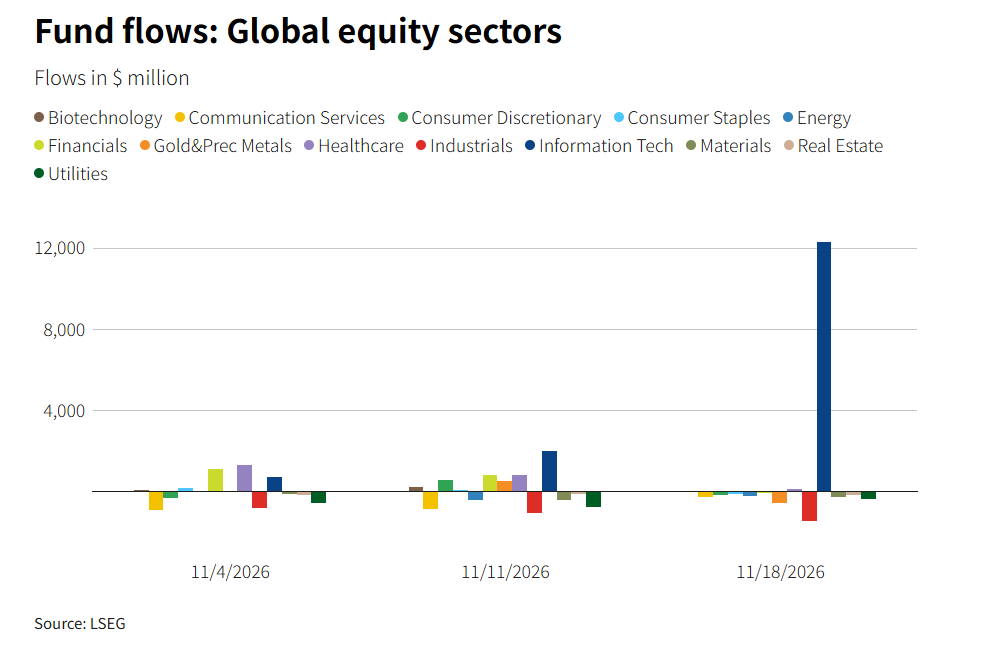
As a comparison, after another week, net inflows of US equity funds jumped to 45.71 billion US dollars, Europe fell back to 15 billion US dollars, and Asia turned to net outflows of 2.78 billion US dollars. The US tech sector fund also had a net outflow of about US$160 million from the week of November 4 to a net inflow of US$10.3 billion for the week of the 18th.
Prior to this round of sharp sell-off of technology stocks in the Thursday market, in the week ending November 18, global equity funds had collected net proceeds of US$59.23 billion, receiving net subscriptions for the ninth week in a row. Of these, US equity funds attracted US$45.71 billion, contributing about 77.2%.
Claude developer Anthropic issued at $83 per share and opened on the NASDAQ at $111.50 on Thursday, hitting an intraday high of $115.10 and finally closing at $97.17. The allotted investors earned 17.07% on the first day, while investors who bought at the opening price and held until the close lost 12.85%. The Philadelphia Semiconductor Index fell 2.41% to 9,419.72 points. This week's cumulative decline as of Thursday was 7.16%, retreating 35.63% from the historical closing high on June 22. This global semiconductor benchmark index is already mired in a technical bear market.
The major valuation differences among Wall Street analysts over Anthropic, which recently “pumped out” a large scale from the market, ultimately came down to whether paid inference revenue could cover the cost of computing power locked in advance. New Street, Citizens, Wolfe, and Needham gave target prices of 105, 125, 135, and 150 dollars, respectively. Melius gave a 24-month target price of 155 dollars, which is 59.5% higher than the closing price of the first day. Morningstar used the cash flow valuation method to estimate the fair value per share of $92.
According to the prospectus, Anthropic's procurement, leasing, etc. commitments are approximately US$909 million, almost all involving computing power and infrastructure, and some of these arrangements include termination rights or entry into force conditions. For model companies, the number of customer paid calls, inference revenue per unit, and utilization rate of leased computing power together determine profit margins. For upstream vendors such as Micron, profits depend more on when cloud vendors turn expansion plans into orders for accelerators equipped with high-bandwidth memory (HBM). Even if companies continue to adopt AI, the pace of profit cashing at both ends may clearly diverge. Before the market on Friday, LSEG data flow once reported that Anthropic fell by another 10%. The valuation test that global investors are concerned about continues.
US stock funds attracted gold for the third week in a row, and the technology industry recorded the biggest net inflow since June
In the week ending November 18, investors made net purchases of US equity funds for the third consecutive week. Despite the recent increase in market volatility and rising uncertainty surrounding AI transactions, strong corporate profits and falling crude oil prices still support the stock market.
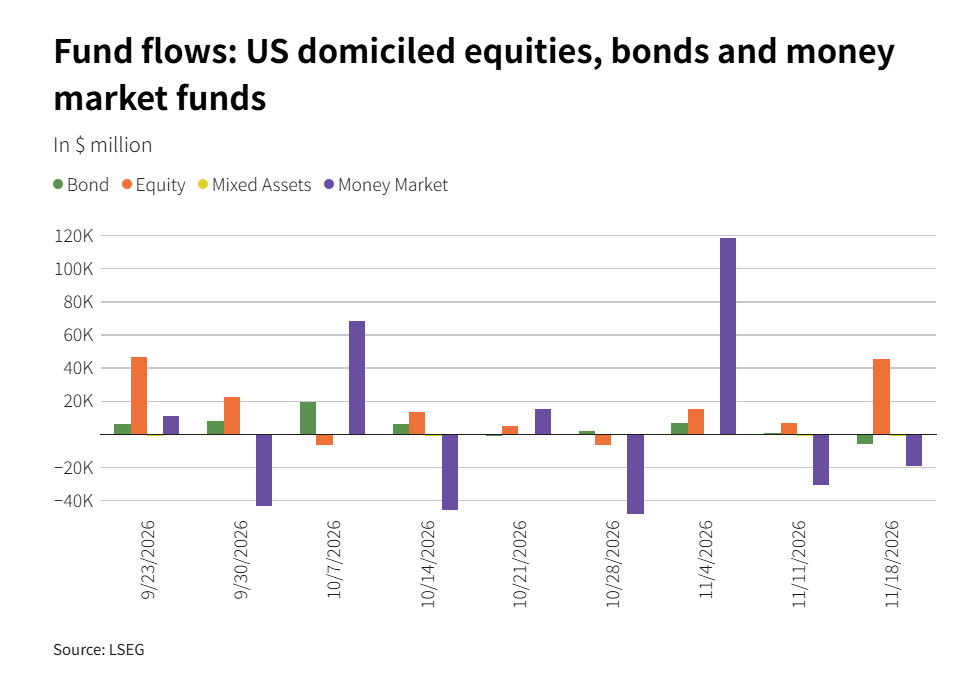
According to the latest global capital data flow compiled by LSEG, investors made a net purchase of 45.71 billion US equity funds during the week, the largest weekly net purchase amount since September 23.
Despite concerns about AI trading, fund investors are optimistic about strong third-quarter profits. Meanwhile, huge spending in the AI sector and market expectations of stricter regulations and a slowdown in data center expansion after the Democratic Party's victory in the midterm elections put pressure on technology stocks.
According to data from LSEG covering 1,921 companies, about 94% of large and medium-sized enterprises in the US have released financial reports. Third-quarter profits increased 40.2% year-on-year, with profits in the technology industry increasing 65%.
Mark Hafer, chief investment officer of UBS Global Wealth Management, said in a report: “We believe that economic expansion, corporate profit cycles, and the structural trends that support long-term investment in AI are still intact.”
“Our benchmark judgment for 2027 is still that the economic growth rate is close to the trend level, corporate profits continue to rise, AI investment grows further, and inflation tends to ease later in the year.”
US large-cap equity funds attracted 31.7 billion US dollars in the week, the biggest net inflow in eight weeks. Mid-cap and small-cap funds had net outflows of US$1.15 billion and US$535 million, respectively.
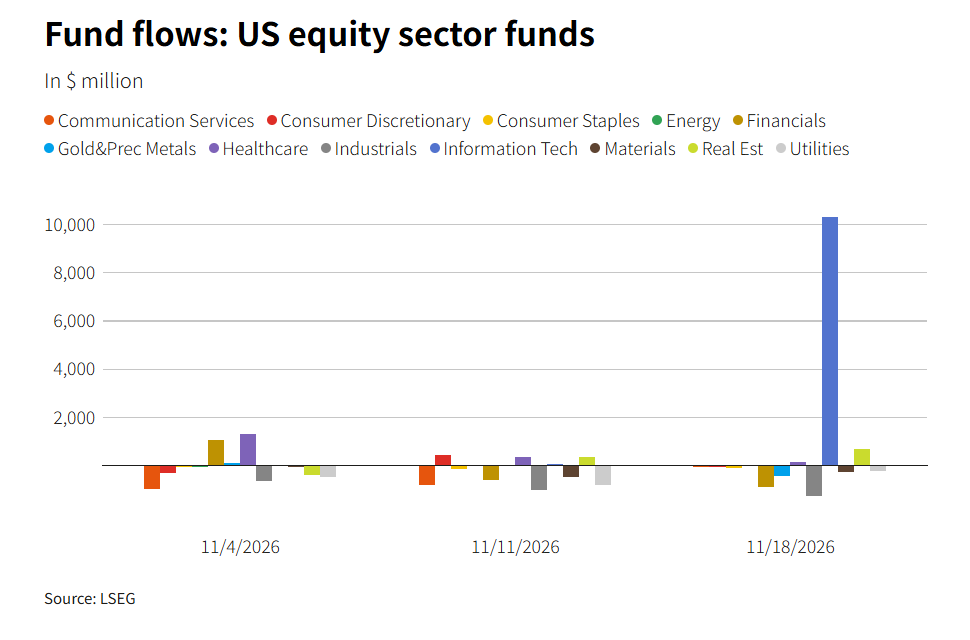
Among industry funds, technology funds attracted a net inflow of US$10.3 billion, a record high since June 16. Industrial and financial sector funds had net outflows of US$1.23 billion and US$884 million, respectively.
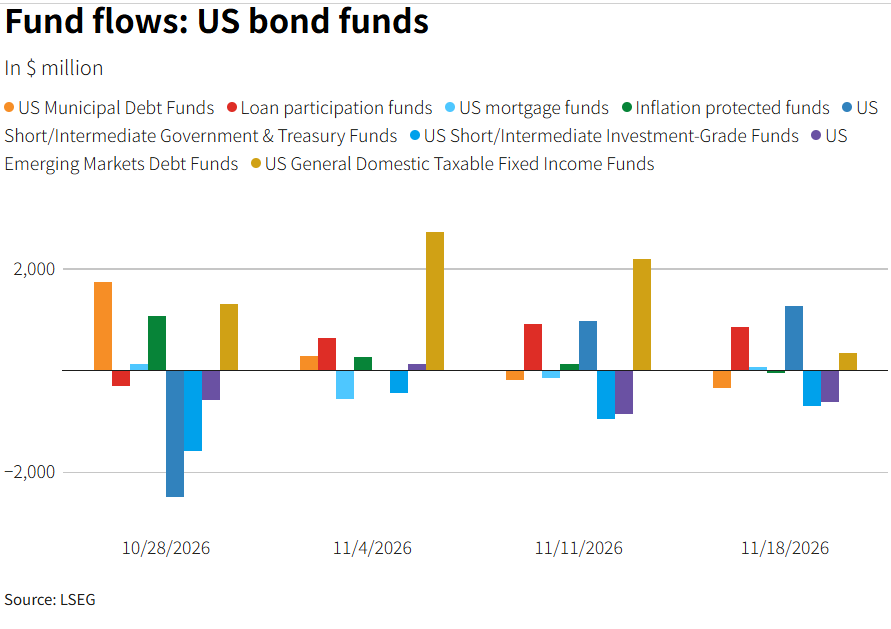
US bond funds recorded their first weekly net outflow in four weeks, with investors making net redemptions of US$5.58 billion.
The net outflow from US long-term government bonds and treasury bond funds was US$2.64 billion, and the net outflow from high-yield bond funds was US$2.31 billion. Short-term to medium-term government bond and treasury bond funds attracted US$1.27 billion, while loan participation funds attracted US$859 million.
Meanwhile, the net outflow of funds from the US money market was US$19.12 billion, the second consecutive week of net outflow.
Global equity funds have been drawing money for nine consecutive weeks. The US and Europe have increased their allocations, and Asia has been redeemed on a large scale
Global equity funds recorded significant net inflows for the week ending November 18. Despite recent increased volatility in some large technology stocks, strong third-quarter results and falling crude oil prices have boosted investors' confidence in establishing long-term positions.
According to LSEG's latest capital data flow, investors made a net investment of US$59.23 billion in global equity funds during the week, the largest weekly net purchase amount since mid-June.
With about 91% of the MSCI Global National Index companies having released financial reports, third-quarter profit increased 31.6% year-on-year, and the profit level was about 6.2% higher than analysts' expectations.
However, concerns about the scale of AI spending, combined with the Democratic Party's victory in the midterm elections, have raised market concerns about stricter regulatory scrutiny and a slowdown in data center expansion, which has recently put pressure on the technology sector.
Mark Hafer, chief investment officer of UBS Global Wealth Management, said in a report: “We believe that economic expansion, corporate profit cycles, and the structural global economic growth trends that support long-term investment in AI are still intact.”
“Our benchmark judgment for 2027 is still that the economic growth rate is close to the trend level, corporate profits continue to rise, the scale of AI investment continues to grow at the trillion-dollar level, and inflation tends to ease later in the year.”
Investors made a net purchase of US$45.71 billion in US equity funds, the biggest weekly net inflow since September 23. European equity funds also attracted a net inflow of $15 billion, while Asian equity funds had a net outflow of $2.78 billion.
By industry, there was a net inflow of $12.3 billion in technology funds. Industrial sector funds and equity funds investing in gold and other precious metals had net outflows of US$1.43 billion and US$538 million, respectively.
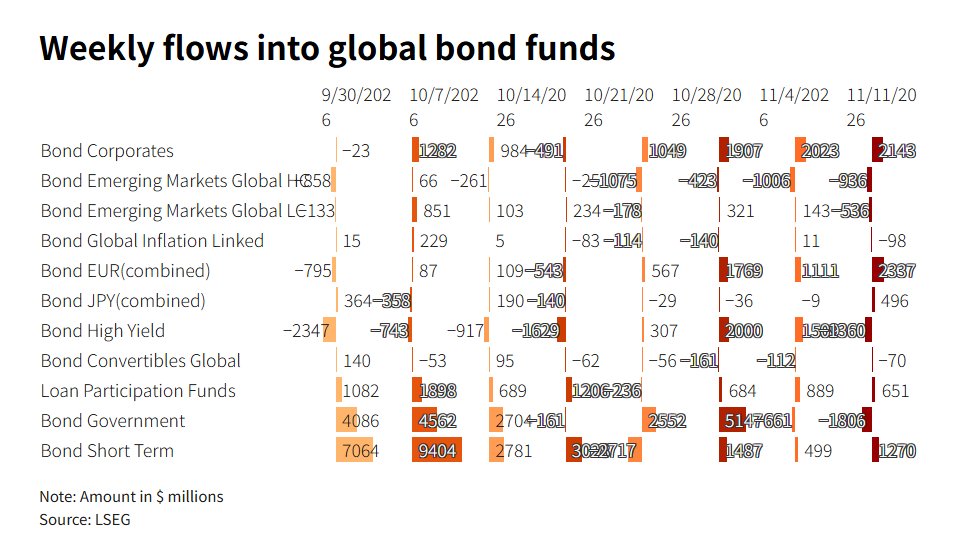
Global bond funds experienced net redemptions for the second week in a row, with a net outflow of US$3.2 billion for the week.
The net outflows of USD-denominated bond funds and high-yield bond funds were $2.78 billion and $1.36 billion, respectively. Euro-denominated bond-type fund assets attracted US$2.34 billion, the biggest weekly net inflow since August 12.
Meanwhile, investors made a net withdrawal of US$13.89 billion from global money market funds, a net outflow for the second consecutive week.
Among commodity funds, energy funds attracted US$260.84 million, receiving net purchases for the fifth consecutive week. Gold and other precious metals funds in this category also recorded a net inflow of US$1528.2 million.
In emerging markets around the world, data covering 29,197 funds showed that investors made a net investment of US$1.98 billion in equity funds, which was the seventh consecutive week of net purchases, while bond funds had a net outflow of US$1.38 billion.