


EN
Under the turmoil of Hwang In-hoon, how many winners are left on the AI track?
The Zhitong Finance App learned that after experiencing severe shocks in the past week, the stock market win/loss pattern triggered by Huang Renxun's sudden departure from NVDA.US (NVDA.US) has gradually become clear: the winners are chip manufacturers that compete with Nvidia for computing power center orders; while almost all other targets in the AI trading chain have become losers.
Ken Mahoney Asset Management President said, “We are trying to single out who will benefit and who will be harmed, but right now the vast majority are the losers. Before this chaos broke out, the AI sector was already in decline.”
Since the relevant news broke at the end of October, Nvidia's stock price has fallen by more than 29%, and the market value has evaporated by 1.4 trillion US dollars in just a few weeks. But it's far more than Nvidia alone under pressure.
Next-generation cloud service provider Nebius Group NV (NBIS.US) and Iren Ltd (IREN.US) fell more than 35% over the same period; CoreWeave (CRWV.US), which received support from Nvidia and completed its IPO in 2025, fell 18%. Companies that supply hardware for data centers equipped with Nvidia's AI chips, such as Dell (DELL.US) and Vertiv Holdings (VRT.US), have plummeted by more than 20%. Memory chip stocks also weakened, with SanDisk (SNDK.US) shares falling 34% in November and Western Digital (WDC.US) falling 19%.
In fact, as early as the beginning of the third quarter, the market already had doubts about the sustainability of hundreds of billions of dollars in capital expenditure on AI infrastructure, and related individual stocks continued to be under pressure. Afterwards, the US midterm elections were held, and many candidates opposed to data center expansion won the election, further triggering market concerns about the pace of industry growth and dragging down the collective weakening of all AI-related targets. Even though Anthropic (ANT.US) completed its historic IPO on Thursday, it failed to drive the tech sector to rebound.
But what really caused the market's concerns about the future of the AI industry to erupt was a personnel change at the world's top chip giant — the most recognizable and powerful “spokesperson” on the AI circuit left the field.
However, under Nvidia's crisis, a number of clear beneficiary targets have surfaced.
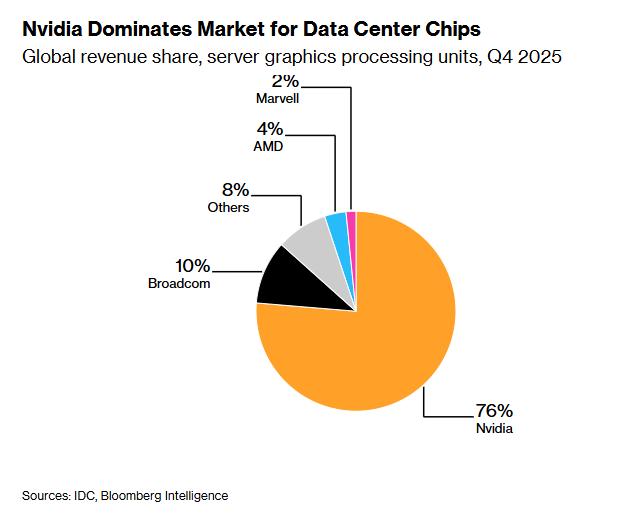
For example, the stock price of competitor chip manufacturer Broadcom (AVGO.US) rose 6% this month; AMD (AMD.US) also rose as before. It wasn't until Thursday, when a shorting report directly pointed to its exposure to China's business, that the stock price was suppressed.
Jay Peters (whose holdings include Broadcom), managing director of NewEdge Wealth and fund manager, said, “These two companies are Nvidia's main rivals. Without Wong In-hoon's ability to launch businesses and finalize key collaborations, Nvidia's market share and moat may be under pressure.”
Last week, William Blair raised the AMD rating from “equal to the market” to “outperforming the market”. The core reason is that Nvidia is in turmoil, opening a window of opportunity for AMD's Instinct series chips.
Analyst Sebastian Nagy wrote in a client research report: “We think the stock still has room to rise. AMD will focus on business implementation and rely on Instinct chips to seize share; while its biggest competitor, Nvidia, is mired in management turmoil and regulatory turmoil, which will give AMD additional upward momentum.”
Dirk Muraki, managing director of SLC Management, added that chip maker MRVL.US (MRVL.US) is also expected to seize share, but the stock price has yet to show the same increase as its peers; chip companies with different routes such as Arm (ARM.US) and Cerebras (CBRS.US) will also reap some benefits, but their volume is relatively limited.
CoreWeave, on the other hand, said that its collaboration with Nvidia is far more than just Hwang In-hoon's personal partnership. A company spokesperson said in a statement: “Nvidia has long been an important driver of the AI ecosystem, helping the market understand the potential of AI and drive the development of the entire industry. The cooperation between CRWV and Nvidia is independent of any one person, and the two sides have deep collaboration at the engineering and technical levels.”
The remaining companies affected by the Nvidia incident either declined to comment or did not respond to requests for comment.
Nvidia's quarterly earnings report on Tuesday also failed to dispel market concerns about the chain shock following Hwang In-hoon's departure. The company's fundamental performance is steady, raising next year's revenue guidelines and increasing the share repurchase plan by 150 billion US dollars. At the same time, it has stated that it will optimize supply guarantees for key components.
However, the biggest impact on the market is that Nvidia's management directly dismissed expectations of Hwang In-hoon's return. Many companies that previously relied on Nvidia's 100 billion cooperative orders over the past few years have been hit as a result. Nvidia's interim CEO Colette Kress has repeatedly used terms such as “prudent” and “strict” to describe the company's future review standards for AI supply chain investment projects. This shift is being closely tracked by Wall Street.
Mulaki said, “Nvidia is equivalent to a central bank in the AI ecosystem. If it tightens capital investment, startups will bear the brunt, and next-generation cloud vendors will be hit particularly hard. They previously relied heavily on Nvidia's resource support.”
Wall Street's biggest concern right now is when will Nvidia finalize a new head. Currently, the timing is unclear, and it is difficult to implement in the short term, and this uncertainty is putting huge risks on the entire AI transaction line.
Muraki said, “Investors have always believed that Hwang In-hoon can quickly adapt to market changes, and decades of experience have proven this. This confidence will need to be re-established under the leadership of new management, and this will take time.”