


EN
The wave of sell-offs has spilled over the tech world, and the S&P 500 may have the worst weekly performance in a year and a half! The AI market is repeating the dangerous script of the 2000 internet bubble
The Zhitong Finance App learned that this round of stock market sell-offs driven by artificial intelligence (AI) markets is spreading outward from the technology sector, and its interpretative path has even revealed some unsettling commonalities, which are highly similar to the market trend on the eve of the bursting of the internet bubble.
Analysis by TS Lombard, a London economic research institute, shows that in 2000, the Nasdaq Composite Index, which gathers technology stocks, peaked on March 10. By mid-April, the index had fallen by more than one-third; then bottom-up capital entered the market and capital turned to large, stable profitable technology stocks, and the index rebounded 35% by mid-June.
The S&P 500 index has remained at an all-time high for half a year since the technology benchmark index entered adjustment.
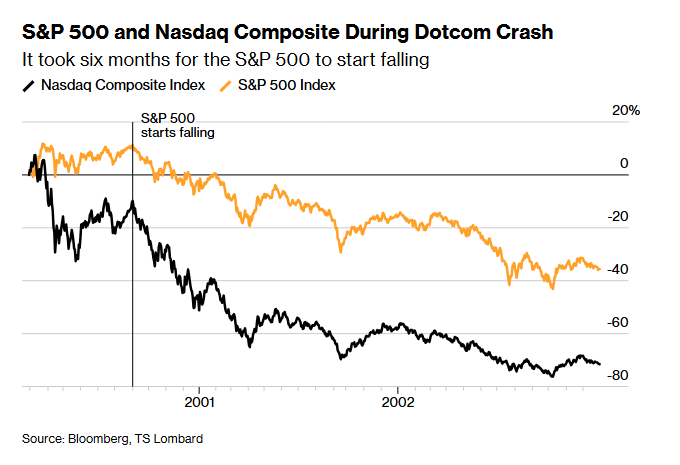
But then the risks began to ferment at an accelerated pace. The financing environment for underqualified technology companies has been tightened, credit spreads widened, and profit expectations have been lowered. Even the profit leaders that use such technology companies as customers are beginning to come under pressure.
That year, the Nasdaq index plummeted by more than 40% in three months. Seemingly full orders conceal signs that the market is about to reverse.
TS Lombard macro strategist Dario Perkins (Dario Perkins) said, “Supply bottlenecks are not a reason to be optimistic. After bottlenecks, there is often large-scale oversupply.”
In the current market, a similar story seems to be repeated.
In previous weeks, selling pressure was concentrated in the tech sector. Affected by factors such as concerns about excessive capital expenditure in the AI sector and the Democratic Party's control of Congress, the NASDAQ has retreated from a record high in early October and has begun to adjust the market. The initial performance of the S&P 500 was relatively resistant to falling and outperforming the NASDAQ, but now the pain has spread to the market. The S&P 500 is expected to record its worst weekly performance since April 2025 this week.
Perkins said, “The current market trend has an unsettling similarity to the scene before the bubble burst in the summer of 2000.”
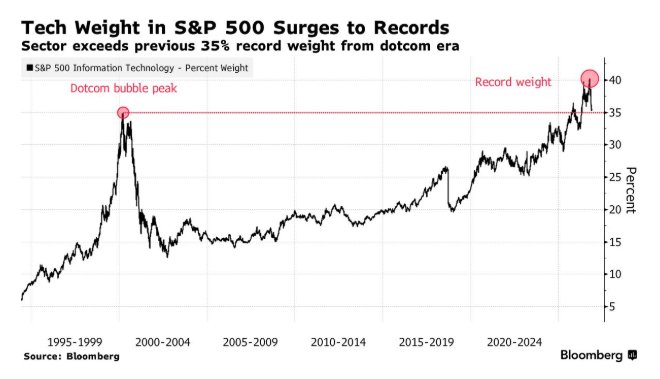
By 2026, the technology sector's risk transmission effect on the market has been further amplified — the share of technology stocks in mainstream indices is already much higher than that year. The IT sector's weight in the S&P 500 surpassed 40% last month, compared to only 35% at the peak of the bubble in 2000.
This does not include large market technology leaders such as Meta (META.US) and Alphabet (GOOGL.US) classified in the communications service sector. If the entire broad technology camp is included in the statistics, the total weight of this group in the S&P 500 was already over 46% last month.
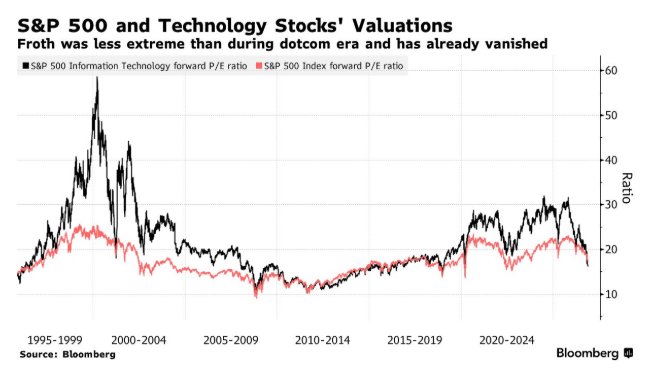
One major difference from 26 years ago is the level of valuation. In 2000, a large number of Internet companies were not profitable at all, and a few profitable companies were highly valued by capital; near the peak of the bubble, the dynamic long-term price-earnings ratio of the information technology sector once reached about 60 times.
Today, most leading technology companies are making good profits, and stock price premiums are relatively restrained. The valuation bubble built up during the internet bubble took years to clear up; the inflated valuations in this round of the AI market seem to have been quickly digested.
Investors faced sharp fluctuations and sharp pullbacks this week, but there are still good reasons to believe that the AI industry's dividends are not over yet. Major cloud vendors have yet to cut high capital expenditure plans, and demand for computing power is still strong; corporate profits are growing strongly, and macroeconomic fundamentals remain steady.
However, Perkins and the TS Lombard team reminded of a historical rule worth being wary of: the market often goes through a round of adjustments and a rapid rebound before finally falling sharply.
Furthermore, the agency itself sees the logic of long-term expansion of the AI industry, which is “surprisingly similar” to the bullish rhetoric circulating in the market when the Internet bubble burst in 2000. “At least, it's a reminder to be in awe,” Perkins said.