


EN
US stock outlook | The three major stock index futures had mixed ups and downs, and the panic index rose above 30 to hit a new high in nearly eight months, Anthropic fell more than 7% before the market
Pre-market market trends
1. On November 20 (Friday), the three major stock index futures had mixed ups and downs before the US stock market. As of press release, Dow futures were up 0.02%, S&P 500 futures were down 0.63%, and NASDAQ futures were down 1.51%.

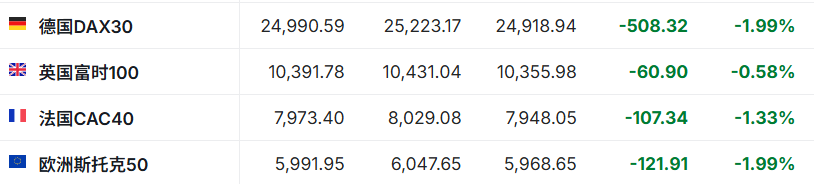
2. As of press release, the German DAX index fell 1.99%, the UK FTSE 100 index fell 0.58%, the French CAC40 index rose 1.33%, and the European Stoxx 50 index fell 1.99%.
3. As of press release, WTI crude oil futures fell 0.18% to $82.29 per barrel, while Brent crude futures fell 0.54% to $91.48 per barrel.

Market news
Global market fears have heated up. VIX has risen above 30 to a new high of nearly eight months, and various types of assets have been sold off. On Friday, market risk appetite continued to cool down. Stocks, precious metals and cryptocurrencies were simultaneously under pressure. The VIX Panic Index rose to 30, the highest since the end of March. The Asia-Pacific market generally declined on Friday. The Nikkei 225 Index and Korea's KOSPI Index fell 5.1% and 5.2% respectively, and the Hang Seng Index fell 1.9%; major European stock indexes also fell across the board. Safe haven funds have driven up the price of US bonds, and the 10-year US bond yield has fallen below the 5% mark. Market concerns focus on three main lines: further interest rate hikes by the Federal Reserve, uncertainty about returns on AI investments, and tightening global liquidity.
Expectations of the Federal Reserve's interest rate hike are compounded by AI sell-offs, and both gold and copper are under pressure this week. Gold prices weakened again on Friday, and this week's performance is likely to hit the worst record in eight months. The strong trend of the US dollar, combined with market expectations that the Federal Reserve will raise interest rates in December, put pressure on the price of gold. The cumulative decline in gold prices this week was about 7%, the biggest weekly decline since the week of March 20 (or 8 months). Furthermore, copper prices fell to their lowest level since March. The price of LME's three-month copper contract once plummeted by more than 3%, making this week's copper price likely to record one of the worst weekly performances in the past ten years. The main factor triggering the sell-off of copper was the market's growing doubts about whether AI-related spending could be sustainable and the role of copper in AI infrastructure construction.
Hwang In-hoon is said to be starting a new semiconductor company. The whereabouts of former Nvidia CEO Hwang In-hoon has become a hot topic in Silicon Valley. Tech media reporter Rohan Goswami predicts that Hwang In-hoon may return to the AI circuit after taking a break, start a new semiconductor company, and not return to Nvidia. Analysts believe that with mature entrepreneurial experience and industry contacts, he has the ability to build an influential enterprise. Goswami also mentioned that Hwang In-hoon may have raised 50 billion US dollars from friends and industry allies, but the news is only a prediction, not an official announcement plan. Currently, there is no evidence that he has raised capital or registered a new company.
Trump postponed his decision on Iran until next year, and Hormuz interfered to limit the drop in oil prices. According to reports, US President Trump said he will wait until next year to decide whether to resume the crackdown on Iran and postpone the schedule linked to this month's midterm elections. It was revealed that the White House has asked the Pentagon and intelligence services to analyze Iran's response under different strike plans, paying particular attention to whether it attacked oil and gas facilities in the Gulf countries; Iran's Revolutionary Guard Corps said on the same day that it will not discuss the nuclear issue until the Strait of Hormuz issue is resolved. Due to geographical uncertainty, oil prices still maintain a risk premium in the context of oversupply.
Britain and the European Union reached a package agreement to deepen post-Brexit relations. Britain and the European Union reached a package agreement at the Brussels summit on Friday to deepen bilateral relations after Brexit. The agreement will simplify food trade, connect with carbon markets, and ease restrictions on young people studying, working and living across borders. The effective date is subject to the announcement of a joint statement. The negotiations took several months, and the process was delayed due to the resignation of former Prime Minister Stammer. British Prime Minister Burnham estimated that the agreement would boost British economic output by 0.4%. However, the two sides still have differences over tuition fees for international students. The EU wants the British side to charge fees according to local standards. The impasse has caused the market to worry that the implementation of the agreement may be delayed.
The boom in artificial intelligence has driven the issuance of European bonds to a record of 2 trillion euros. The total amount of Eurobonds issued surpassed 2 trillion euros (about 2.2 trillion US dollars) for the first time. What is behind this phenomenon is a “collision” between the government's continuous demand for loans and the huge demand for capital brought about by the artificial intelligence (AI) boom. Technology companies are the main force driving the annual distribution to record levels. American hyperscale technology companies, represented by Alphabet and Amazon, have raised huge sums of money to build data centers and related infrastructure needed for AI. As the tech race continues to accelerate, I'm afraid European bankers will still be busy handling all kinds of financing operations.
The Global Electronics Association warns that PCB shortages are spreading, and that supply is tight or will continue until mid-2028. The Global Electronics Association (Global Electronics Association) stated in an early warning report that the global electronics industry is facing a serious shortage of printed circuit boards (PCBs). The supply gap for this basic component, which is present in almost all products containing electronic components, is likely to have a widespread impact on the global economy, and the tense situation may continue until mid-2028. At a time when AI hardware stocks are collectively recovering due to capital expenditure concerns, supply bottlenecks for upstream basic components have added new cost variables to the industry chain, and the market is concerned about its transmission to the gross profit and delivery pace of electronic products.
Individual stock news
Large technology stocks generally fell before the market, and Nvidia (NVDA.US) declined for six days in a row to lead the decline. Before the US stock market on Friday, Nvidia fell 2.46%, Microsoft (MSFT.US) fell 1.70%, Amazon (AMZN.US) fell 1.89%, Meta (META.US) fell 2.35%, Tesla (TSLA.US) fell 2.07%; Apple (AAPL.US) rose 0.31%, and Google (GOOGL.US) rose 0.09%. Weighted stocks are under overall pressure, in line with the direction of stock index futures; Nvidia has been falling for the sixth consecutive trading day, and market scrutiny of AI capital expenditure returns continues to suppress tech giants' valuations.
The biggest IPO in history surged high and fell on the first day, and the contradiction between Anthropic (ANT.US)'s huge losses and overvaluation became prominent. Anthropic raised $81 billion and set the record for the largest IPO in history, with an issue price of $83 and an opening price of $111.50. The market capitalization briefly topped $2 trillion, but in the end, the closing price narrowed to 17.07%, to $97.17. It traded $15 billion in the first minute and fell 13% from the opening price in the next half hour, making it one of the worst starts for major US stock IPOs since 2008. According to the prospectus, the company had revenue of 33.2 billion US dollars in the first three quarters of this year, but the net loss exceeded 100 billion US dollars, and signed irrevocable procurement and leasing promises totaling 909 billion US dollars to compete for computing power. MSI will include it in the large-cap stock index on December 1. As of press time, Anthropic is down about 7% in the premarket.
Anthropic's Australian data center project was overwhelmingly opposed by local residents. According to reports, the project application documents show that the Western Downs Digital Park data center project in Australia, where Anthropic is the main tenant, was strongly opposed by local residents. The park is located on farmland about 250 km west of Brisbane, with a planned load of 1.44 GW. After completion, it will become one of the largest data centers in Australia. Nearly 600 public feedbacks were received this time, with only 2 in favor, 1 neutral, and 595 requests rejected or suspended until environmental issues were resolved. About one-third of the comments came from residents within 200 km of the project. The main concerns were water consumption, the use of electricity to drive up electricity prices, noise, road damage, and pressure on housing supply.
Rumor has it that Apple is developing its own AI agent. Apple is developing its own autonomous artificial intelligence agent (AI agent). Apple outlined this plan in a new job posting on its official website this week. In one of the hires, Apple said it was hiring a senior engineering manager for an “active, intelligent AI assistant.” According to the recruitment notice, the system will write code, browse the web, control the application, and operate on the device on behalf of the user.
Musk wants to give computing power to heaven, and SpaceX (SPCX.US) creditors plan to add a clause to the contract: Please leave the mortgaged Nvidia GPU on Earth. According to reports, SpaceX's latest $43 billion debt financing was secured by Nvidia GPUs. SpaceX said it plans to use this batch of chips in data centers within the US. Creditors are worried that if SpaceX launches the chip in the future, once the company defaults, they will not be able to take back and sell the collateral. As a result, creditors sought to include a restrictive clause, and it is currently unclear whether this provision will be included in the final document. On Thursday, SpaceX sold more than $30 billion in bonds to large investors as part of a financing package called “Project Saturn” (Project Saturn). The largest of the financing was a $25 billion investment-grade bond, supported by the five-year rent SpaceX paid to rent Nvidia chips.
Visa (V.US), Mastercard (MA.US), and JPMorgan Chase (JPM.US) customer data was leaked by hackers. The ransomware hacker group leaked data on thousands of Visa, Mastercard, and J.P. Morgan Chase customers on Thursday. This is the latest in a series of technical security incidents that have occurred one after another in the past week, making consumers even more concerned about the safety of related services. The three companies said that the hacker obtained and leaked customer information by hacking into a third party agency, but it did not affect the operation of related services.
ROST.US (ROST.US) exceeded expectations in the third quarter but lowered its guidelines. The company released after-hours results for the third fiscal quarter ending October 31 after the market on Thursday: diluted earnings of $1.91 per share, higher than FactSet analysts' expectations of $1.87; sales increased 12% to $6.256 billion, slightly higher than the forecast of $6.25 billion. However, guidance for the fourth fiscal quarter was weak — maintaining same-store sales growth of 4% to 5% (up 9% in the same period last year) and lowering EPS expectations to $2.16 to $2.25, corresponding to an increase of 8% to 13%, lower than analysts' expectations of $2.27. The guidance fell short of expectations, causing the stock price to fall by about 4% before the market.
Key economic data and event forecasts
21:25 Beijing time: Federal Reserve Governor Waller delivered a speech
23:00 Beijing time: The final value of the US Consumer Confidence Index for November at the University of Michigan
01:15 Beijing time the next day: Federal Reserve Governor Lisa Cook delivered a speech