


EN
The UK's deficit in October was £1 billion less than expected! Taxes bear the energy shock, and UBS is betting that both the pound and Phnom Penh bonds will strengthen
The Zhitong Finance App learned that the British government's October loans fell short of expectations. The economy remained resilient, helping the government offset some of the spending pressure brought about by rising inflation. According to data from the UK Office for National Statistics, the budget deficit for October was 17 billion pounds (about 22.3 billion US dollars), slightly higher than the same period last year, but lower than the median value of 18 billion pounds predicted by economists in institutional surveys.
So far, the cumulative deficit for the first seven months of this fiscal year reached £111.3 billion, £7.3 billion less than the same period last year, but £3.3 billion higher than the level predicted by the UK Office of Budget Responsibility in its March outlook.
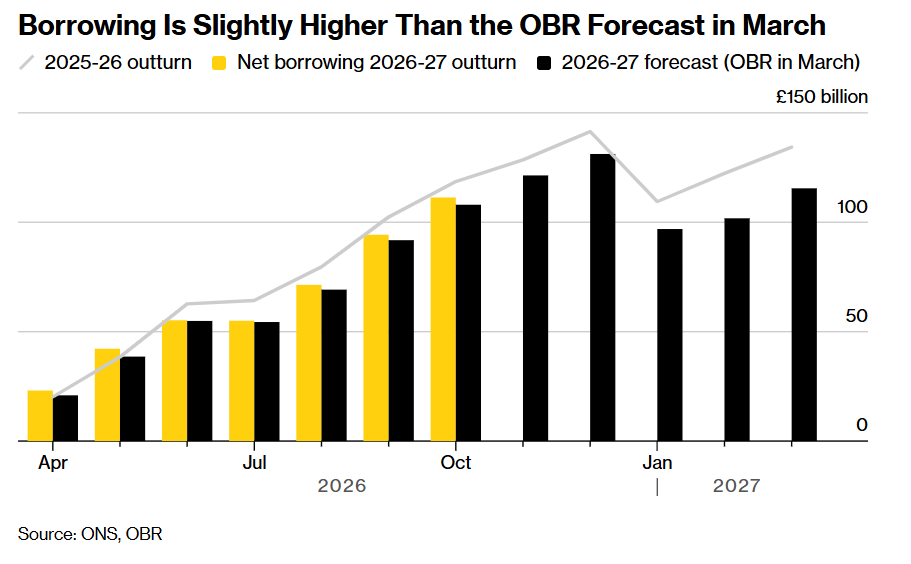
As shown in the chart above, UK borrowing was slightly higher than the March forecast of the Office of Budget Responsibility. Source: UK Office for National Statistics, UK Budget Responsibility Office.
In the budget announced on October 28, Chancellor of the Exchequer John Healy promised to provide households with cost of living allowances during the energy shock and took part of the spending pressure. As a result, the Office of Budget Responsibility raised its overall borrowing forecast for the 2026/27 fiscal year by £17.7 billion. The UK Office for National Statistics said that the Office of Budget Responsibility will release a new monthly borrowing forecast next month.
Despite rising inflation and the ongoing impact of the Middle East conflict on the economy, the UK's economic performance this year was still more resilient than expected, and the growth rate surpassed almost all other members of the G7. The International Monetary Fund also confirmed the British government's plan to reduce the deficit last month. Among developed economies, the UK is moving ahead with fiscal consolidation the fastest.
UBS Global Wealth Management is betting on the rise of the British pound and British treasury bonds (also known as “Phnom Penh bonds”). It believes that the UK's political stability, combined with the government's efforts to control spending, will give the UK an advantage over most economies in the Eurozone.
Tax revenue has remained strong, increasing £40.5 billion so far this fiscal year over the same period last year. Boosted by strong wage growth, income-linked tax performance was particularly prominent. According to the UK Office for National Statistics breakdown, £40.5 billion is an increase in the central government's regular revenue, with taxes increasing by £34 billion.
Spending increased £36.2 billion over the same period. Inflation has boosted the cost of government procurement of goods and services, as well as increased debt interest and social welfare spending.
Interest costs on October debt increased 33.4% year over year to £8.4 billion from £8.4 billion in the same period last year. About a quarter of the UK government debt is linked to the retail price index. The RPI rose 4.2% year on year in October, and is expected to increase by more than 5% at the beginning of next year.
Emma Reynolds, chief secretary of the British Treasury, said that fiscal discipline “is the foundation for the current administration to make decisions every day,” adding that the government will control spending. “We will reprioritize spending and use artificial intelligence to improve the efficiency of public services, thereby reducing waste and streamlining administrative processes.”
The amount of loans for the first six months of the 2026/27 fiscal year was revised down by £3.6 billion, which also improved the government's financial situation.
Rob Wood, chief British economist at Pantheon Macroeconomic Consulting, said: “The latest public finance data brings some good news to the Chancellor of the Exchequer. October loans are likely to fall short of expectations when preparing the budget, and the cumulative loan amount for the first five months of this fiscal year has also been revised down.”
The government has ambitious plans for national defense, decentralization to local authorities, and social care. But rising borrowing costs have eroded the margin to meet fiscal rules, and Healy has left little room for maneuver in the budget. The fiscal buffer was almost halved to £14.5 billion. However, when the spring fiscal statement postponed the target fiscal year by one year, the buffer is expected to increase to £21.7 billion.
The UK's main fiscal target requires that tax revenue should be sufficient to cover everyday expenses by the 2029/30 fiscal year. According to this caliber, loans from April to October were £72.9 billion, a decrease of £8.5 billion compared to the same period last year.
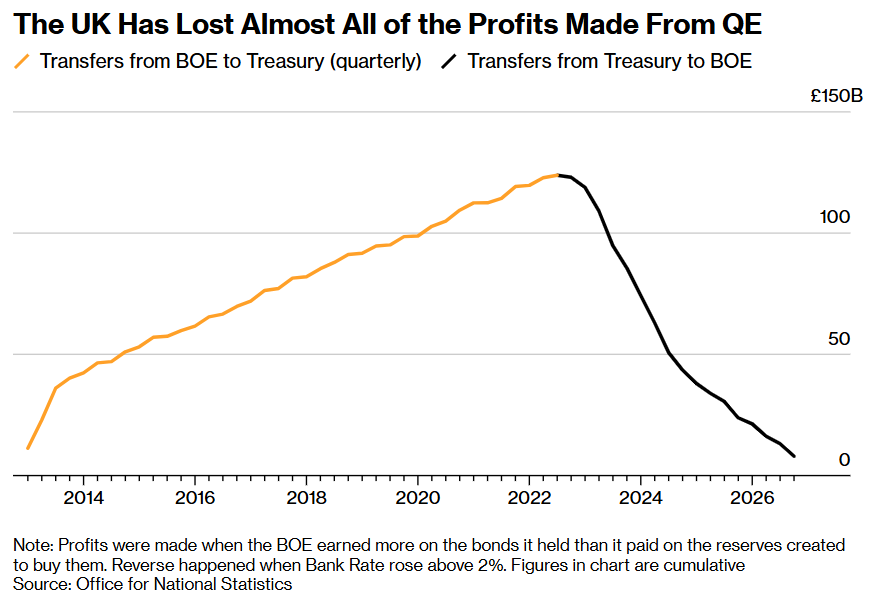
As shown in the chart above, almost all of the gains made by quantitative easing in the UK have been returned. Note: Interest income from bonds held by the Bank of England was once higher than the interest it paid on reserves created to buy bonds, thus obtaining benefits. When the policy interest rate rises above 2%, the relationship between the two completely reverses. The figure shows the cumulative amount. Source: UK Office for National Statistics
The UK Office for National Statistics also revealed that the Treasury once again allocated 5.2 billion pounds to the Bank of England in October to cover losses in the quantitative easing program. Related losses have accumulated to £115.9 billion, almost offsetting the £124 billion in gains made between 2009 and 2022.
The UK's deficit in October was £1 billion less than expected. Why is UBS optimistic about the British pound and British debt?
Net public sector borrowing in October was £17 billion, lower than the £18 billion forecast in the Bloomberg survey, but it was an increase of £800 million over the same period last year, or 5.2 percent. Extended from April to October, the cumulative deficit for the current fiscal year was £111.3 billion, a year-on-year decrease of £7.3 billion, which is still £3.3 billion higher than the UK Budget Responsibility Office (OBR) forecast in March.
Wage increases supported taxes and helped the government absorb some of the energy shocks, but interest accrued by the central government jumped 33.4% year on year to £11.2 billion in October, the highest in the same period since monthly records were set in 1997. UBS Global Wealth Management is optimistic about the British pound and British treasury bonds, betting that Britain's relatively stable political environment and fiscal consolidation are expected to increase the attractiveness of the two types of assets. After the data was released, British treasury bond futures declined for a while, and overall changes were limited thereafter.
A more favorable signal for Chancellor of the Exchequer John Healy comes from daily income and expenditure directly related to fiscal rules. In the first seven months, net public sector borrowing, including capital investments, was £3.3 billion higher than the March forecast. The regular budget deficit to cover the daily income and expenditure gap was £72.9 billion over the same period, which was £500 million lower than the forecast.
Improvements on the revenue side are also well documented. The central government's current revenue increased 6.6% year over year to £650 billion, an increase of £40.5 billion. Among them, taxes increased by £34 billion, and income-linked taxes increased by 8.3%, which is the biggest source of revenue growth. This means that the UK has made progress in narrowing its daily fiscal gap, while the government's overall financing needs are still higher than anticipated at the beginning of the year.
How can the same rate hike support the British pound's arbitrage logic and squeeze the UK's fiscal balance?
For the British pound, the transaction is based on the logic of interest spreads; for British treasury bonds, investors also need to determine whether the fiscal risk premium can fall back. The Bank of England raised interest rates by 25 basis points to 4% in November. UBS listed the British pound as the preferred arbitrage target among G10 currencies. It is expected that the Bank of England will raise interest rates again in early 2027, so that the pound maintains its yield advantage over the euro, the Swiss franc, and the yen.
The logic of British Phnom Penh bonds depends on whether the government can fulfill spending discipline and reduce the additional compensation required for investors to hold long-term treasury bonds. Estimates from the UK Treasury reveal how strong this constraint is: an increase in debt interest forecasts alone has eroded the fiscal balance of £12 billion. After taking into account other forecast adjustments and policy measures, the balance for the 2029/30 fiscal year fell from $23.6 billion to £14.5 billion, a reduction of around 39%.
The sensitivity of the British treasury to inflation and interest rates is reflected in two accounts of a different nature. The first one is an inflation-linked treasury bond. Of the £11.2 billion accrued debt interest in October, 4.2 billion came from bond principal raised in line with the retail price index (RPI), mainly reflecting a 0.6% month-on-month increase in RPI from July to August. This part of the value-added value is included in interest expenses in the current month and only paid when due. Therefore, the year-on-year increase in RPI in October cannot be used to directly estimate cash interest payments for that month.
The second is interest rate exposure left by quantitative easing (QE). The Bank of England buys long-term bonds. Interest on holding positions is relatively fixed, and financing costs are adjusted according to policy interest rates. The Ministry of Finance allocated an additional 5.2 billion pounds in October to cover related losses. Based on the cumulative amount reported, about 93.5% of past QE earnings have been offset, leaving only about £8.1 billion. Note that these grants offset each other in the public sector consolidated accounts and cannot be added to the current month's deficit of £17 billion.