EN
Silicon Industry Branch: Industrial silicon market futures fluctuated strongly this week, and spot prices continued to operate steadily
The Zhitong Finance App learned that on November 20, the Silicon Industry Branch released the Industrial Silicon Weekly Review. This week, the industrial silicon market showed a pattern of “strong fluctuations in futures and steady operation of spot stocks”. Furnace shutdowns deepened during the dry water period in the southwest, and the number of furnaces started across the country continued to decline, and supply-side contraction signals continued to strengthen; however, downstream polysilicon and silicone production were cut simultaneously, and the demand side was also weak, and prices remained in a narrow circle between cost support and weak demand.
Market performance: futures are running strongly, and spot is strong and stable
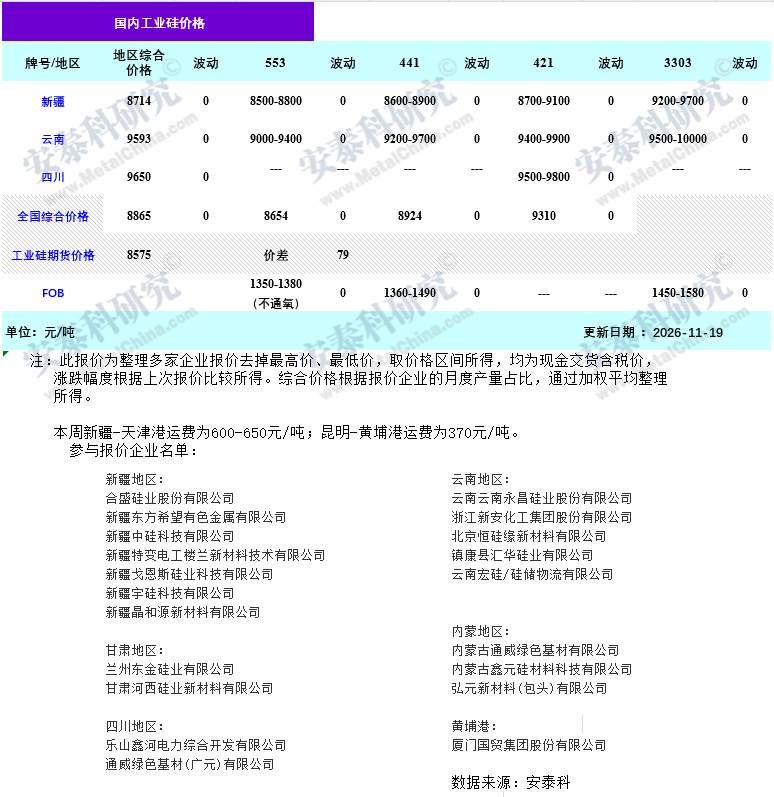
In terms of futures, industrial silicon futures completed the main position transfer to the month this week, and the overall market showed a volatile and weakening trend. According to data from the Guangji Institute, on and before November 18, the market still used the 2612 contract as the main reference, closing at 8,690 yuan/ton on November 18; starting November 19, the main force officially switched to a 2701 contract, and the new main force declined under pressure, closing at 8,575 yuan/ton on the same day. The market was repeatedly torn between cost support and weak demand during the week. Supply contraction due to production cuts in the southwest was expected to underpin the bottom, but simultaneous production cuts in downstream polysilicon and silicone suppressed the height of the rebound, and overall there was no clear one-sided drive.
In terms of stock, according to Antec's November 19 price, the national comprehensive price is 8,865 yuan/ton, the same as last week. By specification, 553 #报8654元 /ton, 441 #报8924元 /ton, and 421 #报9310元 /ton were all the same as last week. Looking at the subregions, prices in Xinjiang, Yunnan, and Sichuan were 8,714 yuan/ton, 9,593 yuan/ton, and 9,650 yuan/ton respectively, all the same as last week. In terms of export FOB, prices are the same as last week.
Judging from the transaction situation, the spot market's inquiry activity has improved compared to the previous period, but actual transactions are still dominated by a small amount that just needs to be replenished. Manufacturers' prices are strong, and it is difficult to find low-price supplies; the downstream as a whole is still in the early stages of consumption of its own inventory, and there is no large-scale centralized procurement. Buyers and sellers maintain a game near the cost line.
Supply side: The shutdown of furnaces in the southwest continues to deepen, and the increase in supply in the north is limited
The supply-side contraction trend has been largely confirmed this week, and the overall number of industrial silicon furnaces in the country is relatively stable. In the southwest production area, production cuts during the dry water period have come to an end. The vast majority of silicon companies in the southwest that lacked supporting facilities have shut down, and only a very small number of companies maintained low production loads due to electricity price surpluses in November. It is expected that these companies will run out of quota and completely stop production by the end of November. At that time, supply in the southwest will further bottom out. In addition, some integrated supporting companies are continuing to shut down production, mainly due to the consumption of early industrial silicon inventories. Looking at the main production areas in the north, the overall operating rate remains low. Although some maintenance capacity was resumed in Inner Mongolia, Xinjiang, etc., other enterprises immediately went into maintenance, and there was no substantial increase in supply growth; major factories in Xinjiang still have no clear plans to resume production, and the north as a whole cannot effectively hedge against the reduction in the southwest. Taken together, the current supply-side shows a pattern of “bottoming out in the southwest and stabilizing in the north”. As the last batch of companies shut down at the end of the month, the net contraction on the supply side will basically take shape. The bearish power of the early market based on the “resumption of production hedging” logic has basically subsided, and the supply-side's substantial role in supporting prices continues.
Demand side: Polysilicon transactions are light, and silicone continues to reduce load
The overall demand side continued to be weak this week, and all sectors contracted at the same time. In terms of polysilicon, market transactions continued to decline compared to last week. Production companies insist on selling at no less than full cost. Upstream and downstream prices have not yet formed an effective link, making it more difficult to negotiate new orders. The industry's operating rate is expected to drop further to around 36% in November. Purchases of industrial silicon are still mainly based on consumption of own raw material stocks, and the willingness to buy new products is weak. In terms of silicone, capacity utilization remains low, and some monomer plants continue to maintain half-load production. Production cuts directly suppress demand for industrial silicon procurement, and the increase drove expectations to fall short. In terms of aluminum alloy, the overall procurement pace is normal, but due to large-scale furnace shutdowns by southwest silicon companies, some supplies are structurally tight. High-end aluminum alloys in the south have high requirements for silicon powder and high-quality small furnace materials. Recently, due to the contraction of supply in the southwest, some companies have faced pressure to purchase raw materials, and the willingness to inquire in the market has increased, but it has not yet evolved into an industry shortage. Overall, the demand side is still a situation where “downstream production is being cut and they are unwilling to stock up”.
Looking ahead to the future market: the bottom is strong, but breaking the game requires new variables
In the short term, the industrial silicon market is currently in a game phase where “supply contraction continues to deepen, demand weakens simultaneously, and cost support strengthens.” The shutdown of furnaces in the southwest and restrictions in the north are jointly driving a net contraction on the supply side. The rise in electricity prices during the dry water period consolidated the bottom of costs, and there is limited room for price decline. However, production of polysilicon and silicone was reduced simultaneously, and the demand side was also weak, and there was no upward price drive. Prices are expected to fluctuate in a narrow range in the short term, with reference range of 8,500-8,800 yuan/ton for the main contract. In the future, we need to focus on tracking: the actual scale of impact of the shutdown of the furnace in the southwest and the discontinuation of production by integrated enterprises, whether the inventory can reach an inflection point after the reduction in production of polysilicon is implemented, and the actual implementation of silicone load reduction. The market is likely to remain deadlocked until there are clear signs of improvement on the demand side.