


EN
AI ebbs down+the Federal Reserve eagles, BlackRock Bitcoin ETF lost a record $541 million in blood in a single day, and Bitcoin fell below $62,000 under the wave of sell-offs
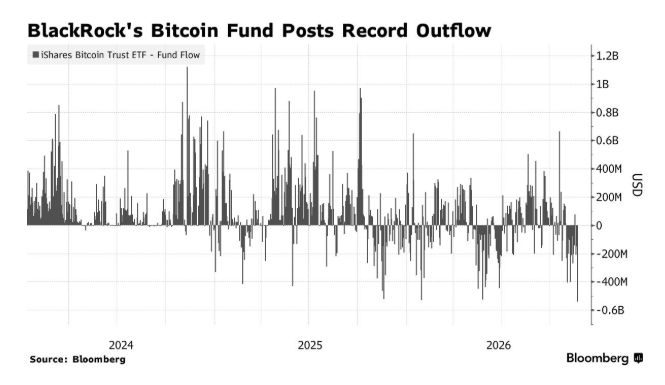
The Zhitong Finance App learned that on Thursday, BlackRock's spot Bitcoin ETF recorded the largest single-day capital redemption in history. In an environment where risk assets are generally declining, investors continue to withdraw funds from this product.
According to the data, investors redeemed $541 million from the Bitcoin ETF-iShares (IBIT.US), which is the largest outflow of the fund since it went public in January 2024. On the same day, there was a total net outflow of USD 582 million from spot Bitcoin ETFs listed on the US stock market.
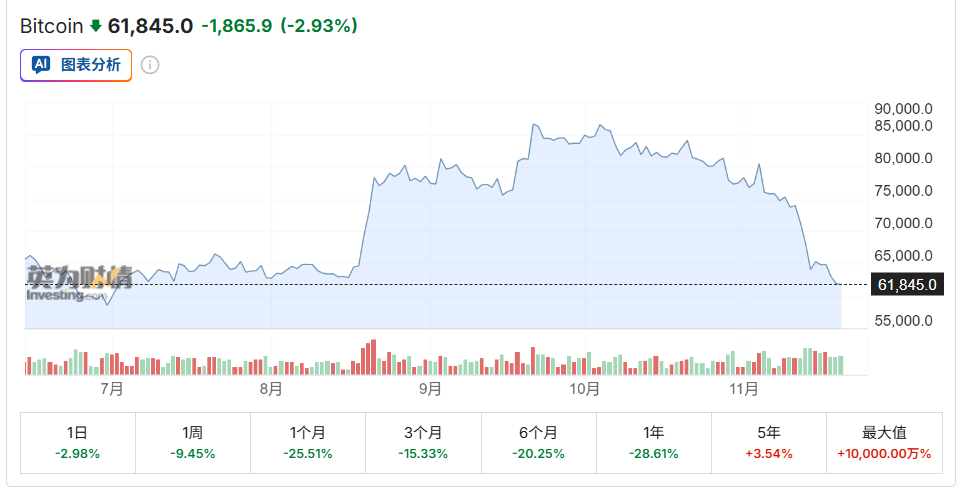
After a sharp drop on the previous trading day, Bitcoin traded around $62,000 on Friday and fell to a low of $61242 during the Asian trading session. The pessimism surrounding artificial intelligence (AI) trading continues to weigh on the market. Hawkish signals from the Federal Reserve also strengthened expectations of another rate hike in December, further dampening risk appetite.
Paul Howard, senior director of market maker Wincent, said, “ETF outflows have shown the current state of the market. Combined with the Federal Reserve's hawkish stance continuing to put pressure on risky assets, institutional capital has not yet bottomed out on a large scale.”
The day after the major listing of AI company Anthropic (ANT.US), the Asian stock market weakened at the same time. Anthropic's share price fell along with the market after the market. The MSCI Global National Index, which measures the performance of global stock markets, is about to close down for the 7th consecutive trading day.
Cosmo Jiang, general partner at Pantera Capital, said: “Dragged down by macro-level concerns, digital assets and other risky assets are being sold off simultaneously. “The market is questioning whether the AI capital expenditure cycle will last, and the impact of this cycle on corporate profits.”
In recent weeks, multiple pressures have impacted the Bitcoin market. Binance, the world's largest crypto exchange, was hacked at the end of October, shaking the digital asset market; a week later, the Democratic Party won a big victory in the US midterm elections, which also raised concerns about the future of AI companies.
Since the first US stock trading day (October 30) after the Binance hack, spot Bitcoin ETF has accumulated outflows of approximately $4.1 billion.
Bitcoin's current trend is highly suited to the characteristics of risky assets, and often falls at the same time as technology stocks. The 40-day correlation coefficient between Bitcoin and the Nasdaq 100 Index has risen to 0.69, according to compiled data.
Cryptocurrency market maker DWF Labs stated in a report backtracking trends since 2020: “On the days when NASDAQ fell 1% or more in a single day, Bitcoin fell simultaneously for about three-quarters of the time. Historical trends prove that Bitcoin is a risky asset, not a safe-haven asset.”
However, Howard of Wincent believes that Bitcoin is expected to have an orderly recovery this winter.
He said, “Anthropic's IPO has already landed. When Bitcoin falls further and the price fully absorbs the shortfall, capital may return back to the crypto circuit.”