


EN
“AI trading” cracks continue to show, global stock markets are being sold off, and US bonds are expected to rise for the longest period in five months
The Zhitong Finance App learned that as the market's doubts about the artificial intelligence (AI) trading market continue to deepen, global stock market sell-offs intensify, and capital pours into safe-haven assets one after another, US Treasury bonds are expected to rise for the longest period in nearly five months.
During the Asian trading session on Friday, full-term yields on US bonds fell by 2 to 3 basis points, and US bond yield indicators are expected to record a fifth consecutive day of rise. This will be the longest round of continuous gains since June 29. The US dollar index is expected to rise for the fourth week in a row.
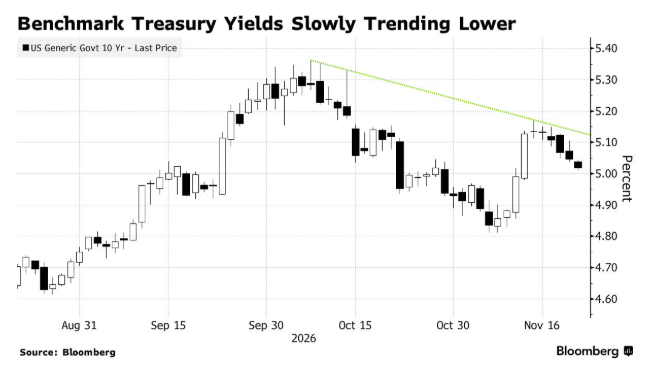
Market risk appetite has cooled down, adding further impetus to the rise in US debt. As investors begin to re-examine the overvalued AI sector and the huge capital expenses that support this round, the global stock market may set a record for the longest continuous decline in more than three years. Concerns about the AI market have spread to the market, and safe-haven demand may continue to suppress US bond yields.
Kenneth Crompton, head of interest rate strategy at the National Bank of Australia, said, “Today, yields are declining steadily, and major Asian stock indexes and US futures are weakening at the same time, indicating that safe-haven transactions that began overnight are continuing.”
Despite recent increases, the overall yield on US bonds is still high. The 10-year US Treasury yield has remained above 5%, and is about to approach the longest record in 20 years. Behind it are market concerns about sticky inflation and expectations that the Federal Reserve will continue to raise interest rates next year.
Crompton also mentioned that although investors are reducing some of their risk exposure, “we don't think the AI market has completely collapsed,” and “the fundamental logic to support the sharp fall of 10-year US Treasury yields below 5% is insufficient.”