


EN
Perfect Healthcare (01830) Interim Report View: How to interpret the strategic flexibility behind changes in non-current assets?
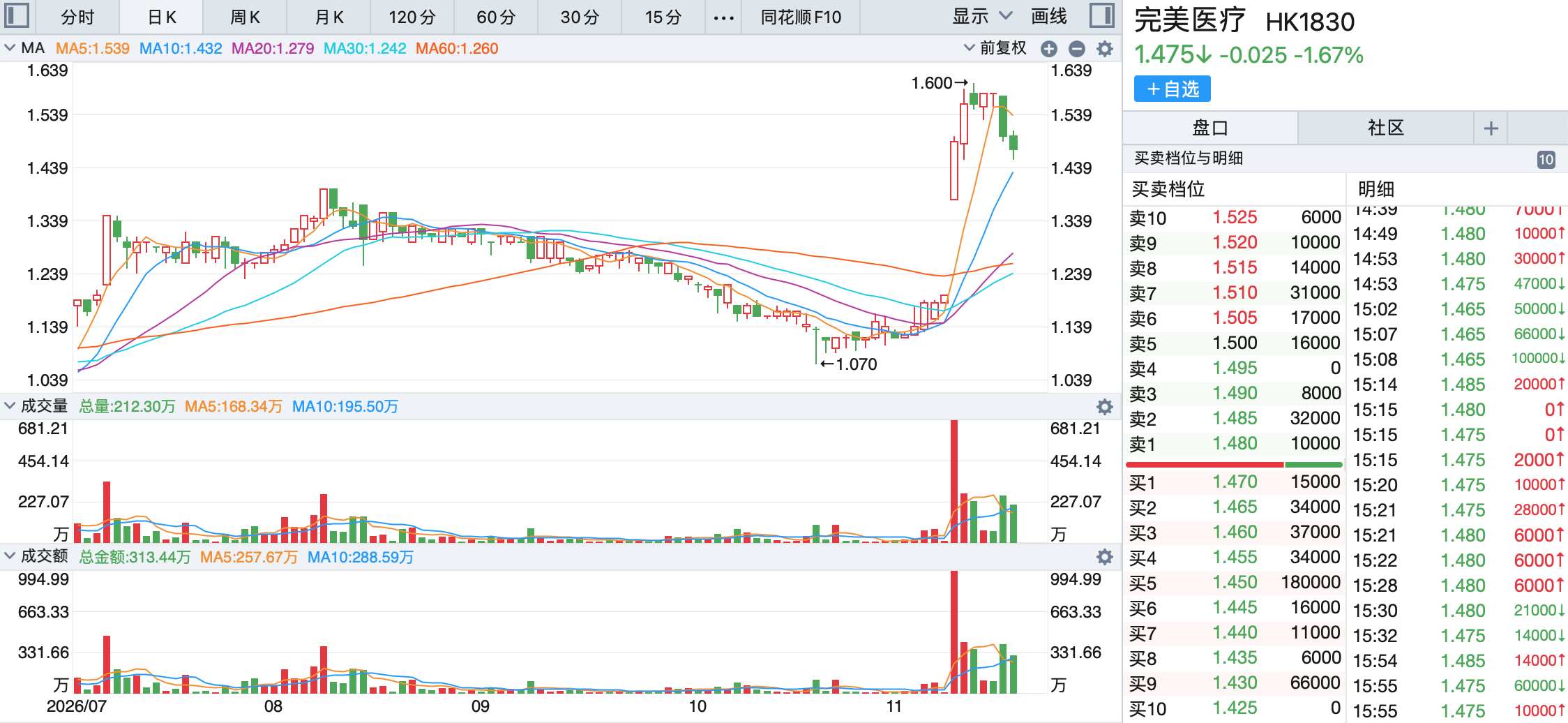
Recently, Perfect Healthcare (01830) showed a wonderful “roller coaster” market in the capital market. On November 10, boosted by mid-term earnings, the stock surged by more than 24% in a single day, and the cumulative increase of more than 30% over the next five trading days. Market sentiment was once ignited. However, after the interim results were officially implemented on November 17, the stock price fell by more than 5%. The decline continued on the 18th, and finally closed at HK$1,475, with a total market value of HK$1,853 million.
Revenue declined slightly and profits soared
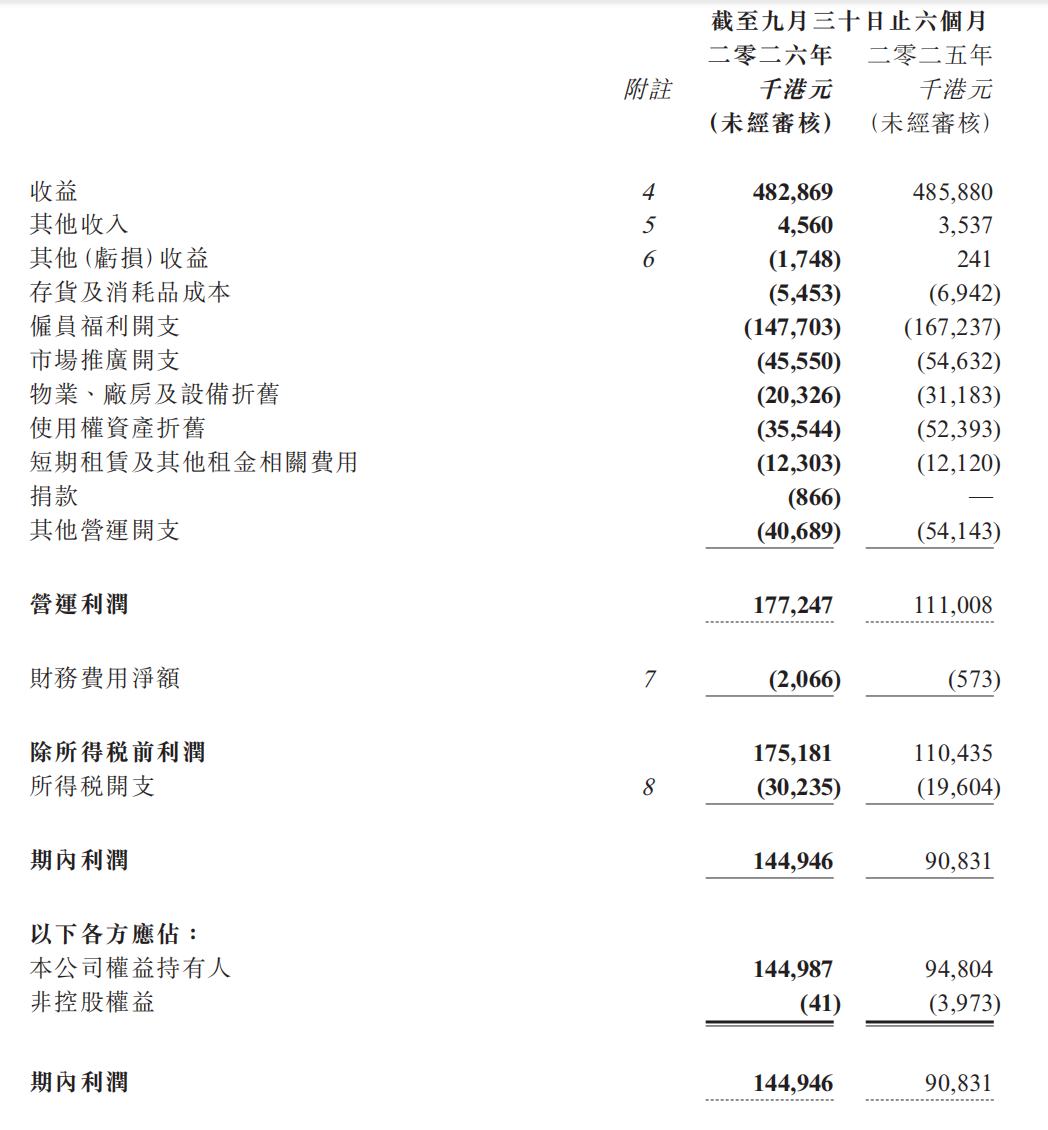
According to the Zhitong Finance App, Perfect Healthcare's performance is characterized by a slight decline in revenue and sharp profits. During the period, the company's total revenue was 483 million yuan (unit: HKD, same below), a slight decrease of 0.62% year over year; however, profit jumped from $908.31 million to $145 million, an increase of 59.6%. The profit attributable to the company's equity holders increased from 94.804 million yuan to 145 million yuan, an increase of 52.93% over the previous year. In a context where revenue was basically flat, profit increased by nearly 60%.
This divergence of “increasing profits without increasing revenue” is precisely the result of Perfect Medical's active strategic contraction and structural optimization. According to financial reports, operating profit increased 59.6% year over year to HK$177 million. This data strongly proves that the “slimming plan” previously implemented by the company has paid off. By integrating service centers with low productivity in an orderly manner, shutting down inefficient outlets and focusing on high-output regions, the company successfully turned fixed costs into operating profits.
Specifically, employee welfare expenses fell 11.7%, marketing expenses fell 16.6%, and depreciation of property, plant and equipment fell sharply by 34.8%. On the premise that the scale of revenue has not shrunk, this “cliff-style” decline on the cost side has directly increased the profit margin.
By region, Hong Kong, as the absolute main market for perfect healthcare, achieved revenue of 381 million yuan during the period, a year-on-year decline of 1.46%. Despite the limited decline, the sector accounted for 78.9% of the Group's total revenue. It can be seen that in a macroeconomic environment where local consumption power in Hong Kong is weak and competition in the medical, aesthetic and health services industry is highly competitive, the scale expansion of the core market has hit a ceiling.
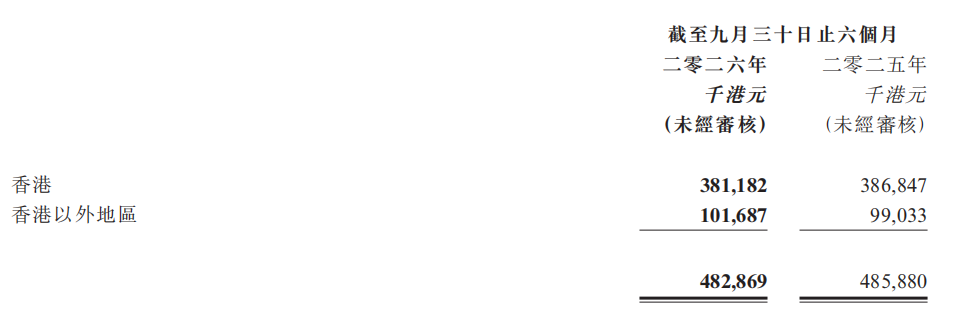
In contrast to the slight decline in Hong Kong, regions outside Hong Kong recorded revenue of $102 million, an increase of 2.68% over the previous year. The sector's share of the company's total revenue increased to 21.1% from 20.4% in the same period last year. Although this portion of the increase could not fully hedge against the slight decline in the Hong Kong market, it effectively smoothed out overall revenue fluctuations and became an important stabilizer on the Group's revenue side.
Furthermore, changes in non-current assets (excluding deferred income tax assets and financial assets measured at fair value) are often an important indicator for observing a company's capital expenditure and strategic focus. As of September 30, 2026, the total value of the Group's non-current assets was 228 million yuan, a year-on-year decrease of 2.73%. Under what appears to be a steady overall decline, drastic regional structural adjustments are hidden.
On the one hand, the reduction in Hong Kong's assets fell from $190 million to $174 million, a decrease of 8.17%. It is highly consistent with management's strategy of “downsizing the network and closing underperforming stores”. As shown in the financial statements, the closure of the store directly caused depreciation or termination of confirmation of the right to use assets of the relevant leased property. At the same time, in line with the reduction in depreciation of the property, plant and equipment, the income statement data showed a 34.8% year-on-year decline. Perfect Healthcare is firmly divesting the Hong Kong market's inefficient assets and reducing rigid operating costs. This is a typical “asset lightening and cost reduction and efficiency” operation, that is, sacrificing part of low-quality income in exchange for higher efficiency and healthier cash flow.
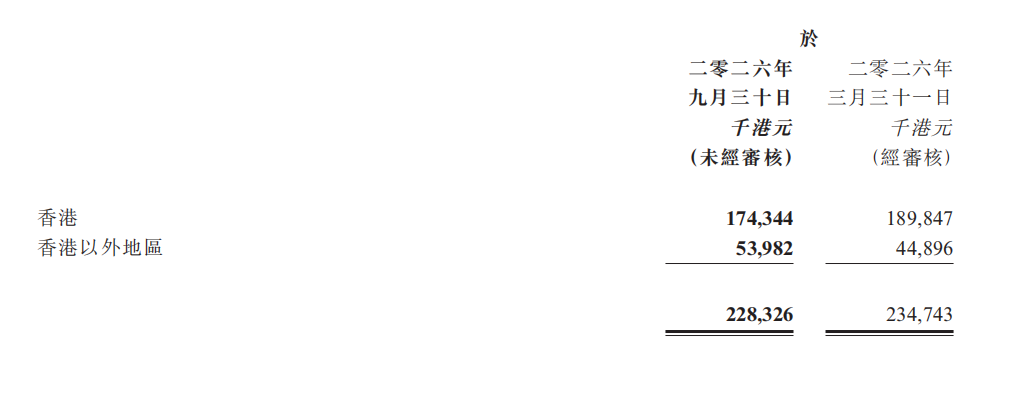
Contrary to Hong Kong's contraction, non-current assets outside Hong Kong rose sharply from $44.896 million to $53.982 million.
The increase was 20.24% in half a year. Combined with the simultaneous increase in earnings in the region, the Group has not taken a defensive position in the Hong Kong market, but has made substantial capital investment and asset allocation. The Group is trying to seize recovery opportunities and build new performance growth poles in markets such as Macau and Southeast Asia through countercyclical capital expenditure.
Exploring the secondary growth curve of regional expansion and digital empowerment
Although Perfect Healthcare achieved a leapfrog increase of 52.9% in net profit through cost reduction and efficiency, the slight decrease of 0.62% on the revenue side did reveal the limitations of simply relying on cost optimization. At a time when the medical and aesthetic industry is completely shifting from “traffic is king” to a “stock game,” the incremental space for perfect medicine will depend on whether it can have a “second spring” in terms of regional expansion and business innovation.
Currently, the local market in Hong Kong contributes nearly 80% of Perfect Healthcare's revenue. This high level of regional concentration is not only a stable basic market, but also a ceiling for revenue growth. However, the potential of the medical and aesthetic market in mainland China is still huge. Currently, the medical and aesthetic penetration rate in the mainland is only about 3.5%, which is far lower than the 20% in South Korea. As per capita GDP continues to rise and demand for light medicine and beauty explodes, the mainland market has broad room for growth. If Perfect Healthcare can verify its successful high-end service model in Hong Kong and replicate it locally in combination with the mainland's digital marketing methods, it is expected to create a strong growth pole in the Greater Bay Area and the wider mainland market.
Furthermore, in recent years, Perfect Healthcare has actively promoted an internationalization strategy and extended its business footprint to Singapore and Australia. Although the overseas business faced some adjustment pressure in the early stages, with disciplinary network adjustments and the implementation of an asset-light operating model, the Australian, Singapore and Macau businesses have gradually broken out of their troughs, and profitability has improved markedly. The stabilization of overseas markets not only effectively diversifies the macro-risks of a single market, but also provides new impetus for the company's long-term revenue growth.
In the era of inventory games, digitalization is the key to improving operational efficiency and customer acquisition accuracy. Perfect Healthcare is accelerating business digitalization and process streamlining, and optimizing customer experience and accurate marketing through big data analysis. In the future, with the deep application of digital methods in member operations, repurchase improvement, and supply chain management, the company is expected to achieve a steady recovery on the revenue side without a significant increase in marketing expenses.
In summary, in the context of macro-consumption pressure, the company took the initiative to abandon inefficient revenue and “squeezed” nearly 60% profit growth into a market where revenue stagnated through decisive store closures and network integration. This strategy of “sacrificing scale to ensure quality” not only effectively strengthened the cash safety cushion, but also proved to the market that its management's ability to execute in the face of adversity and that its core business model is extremely resilient to high profits. However, the sharp rise after Yingxi's announcement in mid-November and the correction after the implementation of results also showed that investors are examining its future long-term growth engine.