


EN
Disney Just Boosted Its Dividend by 33%. That Gives DIS Stock Investors a Real Reason to Stick Around.
Disney (DIS) is giving investors more than an earnings update to consider. On Nov. 17, the entertainment giant outlined a plan to deliver about $3 billion in annual cost savings by fiscal 2029, alongside a target of $9 billion in share repurchases for fiscal 2027.
The company also announced a 33% dividend increase, bringing its annual payout to $2 per share, payable in two $1 installments, up from $0.75 each. That larger payout follows a fiscal fourth quarter in which streaming revenue grew 19%, while Experiences' operating income climbed 20% to approximately $2.25 billion.
A bigger dividend gives shareholders a concrete reason to pay attention. But does Disney have the financial strength and earnings runway to make DIS stock worth buying here? Let’s find out.
Can Disney Afford the Bigger Dividend?
Disney makes money from movies, TV, streaming, ESPN, theme parks, and cruises. DIS stock is up 15% over the past 52 weeks and 6% on a year-to-date (YTD) basis.
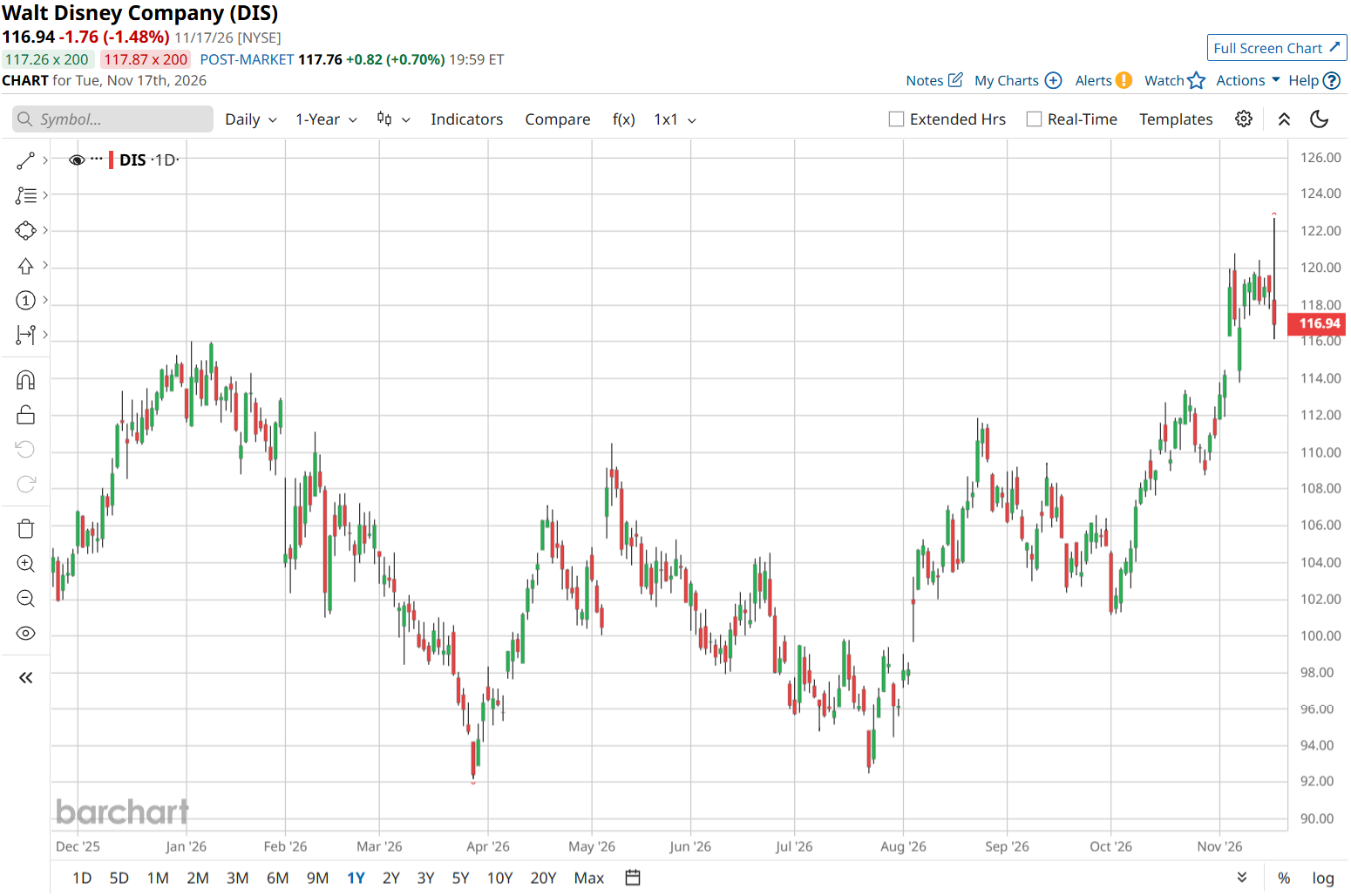
The stock trades at 15.6 times forward earnings, compared with 13 times for the sector. The bigger dividend alone doesn’t justify paying that premium.
For fiscal 2027, the company raised its annual dividend by 33%, from $1.50 to $2 per share. Shareholders will get two $1 payments, up from $0.75 each. The last $0.75 installment was paid on July 22, 2026, to shareholders of record on June 30, 2026. Before the hike, DIS stock yielded 1.28%, the dividend accounted for 23.01% of expected earnings, and the company had a one-year streak of dividend increases. At roughly $120 per share, the new payout yields about 1.66%. Disney also plans to buy back $9 billion of stock in fiscal 2027, but that’s a target and not money already spent.
Disney's fiscal Q4 report helps explain why the company felt comfortable raising the payout. Revenue rose 16% year-over-year (YOY) to $25.95 billion, while net income nearly doubled from $1.31 billion to $2.61 billion. Reported earnings climbed from $0.73 to $1.51 per share, while adjusted earnings came in at $1.77 per share. Streaming revenue grew 19% YOY, and the Experiences segment brought in $10.11 billion in revenue while its operating income rose 20% to $2.25 billion.
Where Disney’s Next Profits Could Come From
Recently, Disney and Adobe (ADBE) announced at Adobe MAX that they will expand their partnership under a multiyear deal. The companies will work together on marketing, industry events, and customer case studies involving Walt Disney World, Disneyland, Disney Cruise Line, ESPN Edge, and StudioLAB. The two will also explore artificial intelligence (AI) tools for the company’s creative teams.
Disney is looking at whether AI could let fans talk with its characters. The company made a conditional $20 million opening bid to license some of Character.ai’s technology, not buy the company. Separately, on Sept. 18, Disney named former Character.ai CEO Karandeep Anand as its first Chief Technology Officer and said several technical employees were expected to join him. The bid hasn’t turned into a deal, so it’s too early to count on any earnings from it.
With traditional TV networks under pressure, Disney is also making money from shows and movies it already owns. The firm is licensing select titles to Netflix (NFLX), including “Percy Jackson and the Olympians” and older “Ice Age” films. That brings in licensing revenue without handing a rival the whole catalog.
How Much Upside Does Wall Street See?
After Disney reported earnings on Nov. 17, analysts expect earnings of $2 per share for the December quarter, up 23% from $1.63 a year earlier. However, they also expect slower growth for the full fiscal year, with earnings rising 7% from $7.02 to $7.48 per share.
After earnings, Needham kept a “Buy” rating on DIS stock and raised its price target from $125 to $135. Meanwhile, Raymond James kept its “Outperform” rating while hiking its target from $119 to $133 per share.
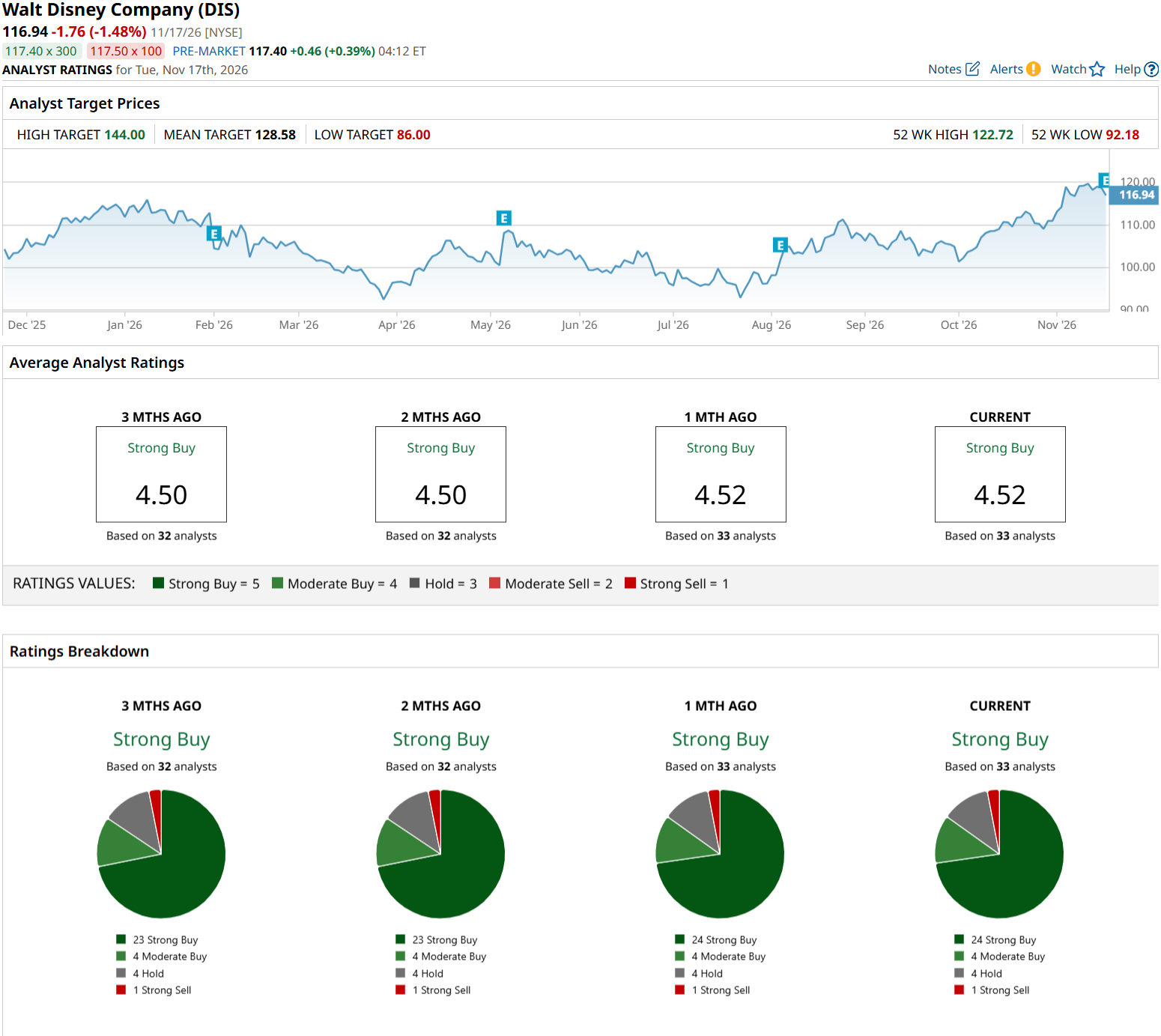
The consensus among the 33 analysts with coverage is a “Strong Buy” rating. The average price target of $132.22 implies potential upside of 10% from current levels.
Conclusion
Disney’s bigger dividend, $9 billion buyback target, and solid Q4 results give shareholders real reasons to stick around. The 33% payout hike and cost-savings plan show management is serious about returning cash while protecting the bottom line. Streaming and parks are still delivering, while Wall Street’s “Strong Buy” consensus with roughly 10% potential upside to the mean target backs a constructive view. DIS stock already trades at a premium to the sector, so it is not a screaming bargain, yet the combination of higher income, buybacks, and steady earnings growth tilts the odds toward gradual gains from here rather than a sharp drop. For patient investors who like the brand and the cash flow, DIS stock looks worth buying on dips.
On the date of publication, Ebube Jones did not directly have a position in any of the securities mentioned in this article. All information and data in this article is solely for informational purposes. For more information please view the Barchart Disclosure Policy here.